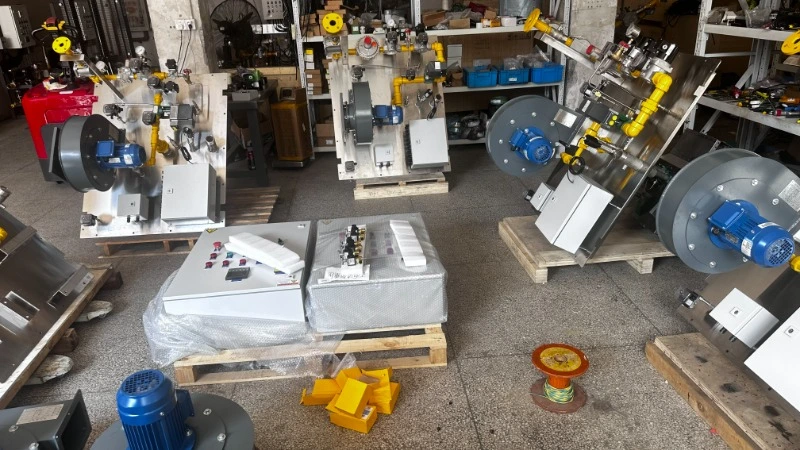
An industrial combustion system for feed drying supplies controlled heat to a dryer while coordinating the burner, fuel train, combustion air, process airflow and protective controls. Its configuration depends on the feed material, the water that must be removed, the dryer design and whether combustion products can contact the product. The U.S. Department of Energy distinguishes direct fuel-fired heating from indirect heating, in which combustion gases remain separated from the heated material. [1]
Watch Industrial Combustion System Assembly for Feed Drying
The HEATFLAM assembly video shows close-up engineering work on piping and valve assemblies, followed by wider equipment views. It illustrates the physical integration behind a feed drying combustion system. The footage is an assembly and equipment presentation; final capacity, fuel pressure, dryer connection and commissioning performance must be confirmed from project documents and site tests.
How Heat and Airflow Dry Feed
Drying is a heat-and-mass-transfer process: energy evaporates water, and moving air carries the vapor away. The heat source and airflow system therefore need to be designed together. For pellets, feed-bed depth, air distribution, temperature, relative humidity and residence time influence how evenly moisture is removed. Kansas State University’s feed-manufacturing guide identifies these variables as drivers of pellet cooling and drying uniformity. [2]
A 2026 Scientific Reports study tested aquatic-feed pellets at drying-air temperatures of 70, 90 and 110°C, measuring drying kinetics, energy use and pellet durability. The experiments used an electrically heated fluidized-bed system rather than a combustion-heated production dryer, so the tested temperatures are evidence that feed formulation and dryer conditions affect process outcomes, not ready-made burner setpoints. [3]
For early sizing, calculate the water-removal duty before choosing an industrial burner for feed drying. With moisture fractions expressed on a wet basis:
dry solids = wet feed flow × (1 − inlet moisture)
final product flow = dry solids ÷ (1 − target final moisture)
water removed = wet feed flow − final product flow
The required heat input then depends on inlet temperatures, evaporation load, dryer losses, exhaust conditions and the selected heat-transfer arrangement. The industrial drying combustion system should be evaluated against those process values rather than chosen from a burner rating alone.
Direct or Indirect Heating?
A direct-fired feed dryer burner system places combustion products in the process-air stream. An indirect-fired arrangement transfers heat through a barrier so that the combustion gases and process stream remain separate. The appropriate choice depends on product-contact requirements, dryer construction, fuel, emissions handling and the applicable plant rules; neither arrangement should be inferred from an assembly video. The DOE’s process-heating explanation provides the underlying distinction. [1]
A related case documented by the California Energy Commission is a full-scale indirect gas-fired thermo-vacuum drying demonstration at Martin Feed in Corona, California. The project integrated a gas-fired heat source, dryer, ejector/heat-pump loop, instrumentation and controls. Its report describes successful demonstration of the dynamic-vacuum concept while identifying mechanical issues for further development. The engineering lesson is to assess the heat source together with dryer mechanics, utilities and control interfaces, not as an isolated burner purchase. [4]
What the Fuel Train and Controls Do
In a gas combustion system for a feed dryer, the fuel train system is the engineered path between the site gas supply and the burner. The system design should establish fuel-pressure regulation, isolation and shutoff, measurement points, leakage checks where required, and the burner-management interfaces specified by the applicable code and equipment design. The exact valve arrangement and safety functions must come from the approved P&ID, component documentation and local requirements. HEATFLAM’s gas-and-air valve-manifold page shows a related integration category.
Combustion control also has to match dryer demand. The U.S. Department of Energy recommends checking burner air-to-fuel ratios and explains why excess air must be evaluated against the heating process. Its guidance specifically cautions that moisture-evaporating processes may need additional airflow for drying and vapor removal; a generic low-oxygen target is therefore unsuitable as a universal feed-dryer setting. [5]
During combustion system assembly, engineers should verify component identity and flow direction, pipe and instrument connections, control wiring, accessible inspection points and the documented test sequence. Installation and commissioning must then confirm the complete fuel train and burner system for the actual fuel, pressure range, dryer airflow and operating modes. Those checks are selection and verification tasks, not performance claims about the equipment shown in the video.
Information Needed for a Customized Combustion System
For a custom combustion solution for feed processing, send the following with the enquiry:
- Material and moisture: feed type, inlet moisture, target final moisture, wet-basis or dry-basis convention, and product-quality constraints.
- Throughput and dryer: normal and peak feed rates, dryer type, bed depth or loading, residence time, recirculation and exhaust arrangement.
- Heat and air: required process-air temperature, airflow range, ambient conditions, heat-transfer method and whether combustion gases may contact the feed.
- Fuel and utilities: fuel type and composition, available inlet pressure, electrical supply and site utility limits.
- Control and safety: turndown needs, operating sequence, instrumentation, alarms, plant-control interface and applicable site code or insurer requirements.
- Site integration: layout, connection drawings, access for inspection and maintenance, and any existing burner or fuel train to retain.
This information lets an engineer define the industrial process heating system for feed drying as one connected duty. It also gives a practical basis for reviewing a customized burner, fuel train and control package. The drying-industry solution pages provide related application categories.
Frequently Asked Questions
How are industrial combustion systems used in feed drying?
The burner supplies heat, the dryer airflow transfers that heat to the feed and removes vapor, and the combustion control system follows the required operating sequence. The fuel train supplies the burner under the specified fuel conditions. DOE process-heating guidance treats heat generation, transfer and process operation as a connected system. [1]
Is a direct-fired industrial burner system suitable for animal feed drying?
Suitability depends on whether combustion gases are permitted in the process stream and on the dryer’s product-contact, air-quality and regulatory requirements. Indirect heating keeps those streams separate. Specify the requirement before selecting the burner and heat exchanger arrangement. [1]
What should be specified for a fuel train and burner system for industrial dryers?
Provide the fuel type and supply pressure, maximum and minimum heat duty, required air-temperature and airflow range, burner-control sequence, shutdown logic, P&ID and applicable site requirements. Those inputs determine the detailed valve-train, burner and control selection.
Does a higher drying temperature always improve the process?
No universal setpoint follows from one study. The cited aquatic-feed experiments compared 70, 90 and 110°C while tracking drying behavior, energy use and pellet durability. Their electrically heated laboratory apparatus and feed formulation differ from a full-scale combustion-heated dryer. Validate the temperature window against the actual feed formulation, dryer and product specification. [3]
Discuss Your Feed Drying Application
HEATFLAM engineers can review the burner, fuel train and combustion-system integration around your dryer requirements. Share the feed type, moisture and throughput data, fuel conditions, airflow and temperature range, dryer drawings and control requirements through the engineering enquiry page.
REFERENCES AND DATA SOURCES:
- U.S. Department of Energy — “What Are the Different Kinds of Process Heating Systems?” (accessed 2026-10-09).
- Kansas State University Feed Science — “Quality Feed Manufacturing Guide: Pelleting” (PDF; accessed 2026-10-09).
- Maikaew et al. — “An innovative chitosan-coated aquatic feed pellets production from coastal waste using top-spray fluidized bed drying,” Scientific Reports (published 2026-01-13; DOI: 10.1038/s41598-026-35937-0).
- California Energy Commission — “Indirect Gas-Fired Dryer with Thermal Driven Ejector System for Bulk Food Processing, Development and Demonstration in California” (updated 2020-03-27; report CEC-500-2020-018).
- U.S. Department of Energy — “Check Burner Air to Fuel Ratios,” Process Heating Tip Sheet #2 (tip sheet published 2007-11; linked from the DOE process-heating resource page).
