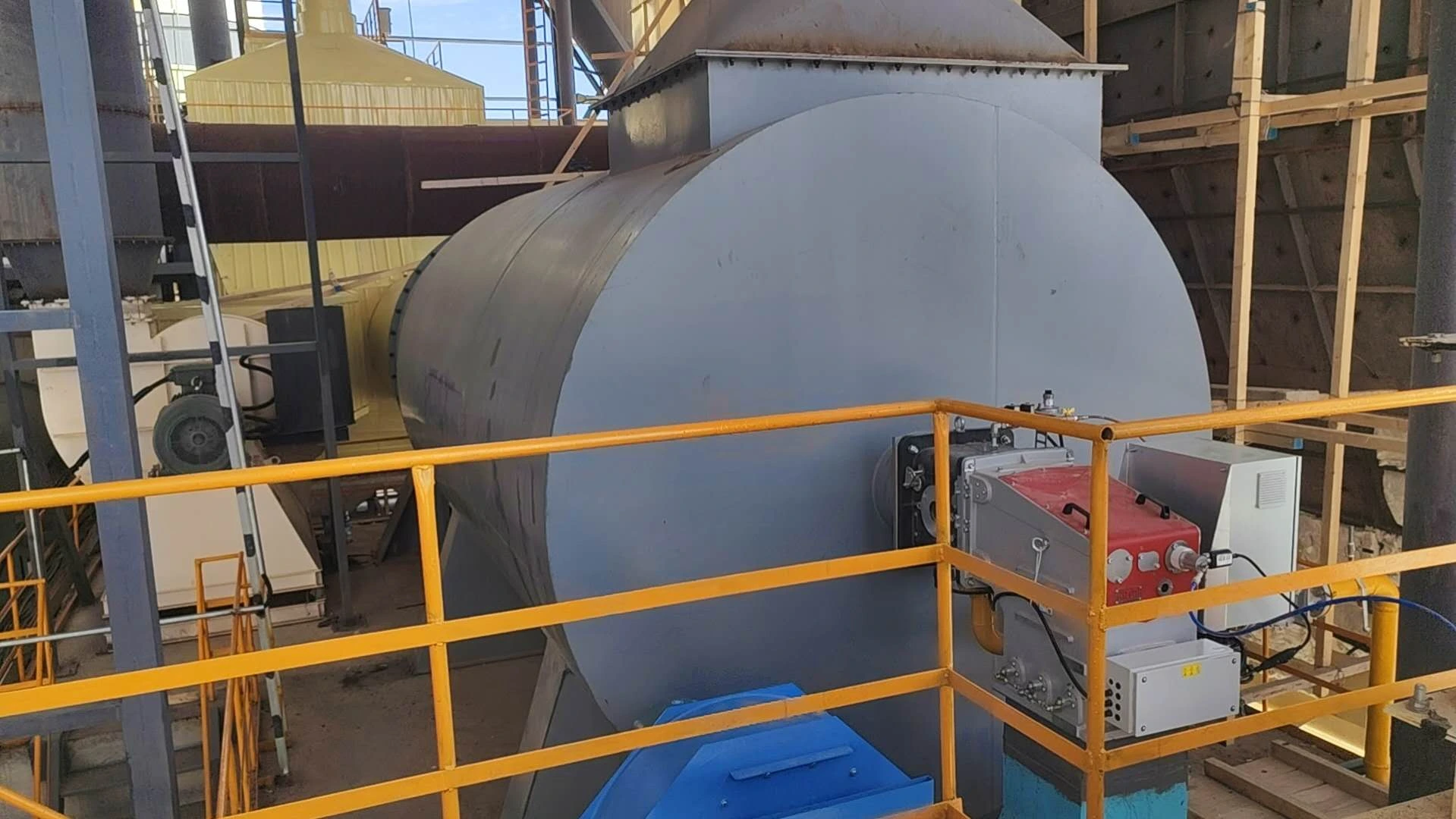
A gypsum board combustion system is part of a larger drying process. After forming and setting, boards pass through a dryer to remove free moisture, according to the Gypsum Association’s manufacturing overview. Burner output therefore has to serve the dryer’s heat and airflow requirements, rather than be assessed in isolation. Heatflam supports combustion solutions for building-material drying.
On-site view: combustion system commissioning
This project video shows the installed industrial combustion equipment at a gypsum board production site, including the burner assembly, fan and control cabinet. It is a visual record of the site installation; it does not establish fuel consumption, emissions, output or final acceptance-test results.
Watch the Heatflam gypsum board commissioning video on YouTube.
What should an on-site commissioning plan verify?
A commissioning plan for an industrial burner and its process heating system should cover the connected equipment and the operating range. The U.S. Department of Energy’s process-heating sourcebook treats heat generation, heat transfer, controls and auxiliary equipment as parts of one system. The checks below are an engineering framework for this application, not a claim that each measurement was performed or passed in this filmed project.
| Interface | Commissioning question |
|---|---|
| Fuel and burner | Does the specified fuel supply support stable burner operation throughout the approved firing range? |
| Combustion air | Do air and fuel settings match the burner manufacturer’s instructions at the required operating points? Verify by appropriate flow or flue-gas measurements. |
| Controls and protective functions | Do the control signals, permissives, trips and shutdown responses match the approved design and equipment documentation? |
| Dryer and product | Does the delivered heat work with dryer airflow, exhaust and board throughput to meet the specified drying schedule? |
Why integration matters for gypsum board drying
Peer-reviewed modelling by Defraeye and colleagues examined how air speed, turbulence, approach-air temperature and the paper liner affect convective drying of gypsum boards. Its practical message is to assess heat transfer and moisture removal together; burner firing rate alone cannot describe the board’s drying response. A separate published study of a Saint-Gobain Gypsum Shanghai drying room documented a gas-fired chamber, mixed and recirculated air, and a dryer heat-balance assessment. Those are external research examples, not specifications or measured results for the Heatflam installation.
A useful industrial heating system review therefore connects the burner to air handling, dryer zones, controls and the production recipe. See Heatflam’s broader industrial combustion system integration overview for related application scope.
A documented plant example
In an independent TECHNOGIPS Pro project in Bulgaria, equipment supplier Grenzebach described an upgrade that included the gas-fired cross-flow dryer, heat exchanger and handling equipment. Its published account explains how dryer airflow and temperature zones were considered alongside the plant expansion. This example illustrates the system-level nature of gypsum board heating; it is not a Heatflam project, and its capacity figures do not apply to this installation. Heatflam’s own combustion project gallery provides separate context for its work.
Information needed for an industrial heating proposal
To specify a combustion system for gypsum board production, provide the fuel type and supply conditions, required heat duty, dryer layout and temperature zones, process-air and exhaust requirements, board sizes and throughput, controls interface, site utilities and applicable local requirements. Existing equipment drawings and the intended commissioning acceptance criteria help define the boundary between burner commissioning and full process validation.
Frequently Asked Questions
Share your dryer process data and combustion requirements with Heatflam for an application review.
REFERENCES AND DATA SOURCES:
- Gypsum Association — Making Gypsum Board (accessed 10 October 2026).
- U.S. Department of Energy and Industrial Heating Equipment Association — Improving Process Heating System Performance: A Sourcebook for Industry, third edition (2016).
- U.S. Department of Energy — Check Burner Air to Fuel Ratios, Process Heating Tip Sheet 2 (November 2007).
- Defraeye, Houvenaghel, Carmeliet and Derome — Numerical analysis of convective drying of gypsum boards, International Journal of Heat and Mass Transfer (2012; DOI: 10.1016/j.ijheatmasstransfer.2012.01.001).
- Xu and Qian — Energy saving and emission reduction technological transformation of gypsum board drying room, Energy Research and Information 31(2), 106–108 (2015).
- Grenzebach — Quick and smooth capacity upgrade: TECHNOGIPS Pro, Bulgaria (24 June 2019).
