
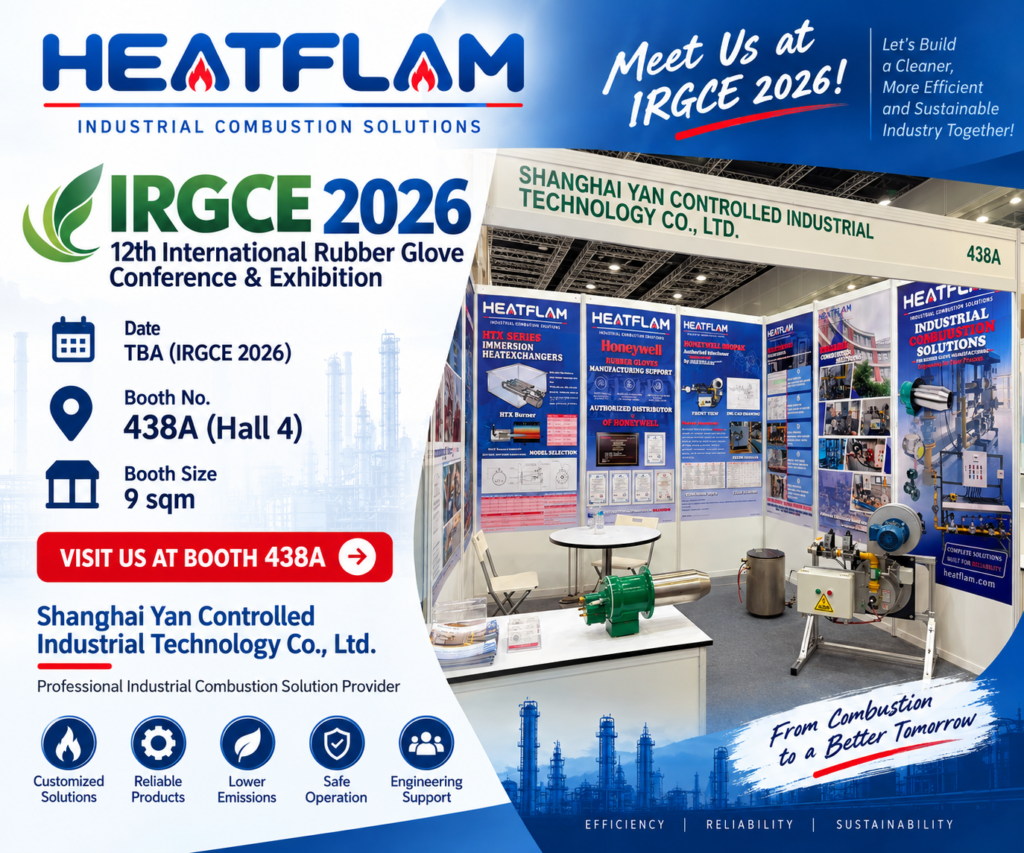
Where can you meet Heatflam at IRGCE 2026?
Shanghai Yan Controlled Industrial Technology Co., Ltd, the company behind Heatflam, is exhibiting at IRGCE 2026. Visit Booth 438A in Hall 4 to discuss industrial combustion solutions for new heating equipment, existing glove production lines and burner replacement projects.
Based in Shanghai, China, Heatflam provides customized combustion engineering: system design, equipment selection, integration and optimization. Our scope includes gas and oil valve trains, burner systems, hot air heating, ignition and combustion controls. We also supply our own HEATFLAM product lines, standard burners and replacement components, with selection based on the project’s fuel, duty, installation and control requirements.
The 12th International Rubber Glove Conference & Exhibition takes place on 8–10 September 2026 at the Kuala Lumpur Convention Centre, Malaysia. [1] [2]
| Exhibition detail | Information |
|---|---|
| Company | Shanghai Yan Controlled Industrial Technology Co., Ltd |
| Brand | Heatflam |
| Booth | 438A (Hall 4) |
| Booth size | 9 sqm |
| Dates | 8–10 September 2026 |
| Venue | Kuala Lumpur Convention Centre, Malaysia |
Our discussion topics include customized burner systems, gas valve trains, combustion controls, industrial hot air heating systems and retrofit planning. Explore Heatflam’s industrial combustion solutions before your visit.
What should a rubber glove production heating system deliver?
Glove manufacture includes drying a coated former and removing water from the deposited polymer film. Cambridge researchers identify water evaporation as an energy-intensive part of the process. This makes the heating duty and drying conditions relevant starting points for an equipment discussion. [3]
For latex glove manufacturing, specify the approved process temperature profile, residence time, line speed and moisture-removal duty. Identify the exact stage being heated and the required product acceptance criteria. Use that information to define the heating system specification.
Ask the equipment supplier to assess burner capacity together with air distribution, heat transfer and zone control. Set acceptance criteria for the complete rubber glove production heating system, including its response during normal production, reduced load and line stops.
How should industrial burners for rubber glove manufacturing be selected?
Start with the heating arrangement. In direct fuel-fired heating, combustion gases contact the material; indirect heating separates the combustion gases from it. Product tolerance for combustion gases is therefore a selection condition. [4]
For an industrial hot air heating system, define whether combustion gases are permitted in the process air. Confirm this with the glove process owner before choosing the burner and heat-transfer arrangement.
- Specify the fuel composition and available supply pressure, including variation during production.
- Provide required heat output with its unit and distinguish burner fuel input from useful process heat.
- Define minimum and maximum operating duty, temperature limits and control response requirements.
- Supply the heating chamber or heat exchanger drawings, airflow data and installation dimensions.
Use these inputs when discussing Heatflam industrial burners and a customized burner system. Select the final industrial burner system against the operating envelope and installation requirements.
What should the gas valve train and combustion control system cover?
Define the gas valve train and combustion control system as part of the same engineering scope. Ask for a documented component schedule, control sequence and interface list covering fuel pressure regulation, shut-off functions, ignition, flame supervision and the required operating interlocks.
Air-to-fuel ratio affects combustion performance: insufficient combustion air creates incomplete-combustion risks, while excessive air increases heat loss. DOE also cautions that drying processes need airflow to remove vapours; do not treat required process ventilation as expendable combustion excess air. [5]
As a Honeywell Authorized Distributor for boiler-related combustion parts and components, Heatflam supports product supply, model confirmation and replacement selection within that scope.
When discussing Honeywell combustion components, provide the complete part number and required function. Honeywell’s BCU 4 range, for example, controls, ignites and monitors gas burners. Match the exact device, flame detector, supply voltage and interfaces to the proposed system; the family name alone does not establish suitability. [7]
When should you discuss combustion system retrofit or burner replacement?
Bring a retrofit enquiry when you need to investigate recurring trips, unavailable spare parts, changed production duty or an emissions target. Record the symptoms and operating conditions before deciding which equipment to replace.
For burner replacement solutions, provide the existing burner nameplate, mounting dimensions, fuel and air connections, control drawings and recent operating records. Ask the supplier to identify the work required across the burner, fuel train, controls and heating equipment.
For a low NOx burner system enquiry, state the emissions target, measurement units, reference oxygen level, fuel and test loads. Request a proposal with defined acceptance conditions rather than treating the low NOx label as a site-specific emissions guarantee.
Establish a measured baseline before evaluating an upgrade. The Australian Government recommends metering and monitoring to quantify process-heating improvements and track equipment performance. [6]
Compare fuel use against equivalent production output and operating conditions. Include product quality, temperature performance and downtime in the review of industrial heating solutions.
What should you bring to Booth 438A?
Prepare a short project brief with the following information:
- Application and process stage, glove material, line speed and operating schedule.
- Fuel type, fuel pressure range, heat output and process temperature requirements.
- Existing burner and control model numbers, photographs and available drawings.
- Airflow, exhaust arrangement, installation space and site power supply.
- Control interfaces, site requirements, emissions target and preferred shutdown window.
Tell us whether the priority is a new system, component selection, burner replacement or a combustion system retrofit. This gives the discussion a defined technical scope and helps identify the information needed for a proposal.
Frequently Asked Questions
Discuss your rubber glove manufacturing heating requirements with Heatflam. Send your fuel type, heat output, process temperature, site conditions and control requirements to start a project enquiry.
REFERENCES AND DATA SOURCES:
- 1. IRGCE — 12th International Rubber Glove Conference 2026 (accessed 2026-09-08).
- 2. IRGCE — International Rubber Glove Conference & Exhibition (accessed 2026-09-08).
- 3. University of Cambridge, Institute for Energy and Environmental Flows — Rubber Gloves (accessed 2026-09-08).
- 4. U.S. Department of Energy — What Are the Different Kinds of Process Heating Systems? (accessed 2026-09-08).
- 5. U.S. Department of Energy — Improving Process Heating System Performance: A Sourcebook for Industry, Second Edition (accessed 2026-09-08).
- 6. Australian Government, energy.gov.au — Process heat and steam (accessed 2026-09-08).
- 7. Honeywell — BCU 4 (Next Generation) (accessed 2026-09-08).