
What does a rock wool curing oven combustion system do?
A rock wool curing oven combustion system supplies controlled thermal energy to the curing stage of a rock wool production line. After fibers are formed and binder is applied, the wool blanket passes through the curing oven. Heated air moves through the material to set the binder, after which the product proceeds to cooling and downstream processing. The U.S. Environmental Protection Agency describes this same production sequence in its mineral wool manufacturing process overview.[1]
The combustion system is therefore more than a burner mounted beside an oven. It must deliver the required heat into the process air while coordinating fuel isolation, pressure regulation, air-fuel control, ignition, flame supervision, operating limits, and the production line’s control logic.
Watch the on-site rock wool curing oven project
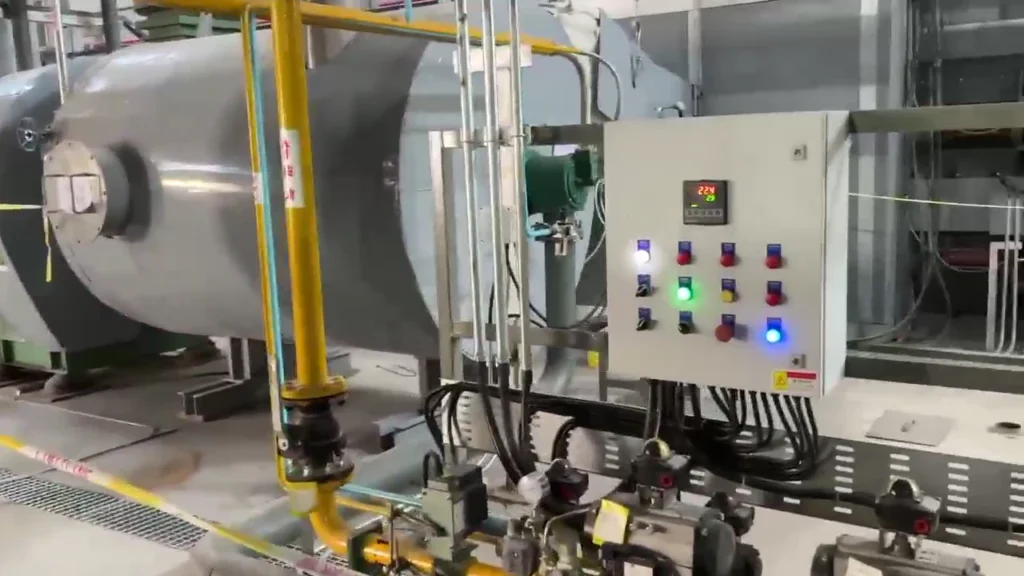
The video moves from the project photos to the production floor. It documents the installed fuel train, piping, actuators, control cabinet, Eclipse ThermJet TJ0500 burner, and hot-air-related equipment within the actual customer-site layout.
On-site view of the installed burner, fuel train, combustion controls, piping, and hot-air system.
Which components make up the on-site system?
The visible installation illustrates the main interfaces that must work together in an industrial burner system. Each component has its own function, but the process result depends on their combined design.
| System element | Engineering role | Key project inputs |
|---|---|---|
| Industrial burner | Converts fuel energy into a controlled high-temperature gas stream for the hot-air process. | Heat duty, fuel, chamber conditions, turndown, mounting, and flame supervision. |
| Gas valve train | Conditions, regulates, isolates, and proves the fuel supply according to the selected safety and operating sequence. | Fuel composition, inlet pressure range, required burner pressure, flow, pipe size, and applicable code. |
| Combustion air and hot-air equipment | Provides combustion air and transfers heat into the process air path serving the curing oven. | Airflow, pressure loss, inlet temperature, target outlet temperature, duct arrangement, and recirculation strategy. |
| Combustion control system | Sequences purge, ignition, flame proving, firing-rate control, shutdown, alarms, and line interlocks. | Control philosophy, I/O list, PLC interface, temperature loops, limit devices, and operator requirements. |
| Piping, valves, and actuators | Connects the functional equipment while preserving access, service clearances, flow conditions, and installation practicality. | Site dimensions, tie-in points, orientation, maintenance access, supports, and commissioning access. |
What is the role of the Eclipse ThermJet TJ0500 burner?
The Eclipse ThermJet family is a high-velocity or medium-velocity nozzle-mix industrial gas-burner platform. Honeywell’s product information identifies adjustable gas and air connection orientations, multiple control methods, and several combustor options across the ThermJet range.[2]
For the TJ0500 model, the manufacturer’s data sheet lists a maximum input of 5,000,000 Btu/h (1,319 kW, using the sheet’s stated HHV/LHV bases). This is a model limit, not the confirmed firing rate of the installation shown here. The same data sheet states that burner results vary with chamber conditions, combustor design, piping, fuel, combustion-air temperature, firing rate, and excess air.[3]
Why must the burner, fuel train, hot-air system, and controls be engineered together?
A fuel-fired process heating system links heat generation, heat transfer, process controls, auxiliary equipment, exhaust handling, and the material being processed. The U.S. Department of Energy recommends a systems approach because changes in one part of the process affect other operating and efficiency opportunities.[4]
In practical project work, this means the burner cannot be finalized before the site fuel conditions and hot-air duty are known. The gas valve train must supply the pressure and flow required by the selected burner while following the specified shutdown and proving sequence. The control cabinet must then coordinate the burner safeguards with oven airflow, temperature demand, fan status, dampers, production permissives, and emergency shutdown signals.
The European Commission’s glass-manufacturing BREF treats glass wool and stone wool as distinct mineral-wool subsectors within the industrial glass sector.[5] That process context matters: a combustion package for a mineral wool curing oven must be matched to the line’s product, binder, airflow, throughput, oven arrangement, and environmental-control scope rather than copied from an unrelated furnace application.
How is the system engineered around site conditions?
An on-site installation rarely offers unlimited space or ideal connection points. Existing steelwork, oven access, duct routing, utility locations, maintenance clearances, cable routes, and the production schedule all influence the final arrangement. A workable design starts with verified site information and closes each interface before fabrication.
- Fuel: composition, calorific-value basis, minimum and maximum inlet pressure, temperature, and available flow.
- Heat duty: required process load, startup demand, operating range, expected turndown, and design margin.
- Temperature and airflow: target air temperature, circulating volume, pressure loss, recirculation ratio, and chamber pressure.
- Controls: firing method, temperature loops, burner-management sequence, alarms, interlocks, communications, and operator interface.
- Layout: burner orientation, valve-train location, pipe route, control-cabinet position, service access, and available installation window.
- Safety and environmental scope: governing code, shutdown philosophy, purge requirements, flame supervision, ventilation, hazardous-area conditions, and connection to the site’s exhaust-treatment strategy.
Heatflam develops customized industrial combustion systems by reviewing these inputs as one project rather than treating the burner, gas valve train, hot-air system, and control cabinet as isolated purchases.
What information should you provide for a rock wool curing oven project?
For a new line, retrofit, burner replacement, or combustion-control upgrade, provide the information below before requesting a technical selection:
- Rock wool or stone wool product type, line capacity, and curing-oven arrangement.
- Fuel type, composition, calorific-value basis, inlet pressure range, and available flow.
- Required heat output and whether it is a calculated design load, burner input, or measured operating value.
- Process-air inlet and target temperatures, airflow, pressure, and recirculation data.
- Existing burner model, valve-train arrangement, fan data, control drawings, and I/O list for retrofit work.
- Site photographs, dimensional drawings, tie-in points, voltage, control standard, applicable code, and required delivery scope.
Frequently Asked Questions
Send your fuel data, required heat duty, process-air temperature and flow, control requirements, existing drawings, and site layout. Heatflam will review the burner, fuel train, hot-air equipment, and controls as one integrated engineering scope.
REFERENCES AND DATA SOURCES:
- U.S. Environmental Protection Agency — AP-42, Section 11.18: Mineral Wool Manufacturing (July 1993; table correction issued January 3, 2007).
- Honeywell Thermal Solutions — ThermJet direct-fired furnace burners (accessed September 4, 2026).
- Eclipse — ThermJet TJ0500, Version 2, Data Sheet (Edition 1.15).
- U.S. Department of Energy, Lawrence Berkeley National Laboratory, National Renewable Energy Laboratory, and Industrial Heating Equipment Association — Improving Process Heating System Performance: A Sourcebook for Industry (Second Edition, 2007).
- European Commission Joint Research Centre — Manufacture of Glass BREF (published May 2013).