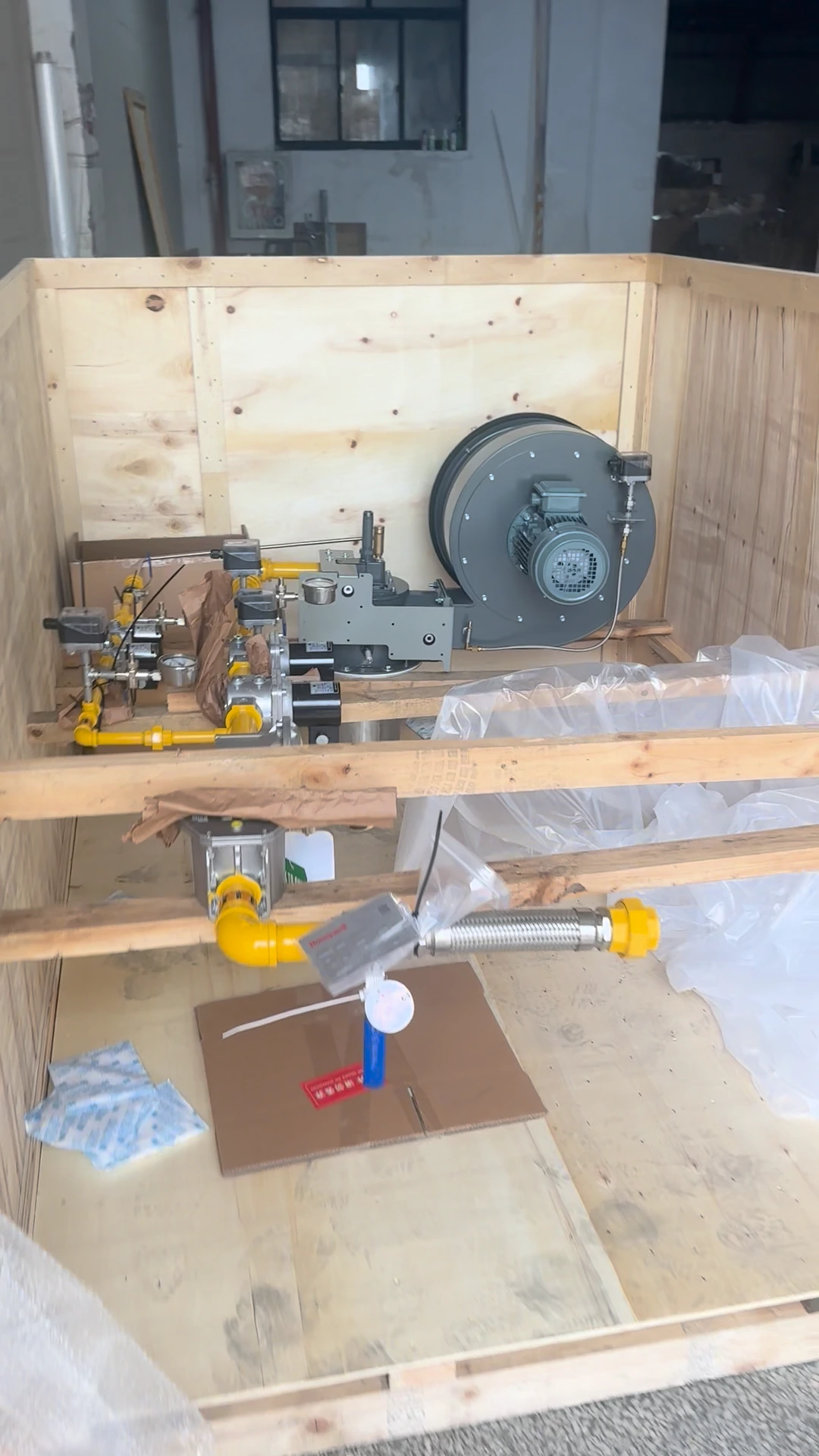
A new Honeywell combustion system has arrived at our workshop. Receiving the equipment begins a wider engineering workflow: establish its incoming condition, review the configuration and determine how it should be adapted for the actual application. HEATFLAM’s objective is a customized combustion solution with clearly defined equipment and plant interfaces.
This update covers receipt, unpacking and preparation for engineering review. Modification, system integration and commissioning are subsequent stages; the video does not demonstrate completed operation or verified performance.
What does the arrival video show?
The workshop footage shows the assembly being unpacked, with views of the blower, piping, valves and overall arrangement. These details provide a starting point for inspection and configuration review before custom engineering begins.
What should incoming inspection establish?
Incoming inspection should create a record of the assembly as received. Before changing components or connections, review the following items against the order, equipment identification and manufacturer documentation:
- Condition: Check accessible components, supports and connections for visible transport damage or loose items.
- Configuration: Identify the equipment and compare the visible arrangement with the required scope; record discrepancies for resolution.
- Interfaces: Note fuel and air connections, electrical interfaces, mounting points and service access.
- Traceability: Record component identification and retain the documents needed for the engineering review.
These are inspection priorities, not a report that every check has already passed. Visual inspection also does not establish leak-tightness, functional safety or suitability for operation.
Why does a Honeywell combustion system need application-specific engineering?
An industrial combustion system must serve the thermal process around it. The U.S. Department of Energy’s process heat overview describes heating as the transfer of energy to materials within a wider system that includes controls and material handling. The engineering implication is straightforward: define the process before finalizing the equipment configuration.
For this assembly, HEATFLAM plans to review five connected areas. The table sets out questions for defining the work; it does not assign unconfirmed specifications to the equipment.
| Review area | Customer input | Engineering purpose |
|---|---|---|
| Process | What material is heated, what operating cycle is required, and what temperature and heat input are needed? | Define the thermal duty and equipment interface. |
| Fuel | What fuel composition and supply conditions are available at the site? | Check component compatibility and fuel delivery requirements. |
| Control | How should the system exchange commands, status and alarms with the plant? | Define the control responsibilities and signal interface. |
| Safety | Which protective functions, interlocks and local requirements apply? | Document the safety review and verification scope. |
| Installation | What space, mounting, utility connections and maintenance access are available? | Confirm the mechanical layout and connection plan. |
A custom combustion system begins with these requirements, rather than a list of interchangeable parts. Explore HEATFLAM’s customized combustion systems for related configurations. Application examples such as industrial drying illustrate different process contexts; they do not identify the destination of the assembly shown here.
How should modification and combustion system integration be planned?
The planned workflow is incoming inspection → engineering review → customer-specific modification → system integration. First establish the received configuration. Then agree the changes needed for the application and define how the modified assembly will connect to the surrounding equipment.
For procurement, request an agreed scope covering the component list, layout, piping interfaces, electrical connections, control signals and required verification records. Separate workshop work from site installation and commissioning responsibilities. These deliverables should be agreed before modification starts.
Honeywell’s Thermal Solutions overview distinguishes fuel delivery and burner management functions, including sequencing, flame supervision and air–fuel control. For integration planning, this means reviewing the connections between functions as well as individual components. The exact functions present on this unit must be established during engineering review.
Where a project calls for consolidated piping and valves, HEATFLAM’s integrated gas and air piping / valve manifold systems provide a related solution category. Their published configuration is not a specification for the received Honeywell assembly.
The UK Health and Safety Executive’s plant design guidance highlights the interaction of fuel characteristics, ignition controls and heat transfer, together with risks during startup, shutdown and operation. Use those principles to structure a qualified engineering review against the applicable site requirements; this article is not a commissioning procedure.
What do Honeywell authorization and ISO 9001:2015 cover?
HEATFLAM provides Honeywell combustion solutions within its authorized Eclipse and Maxon scope. This supports a defined brand and product relationship. Selection of a Honeywell industrial burner or associated components still requires review of the actual duty, compatibility and integration requirements.
HEATFLAM’s ISO 9001:2015 certificate identifies a quality management scope covering the sale of industrial burners for export and the assembly of non-standard burners. ISO 9001:2015 specifies quality management system requirements. The certificate does not establish the performance or safety approval of an individual combustion installation.
ISO now identifies a newer edition of the standard. The 2015 designation here refers specifically to HEATFLAM’s certificate; certificate status and transition arrangements should be checked with the certification body for procurement qualification.
What should you send for a combustion system engineering review?
Start with the operating requirements and the boundary of supply. A useful enquiry includes:
- Application, material or process to be heated, and required operating cycle.
- Fuel type and composition, available supply conditions, and site utilities.
- Required heat input and operating temperature, where established.
- Existing equipment identification, layout drawings and connection details.
- Plant control interfaces, safety requirements and destination-market requirements.
- Required supply scope, site responsibilities, documentation and schedule.
For a retrofit, add photographs and identify the existing limitation the project must address. This gives the engineering team a basis for reviewing the configuration and preparing a scope. See HEATFLAM’s industrial combustion solutions for the wider application portfolio.
Frequently Asked Questions
Is the received system ready for installation?
Will every component be replaced?
Can the burner model alone define the complete system?
Does ISO 9001:2015 certify this combustion system’s performance?
What is the first step in requesting a customized solution?
Share your application, fuel and integration requirements with HEATFLAM to discuss the engineering scope.
References and Data Sources
- U.S. Department of Energy — Process Heat Basics (accessed September 23, 2026).
- Honeywell — Thermal Solutions (accessed September 23, 2026).
- UK Health and Safety Executive — Design Codes: Plant (accessed September 23, 2026).
- ISO — ISO 9001:2015: Quality management systems — Requirements (accessed September 23, 2026).
