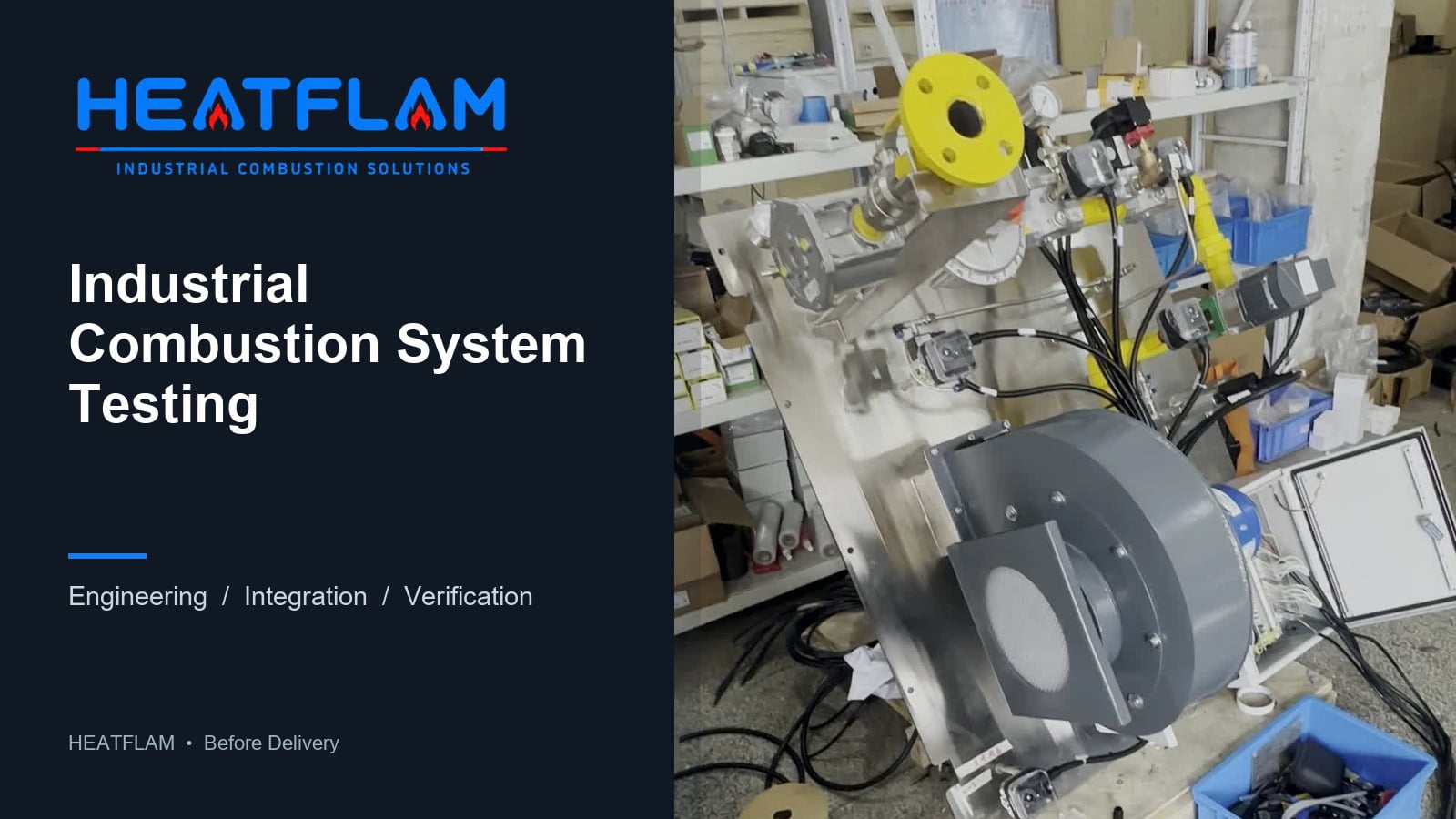
A burner can be correctly selected and still fail to perform as intended when its valve train, electrical controls, airflow, or process interface is integrated incorrectly. Industrial combustion system testing addresses those interfaces before delivery. For boiler, furnace, kiln, and dryer manufacturers, the useful question is specific: what was checked on the assembled system, what was measured, and what still requires verification at the installation site?
HEATFLAM engineering, wiring, and system-check footage. Watch on YouTube.
Why test the complete industrial combustion system?
Combustion safety depends on the sequence and interaction of components, not merely on the burner nameplate. For industrial furnaces within its scope, ISO 13577-2:2023 covers fuel pipework, combustion air and flue gas systems, burners and ignition, and safety-control functions. An original Honeywell burner-control manual illustrates why interlocks, purge, ignition, and safety shutdown must be evaluated as a sequence. The manual is an example of control logic; it does not identify the controller fitted to the system in the video.
The test plan must match the application and governing code. ISO 13577-2 expressly excludes boilers, so a boiler package needs its own applicable requirements and acceptance criteria. For industrial ovens and furnaces, the NFPA 86 standard-development page identifies fire and explosion prevention as the standard’s purpose. Project location, equipment type, fuel, and contract specifications determine which requirements apply.
What should a pre-delivery test plan cover?
Use the following as an RFQ and factory-acceptance checklist. The exact tests, instruments, limits, and witness requirements belong in the project’s agreed test procedure.
| Review stage | Evidence to request | Why it matters |
|---|---|---|
| Design and interfaces | Approved drawings, fuel specification, utility requirements, control I/O list, acceptance criteria | Establishes what the test must prove |
| Mechanical and electrical assembly | Inspection records, component identification, wiring and point-to-point checks, instrument calibration status | Finds assembly and connection errors before energizing |
| Safety sequence | Recorded interlock, purge, ignition, flame-failure, trip, and reset checks where applicable | Shows that the installed control scheme responds to defined faults |
| Operational performance | Fuel and air conditions, stable operating points, oxygen/CO readings and temperatures where specified | Links observed operation to agreed conditions and limits |
| Handover | Signed test report, deviations and closure, manuals, as-built drawings, site commissioning plan | Makes factory findings usable by the site team |
The U.S. Department of Energy recommends checking burner air-to-fuel ratios and adjusting controls to the process. Its process-heating tip sheet explains why excess-air settings should be determined for the equipment rather than copied from another installation. The U.S. EPA’s natural-gas combustion background document also describes higher carbon-monoxide emissions from improperly tuned or off-design boiler operation. These sources support measurement and tuning; they do not establish performance figures for the featured equipment.
Where does factory testing end and site commissioning begin?
An industrial burner commissioning process must verify the real installation: available fuel pressure and quality, combustion-air supply, exhaust path, connected safety devices, process load, and the operating range. Factory checks reduce integration risk before shipment, but they cannot establish every site condition. Specify who owns site start-up, which tests are repeated, and how deviations are closed before production use.
What does HEATFLAM’s engineering video show?
The footage presents an assembled combustion system, engineers discussing its configuration, electrical wiring work, and a system check. It gives buyers a view of combustion system engineering and integration activity. For a purchase decision, pair that visual overview with a project-specific test plan and recorded acceptance results. HEATFLAM’s industrial combustion solutions provide context for integrated equipment; its electronic-ratio control system page is relevant when controls are part of the scope.
Quality-management and distributor documents address organizational scope and commercial authorization; they are not substitutes for a system’s factory-acceptance report. ISO describes ISO 9001 as a quality-management-system standard. Buyers should request the current certificate, its holder and scope, and the relevant project test records separately.
A practical RFQ checklist for OEMs and manufacturers
When comparing a combustion system integration company, send the same technical brief to each supplier: application and thermal duty, fuel composition and supply conditions, process temperature and turndown requirement, operating schedule, electrical supply, control-system interface, installation limits, emissions or local-code requirements, and the required factory and site acceptance tests. For a drying line, describe airflow and product-temperature constraints; HEATFLAM’s drying-industry solution page provides application context. For a kiln, include firing-zone and process-control requirements and review the rotary-kiln combustion-system page as a scope reference.
Ask the supplier to mark which items are verified before shipment, which depend on site commissioning, and which are outside its scope. That distinction makes bids easier to compare and helps the receiving team plan installation.
Frequently Asked Questions
Send HEATFLAM your application, fuel, thermal duty, process conditions, control interfaces, and acceptance requirements for an engineering review.
REFERENCES AND DATA SOURCES:
- ISO — ISO 13577-2:2023, Industrial furnaces and associated processing equipment — Safety — Part 2: Combustion and fuel handling systems (Published 2023-12).
- National Fire Protection Association — NFPA 86, Standard for Ovens and Furnaces (Accessed 2026-10-12).
- Honeywell — RM7800/RM7840 Series Relay Modules: Installation Instructions (Accessed 2026-10-12).
- U.S. Department of Energy — Check Burner Air to Fuel Ratios, Process Heating Tip Sheet #2 (Published 2007-11).
- U.S. Environmental Protection Agency — Background Document, AP-42 Section 1.4: Natural Gas Combustion (Accessed 2026-10-12).
- ISO — ISO 9001 Quality Management Systems (Accessed 2026-10-12).
