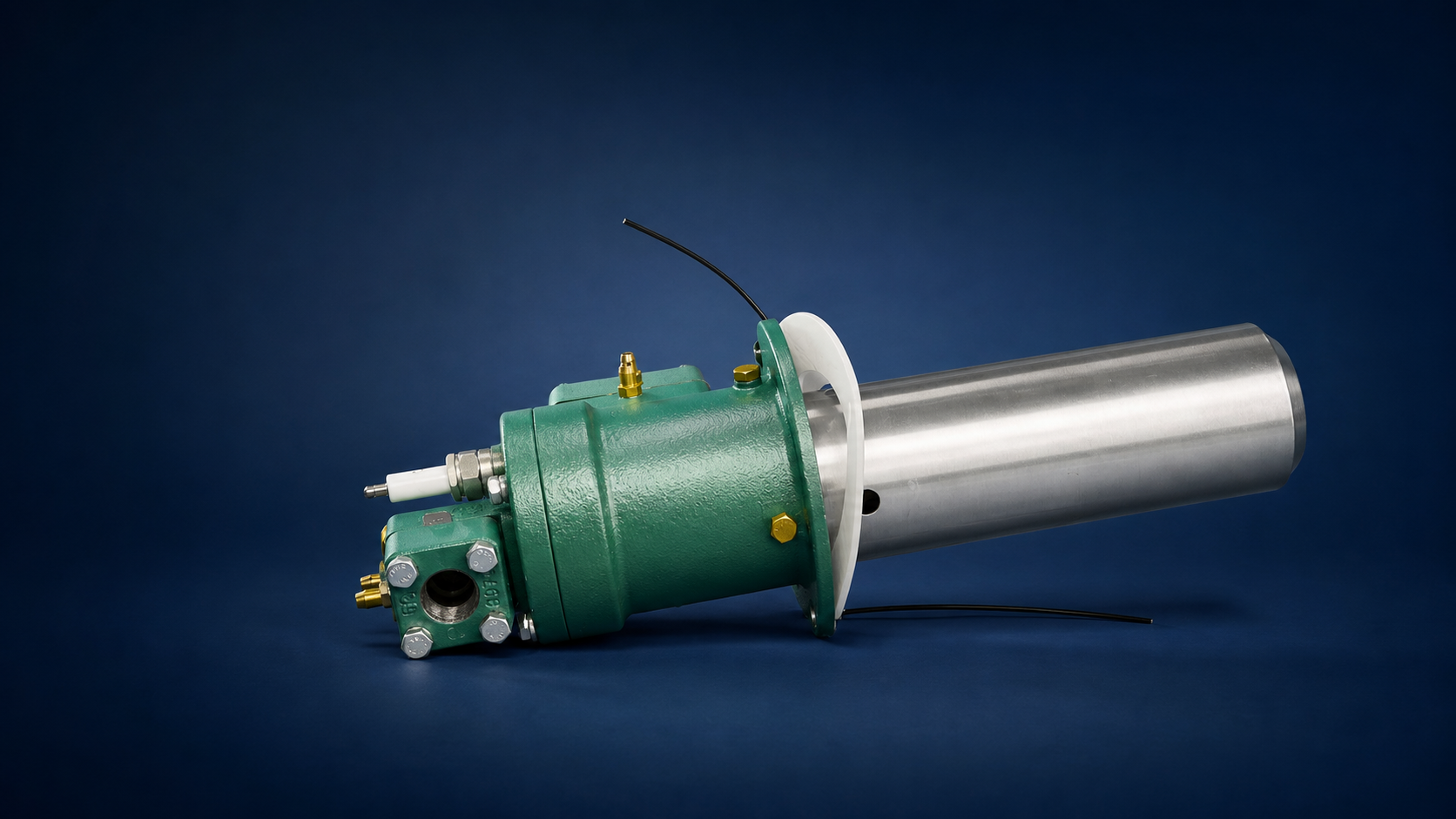
A tube-fired heating system must do more than produce the required heat input. The burner, tube, combustion-air supply, fuel train, ignition system, flame safeguard, and process controls have to operate as one engineered system. The TFB075 Tube Firing Burner is designed for tube-firing duties and offers a documented maximum input of 750,000 Btu/h (220 kW), with three lower nominal input configurations also available.
This guide summarizes the published TFB075 data and explains the information an industrial buyer should confirm before using it as a process heating burner or burner replacement solution. Heatflam can support model review, component matching, fuel-train selection, controls, and system integration; however, compatibility should be confirmed from the actual operating conditions rather than from the model name alone.
What Is the TFB075 Tube Firing Burner?
The TFB075 is an industrial tube firing burner listed in the Eclipse TFB product family. In a tube-fired arrangement, combustion takes place inside a tube rather than exposing the process material directly to the flame. The U.S. Department of Energy describes indirect fuel-fired systems as systems in which the flame is enclosed and heated gases pass through tubes or panels, keeping combustion products separate from the material being heated. This distinction is important for processes where the furnace atmosphere or product must not contact the combustion gases directly.
Depending on the equipment design, buyers may search for an industrial tube firing burner, radiant tube burner, or immersion tube burner. These terms describe related applications, but they are not automatically interchangeable. A radiant tube transfers heat primarily from the tube surface to a furnace load, while an immersion tube transfers heat through a tube wall into a liquid. Each arrangement imposes different requirements for tube material, geometry, backpressure, heat flux, and exhaust routing.
TFB075 Technical Specifications
The following values come from the published TFB075 Version 2, Datasheet 310-2. They are useful for initial screening, not a substitute for a project-specific selection calculation.
| Parameter | Published TFB075 data | Selection implication |
|---|---|---|
| Burner input options | 400, 500, 600, or 750 × 1,000 Btu/h (117, 146, 176, or 220 kW) | Select the configuration from calculated process duty and system losses; 220 kW is the published maximum, not the only rating. |
| Documented fuels | Natural gas, propane, or butane | Fuel composition, calorific value, inlet pressure, and the selected gas orifice must be confirmed. |
| Ignition | Direct spark ignition, 6 kVAC | Match the ignition transformer and control sequence to the local electrical and safety design. |
| Flame detection | Flame rod or UV scanner | The detector and flame safeguard must be selected as a compatible system. The datasheet states that a flame rod is not available with preheated combustion air. |
| Air-tube length | 76–609 mm (3–24 in.), in 25 mm (1 in.) increments | Confirm the mounting wall, tube entry, burner position, and service clearance before ordering. |
| Connections | 2 in. NPT/Rc 2 air inlet; 3/4 in. NPT/Rc 0.75 fuel inlet; NPT or BSP piping available | Specify the thread standard and verify the existing pipework during a replacement review. |
| Maximum preheated combustion-air temperature | 540°C (1,000°F) | PCA configuration and component limits must be confirmed. The datasheet calls for consultation when PCA is combined with propane or butane. |
| Approximate weight | 9–13 kg (20–29 lb) | Actual weight depends on configuration; verify support and access requirements. |
Where a Tube Firing Burner Fits in Process Heating
Industrial process heating transfers energy from a heat source to a material so that a manufacturing step can reach or maintain its required temperature. The DOE identifies burners and radiant burner tubes among the common heating elements used in industrial systems. It also recommends evaluating process heating as a system, because adjustments to combustion, heat-transfer surfaces, pressure, controls, and heat recovery can affect overall performance.
The TFB product family is publicly listed for indirect-fired furnaces, tempering, hardening, continuous lines, annealing, galvanizing, and liquid heating. Whether the TFB075 is suitable for a specific machine depends on the required duty and mechanical design. Common project categories include:
- Radiant tube heating: the tube separates the furnace atmosphere from combustion products while its surface transfers heat to the load.
- Immersion tube heating: the tube wall transfers heat into a liquid; tube surface loading, liquid circulation, and material compatibility require particular attention.
- Indirect process heating: the process benefits from separating combustion gases from the product or controlled atmosphere.
- Burner replacement projects: an existing tube-fired system needs a model review based on duty, dimensions, connections, controls, and operating conditions.
Watch the TFB075 Product Video
The short product video below provides a visual reference for the TFB075 burner body, air connection, fuel connection, and mounting arrangement. Use it for product identification only; ordering details should be checked against the model documentation and the operating conditions of the installation.
Seven Checks Before Selecting the TFB075
- Required heat input. Calculate the useful process duty and account for startup, wall, exhaust, opening, and other system losses. Then choose among the documented 117, 146, 176, and 220 kW configurations.
- Tube geometry and material. Provide the tube type, inside diameter, total length, bends, exhaust arrangement, material, and maximum temperature. These values influence pressure drop, flame development, heat transfer, and tube life.
- Fuel data. State the fuel, composition or gas analysis where relevant, calorific value, available pressure, and expected variation. Alternative or mixed gases require a separate technical review.
- Combustion-air conditions. Confirm blower capacity, available static pressure, air temperature, pipe size, and routing. Published air-orifice differential pressure does not by itself represent the total pressure required by the complete system.
- Control method. Define whether the process uses on-ratio modulation, high/low control, or another approved strategy, together with the required operating range and temperature-control response.
- Ignition and flame safety. Specify the electrical supply, purge and ignition sequence, flame detector, burner management or flame safeguard, valve-proving requirements, and applicable local codes.
- Mechanical installation. Verify the burner mounting pattern, air-tube length, piping thread standard, orientation, access for maintenance, and the clearances around the existing equipment.
TFB075 as a Burner Replacement Solution
A replacement decision should start with the nameplate and operating data from the existing burner, but it should not end there. Two burners with similar nominal heat input can differ in flame shape, combustion-air pressure, fuel pressure, mounting dimensions, ignition method, flame detection, control response, and allowable backpressure.
For an efficient review, send the existing model and serial number, clear nameplate and installation photos, tube drawing, target output, fuel information, process temperature, chamber pressure, control description, electrical supply, and any recurring operating problem. Heatflam can then assess whether the TFB075 configuration is appropriate and identify the associated burner controls, valve train, blower, ignition, flame-detection, and connection requirements.
If the project involves a different brand or an obsolete assembly, treat the exercise as an engineered replacement rather than assuming drop-in compatibility. Heatflam’s industrial combustion solution support can include model selection, system integration, valve-train and control review, and technical communication during the replacement process.
Information to Include in Your RFQ
- Required burner input and expected operating range
- Process type, target temperature, heat-up time, and production cycle
- Fuel type, calorific value or composition, and available inlet pressure
- Tube type, material, inside diameter, length, bends, and exhaust layout
- Combustion-air temperature, blower data, and available static pressure
- Existing burner model, photos, dimensions, and connection details for replacement work
- Electrical supply, control strategy, flame-safety system, and local project requirements
Frequently Asked Questions
Send your required heat input, fuel data, tube drawing, operating conditions, and existing burner information. Heatflam will review the selection and related combustion-system requirements.
REFERENCES AND DATA SOURCES:
- Eclipse — TFB075 Version 2, Datasheet 310-2 (Published 2014-11-14).
- Honeywell Thermal Solutions Docuthek — TFB Tube Firing Burners (Accessed 2026-08-25).
- U.S. Department of Energy — What Are the Different Kinds of Process Heating Systems? (Accessed 2026-08-25).
- U.S. Department of Energy — Process Heating Systems (Accessed 2026-08-25).
- U.S. Department of Energy — Improving Process Heating System Performance: A Sourcebook for Industry, Second Edition (Published 2007).
