
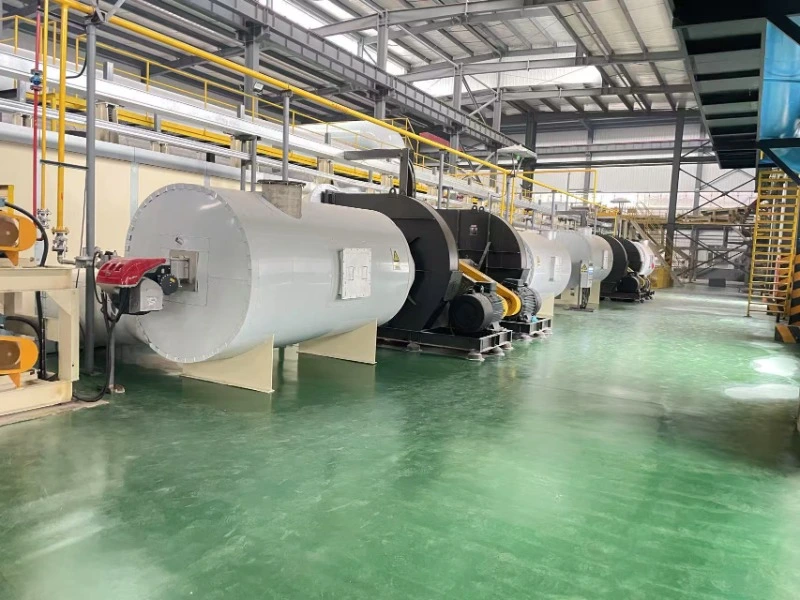
Low NOx Industrial Burner Retrofit Guide for Factories
Root-Cause Diagnosis
A Low NOx Industrial Burner retrofit works when current emissions are driven by flame-temperature, staging, and excess-air limits rather than a damaged furnace or unsafe control system. For natural-gas boilers, low-NOx burners can reduce NOx by 40% to 85%, while low-NOx burners plus FGR can reach 60% to 90% under suitable conditions [2].
Field Troubleshooting Priorities
- Excess air: If the boiler is natural-gas fired, compare measured excess air with the 10% attainable reference before changing burner hardware [1].
- Stack loss: If stack temperature is high, estimate whether each 40 degrees F reduction could recover about 1 percentage point of boiler efficiency [1].
- NOx method: If FGR is proposed, confirm the burner can sustain stable flame with recirculated inert gas before accepting a 60% to 90% NOx reduction claim [2].
- Permit basis: If equipment falls within 1 MW to 50 MW thermal input, verify the local MCP or equivalent permit basis before selecting the emission guarantee [3].
- Monitoring: If the plant follows England and Wales MCP guidance, plan periodic monitoring at least every 3 years up to 20 MWth or every year above 20 MWth [4].
When Retrofit Fits
A Low NOx Industrial Burner retrofit can reduce natural-gas boiler NOx by 40% to 85% when low-NOx staged combustion is suitable for the furnace and operating envelope [2]. When low-NOx burners are combined with flue gas recirculation, EPA AP-42 reports NOx reductions of 60% to 90% for applicable natural-gas boiler systems [2].
Factories usually consider retrofit instead of full equipment replacement when the pressure vessel, furnace, heater, kiln, dryer, or thermal oil system still has usable mechanical life. The decision should start with a measured baseline: current NOx, CO, flue-gas O2, stack temperature, load range, fuel pressure, draft condition, burner cycling, and control-panel capability.
NOx Permit Basis
For medium combustion plants in the EU framework, the regulated scope is 1 MW to 50 MW rated thermal input, while local permits may impose stricter site-specific limits [3]. In England and Wales, current MCP guidance says periodic monitoring is at least every 3 years for MCPs up to 20 MWth and every year for MCPs above 20 MWth [4].
NOx values are not interchangeable unless the oxygen basis, fuel, dry or wet basis, plant category, and measurement method are stated. Before specifying the burner, request the target NOx value in mg/Nm3 or ppm, reference O2 basis, minimum load, maximum load, fuel blend, and required stack-test or monitoring method.
Efficiency Trade-Offs
On well-designed natural-gas boiler systems, 10% excess air is attainable, and DOE-linked guidance gives a rule of thumb of 1 percentage point boiler-efficiency gain for each 15 percentage-point reduction in excess air or each 40 degrees F reduction in stack gas temperature [1]. Inadequate excess air can create unburned combustibles, soot, smoke, and carbon monoxide, while too much air increases stack losses [1].
Low NOx retrofits lower peak flame temperature by staged air, staged fuel, FGR, or related methods. That helps thermal NOx control, but it can increase CO risk if the burner, furnace geometry, draft, and controls are not matched. The target is the lowest stable excess-air setting that keeps CO, flame signal, draft, and process temperature within approved acceptance criteria.
Before Replacing the System
- Application fit: Retrofit is most defensible when the existing boiler, furnace, heater, kiln, dryer, or thermal oil system has sound mechanical life and the fuel, load profile, and draft system can support the new flame pattern.
- Limits: If furnace dimensions, refractory condition, fan pressure, FGR path, or control-panel capacity are unknown, performance is To be confirmed.
- Operational risks: Low NOx tuning can raise CO, weaken flame signal, affect stack temperature, or require burner-management and fuel-train changes.
- Required confirmation: Confirm the OEM manual, local code, environmental permit, insurer requirement, site engineer approval, combustion test, and commissioning report before final acceptance.
Terms That Affect Diagnosis
- Low NOx Industrial Burner: A burner package designed to lower NOx formation through staged combustion, flame shaping, FGR compatibility, or related control methods.
- Flue-gas O2: The measured oxygen remaining in exhaust gas; it is used with CO and stack temperature to judge excess-air setting and combustion stability.
- Excess air: Air supplied above stoichiometric demand; too little increases CO risk, while too much carries heat out through the stack [1].
- FGR: Flue gas recirculation returns part of exhaust gas to the burner windbox to reduce flame temperature and primary-zone oxygen concentration [2].
- NOx basis: The stated unit, oxygen reference, fuel, plant type, dry or wet basis, and measurement method behind an emission number.
- MCP: In the EU policy context, a medium combustion plant is within 1 MW to 50 MW rated thermal input [3].
Verified Troubleshooting Data
| Issue | Condition | Value | Evidence | Action |
|---|---|---|---|---|
| Excess air target | Well-designed natural-gas boiler | 10% attainable | DOE / NREL steam tip sheet [1] | Measure O2, CO, and stack temperature before retrofit. |
| Efficiency recovery | Comparable boiler conditions | 1% per 15% excess-air reduction or 40 degrees F stack-temperature reduction | DOE / NREL steam tip sheet [1] | Estimate fuel saving only after baseline stack readings. |
| Low-NOx burner result | Natural-gas boilers, relative to uncontrolled emissions | 40% to 85% NOx reduction observed | EPA AP-42 Chapter 1.4 [2] | Request the supplier’s guaranteed NOx basis and load range. |
| Low-NOx plus FGR | Suitable natural-gas boiler designs | 60% to 90% NOx reduction capable | EPA AP-42 Chapter 1.4 [2] | Verify FGR fan, ducting, control logic, and flame stability. |
| Regulated scope | EU medium combustion plant context | 1 MW to 50 MW rated thermal input | European Commission MCP page [3] | Check local permit scope before accepting a target NOx value. |
| Maintenance evidence | Boiler operation and safety checks | Daily, weekly, monthly, semiannual, and annual checks listed | National Board boiler log guidance [5] | Include burner flame, interlock, and shutoff-valve checks in commissioning. |
Buyer Specification
Use a specification that forces measurable answers. State the equipment type, burner capacity, fuel, existing control system, required NOx target, oxygen basis, operating hours, process temperature requirement, available outage window, and required documents. For factories outside the EU or UK, replace MCP values with the local permit and environmental authority requirements.
Example requirement: Supply a Low NOx Industrial Burner retrofit for a natural-gas fired process heater. Supplier must confirm achievable NOx at the stated O2 basis, CO limit, turndown ratio, FGR requirement if any, control-panel changes, flame-safeguard compatibility, commissioning method, and post-retrofit stack-test procedure. Unverified values must be marked To be confirmed.
Retrofit Risks
A Low NOx Industrial Burner retrofit should not be accepted if it only reports a NOx number. The factory also needs CO, O2, excess air, flame signal, ignition reliability, pressure drop, noise, vibration, purge timing, shutoff-valve leakage checks, and process temperature stability.
The common technical failure is pushing NOx down while allowing CO, flame instability, or stack loss to rise. Any retrofit touching fuel, air, flame supervision, purge, safety shutoff valves, or burner management logic should be reviewed by qualified combustion personnel and accepted under the applicable local code.
Frequently Asked Questions (FAQ)
REFERENCES AND DATA SOURCES:
- U.S. Department of Energy / National Renewable Energy Laboratory, “Improve Your Boiler’s Combustion Efficiency,” Steam Energy Tips No. 4, states the excess-air, stack-temperature, and boiler-efficiency rule-of-thumb data used in this guide.
- U.S. Environmental Protection Agency, AP-42 Chapter 1.4 “Natural Gas Combustion,” direct PDF used because EPA publishes this chapter as a PDF; it describes FGR, low-NOx burners, and reported NOx reduction ranges.
- European Commission, “The Medium Combustion Plant Directive,” explains the 1-50 MW medium combustion plant scope and the EU policy context for SO2, NOx, and dust emissions.
- GOV.UK, “Medium combustion plant (MCP): comply with emission limit values,” gives current England and Wales guidance on MCP emission limit values, deadlines, oxygen-basis context, and monitoring frequency.
- The National Board of Boiler and Pressure Vessel Inspectors, boiler log and maintenance guidance, lists routine burner flame, combustion-control, interlock, shutoff-valve, and flame-failure checks.