
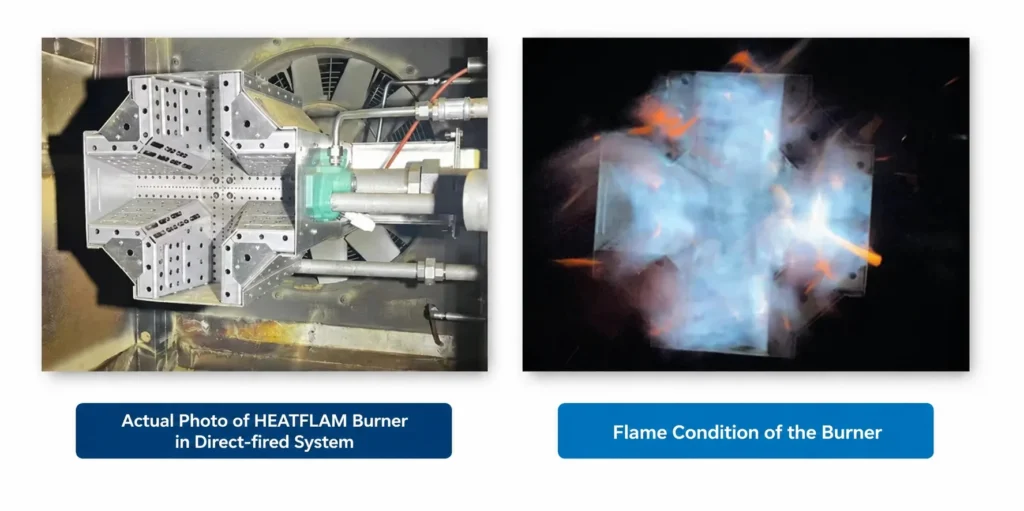
Converting a steam-heated dryer can reduce intermediate heating losses, but the decision involves more than replacing a heat exchanger with a burner. Plant managers and project engineers need a system that meets production, product-quality, maintenance, and safety requirements throughout its operating range.
This guide explains the engineering checks behind a steam to direct fired dryer conversion and the information needed to develop a practical retrofit proposal.
Why Steam-Heated Dryers Can Become Expensive to Operate
A steam-heated dryer depends on the boiler, distribution piping, control valves, steam traps, and condensate return. Damaged insulation, leaks, and faulty traps can increase the cost of supplying heat. These are conditions to measure, not assumptions to make about every steam installation. [2]
At the dryer, accumulated fines can restrict coil passages and make cleaning difficult. Inadequate steam pressure or poor condensate drainage can limit heat delivery. Inspect coil condition and measure pressure drop before deciding whether maintenance or conversion offers the better return.
Steam remains a useful heat-transfer medium. A well-maintained central system can serve several processes efficiently; its value should be assessed at plant level rather than from the dryer alone.
What Is a Direct-Fired Dryer Retrofit?
A direct fired dryer retrofit replaces the steam-to-air heating section with an arrangement that mixes combustion gases into the drying air. An indirect-fired gas heater instead retains a heat exchanger to separate combustion products from process air. [1]
Steam heating:
Gas Boiler → Steam → Steam Piping → Heat Exchanger → Hot Air → Dryer
Direct-fired gas heating:
Natural Gas → Gas Train → Industrial Burner → Hot Air → Dryer
Simplified heating paths. Combustion air, process-air mixing, circulation, exhaust, and safety controls are also required.
Direct firing means combustion-product contact, not intentional flame contact with the product. The installation needs suitable flame clearance and mixing before heated air reaches temperature-sensitive material.
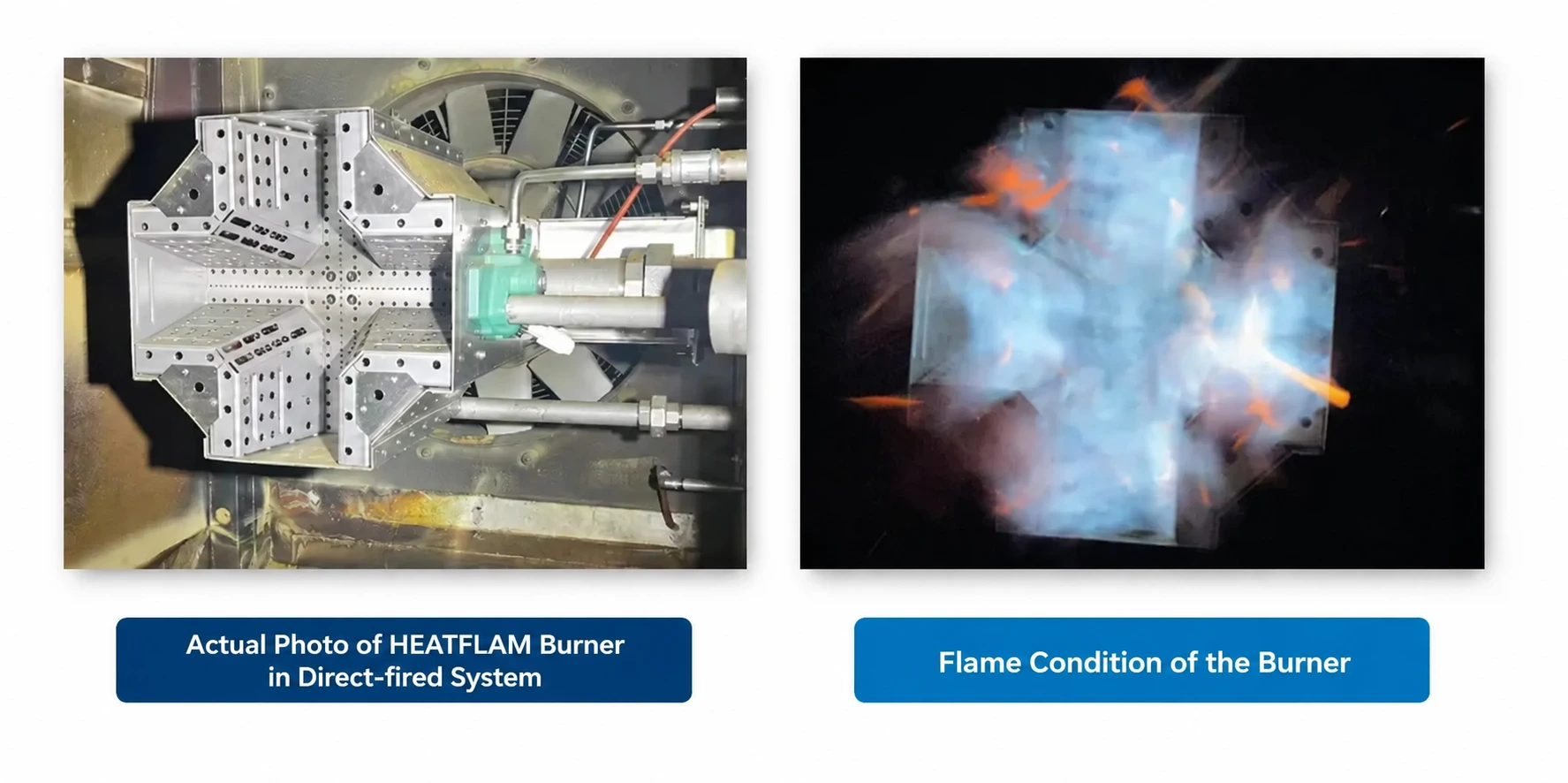
Steam Heating vs. Direct-Fired Gas Heating
| Engineering factor | Steam heating | Direct-fired gas heating |
|---|---|---|
| Heat delivery | Steam transfers heat through a coil | Combustion gases mix with process air |
| Process-air composition | Separated from combustion products during normal operation | Contains combustion products and combustion-generated moisture |
| Utility requirements | Steam supply and condensate handling | Gas supply and combustion-air arrangement |
| Air-side resistance | Depends on coil geometry and fouling | Depends on burner, mixing section, and duct geometry |
| Maintenance focus | Coils, traps, valves, and condensate system | Burner, gas train, flame detection, and interlocks |
Compare both systems at equivalent production rate, inlet moisture, final moisture, and ambient conditions. A change in heating method alone does not establish lower total operating cost.
Why Direct-Fired Heating Can Improve Dryer Energy Efficiency
Fewer heat-transfer stages. Removing steam generation and steam-to-air exchange from the dryer heating route can reduce upstream losses. Evaporation demand, enclosure losses, and exhaust heat still remain. Use a complete energy balance rather than treating burner efficiency as dryer efficiency. [4]
Reduced steam distribution losses. A dedicated steam branch can stop losing heat when it is properly isolated. Shared headers and boilers may remain in operation, so credit only losses that actually disappear after the conversion.
Lower heat-exchanger pressure drop. Removing a restrictive coil can reduce resistance, but the replacement mixing section adds its own losses. Recheck the fan curve and motor loading. At unchanged speed, airflow may rise rather than electricity consumption fall; fan-speed adjustment may be needed. [3]
Faster temperature response. A modulating burner can adjust heat input without waiting for a steam coil to respond. The practical benefit depends on mixing, sensor placement, and control tuning. Faster inlet-air response does not automatically shorten product drying time.
Improved burner modulation. Match maximum output and minimum stable firing rate to the recipe range. An oversized burner can cycle at low demand. Controls should coordinate heat input with airflow and zone requirements. [2]
Is Your Existing Steam Dryer Suitable for Direct-Fired Conversion?
Start with process-air compatibility. Review material specifications, hygiene requirements, and customer restrictions on combustion-product contact. Then check installation space, enclosure temperature limits, exhaust capacity, and access for maintenance.
Verify available gas pressure under simultaneous plant demand, not only the static pressure when equipment is stopped. Establish the required thermal load and airflow for startup, normal production, and minimum-load operation.
Steam heating may remain appropriate when:
- An efficient central boiler serves a well-maintained network.
- Suitable waste steam is available.
- Multiple production lines share steam economically.
- Combustion products cannot contact process air.
- Hygiene, process, or safety restrictions prevent direct firing.
Where direct contact is unsuitable, compare steam-system improvements with indirect-fired heating. A retrofit should follow the process constraints.
Direct-Fired Dryer Retrofit for Pet Food and Aquafeed Production
A pet food dryer retrofit or aquafeed dryer retrofit must preserve drying uniformity and product quality. ANDRITZ’s Combi-zone dryer literature describes both direct gas-fired and indirect steam heating for fish-feed and pet-food applications. That confirms industry use of both arrangements, not universal retrofit compatibility. [5]
Assess pellet size, formulation, bed depth, residence time, and moisture variation between zones. Agree acceptance criteria for final moisture, water activity where relevant, and quality checks across representative recipes.
A feed dryer gas burner adds combustion-generated water vapor to the process air. Include it in the moisture balance, especially with substantial recirculation. Increasing heat input cannot compensate for inadequate moisture removal through the exhaust.
What Equipment Is Required?
An industrial drying system retrofit combines equipment selection with mechanical and control integration.
| Equipment | Engineering requirements |
|---|---|
| Industrial burner | Fuel, thermal load, minimum firing rate, flame geometry, and duct conditions. |
| Gas valve train | Filtration, regulation, safety shutoff, pressure monitoring, and valve proving where required. |
| Combustion air fan | Air supply matched to the selected burner; confirm whether a separate blower is needed. |
| Ignition and flame safety | Ignition equipment and flame detector suited to the burner and operating mode. |
| Burner management system | Supervised startup, firing permissives, flame supervision, and fuel shutdown. |
| PLC and temperature control | Recipes, modulation demand, zone control, alarms, and dryer sequencing. |
| Custom duct or transition section | Mixing, flame clearance, thermal protection, inspection access, and dryer connection. |
Select the gas train for an industrial burner using required flow and minimum available supply pressure, including pressure losses through the complete assembly. Confirm the agreed component and documentation scope before procurement.
How to Calculate Energy Savings and Retrofit ROI
Heatflam upgrade example: 50% lower gas consumption. Heatflam’s before-and-after comparison reports gas use falling from 40 to 20 m³ per ton, with the corresponding cost falling from approximately RMB 180 to RMB 90 per ton. The reduction in reported gas consumption is (40 − 20) ÷ 40 × 100 = 50%. [8]
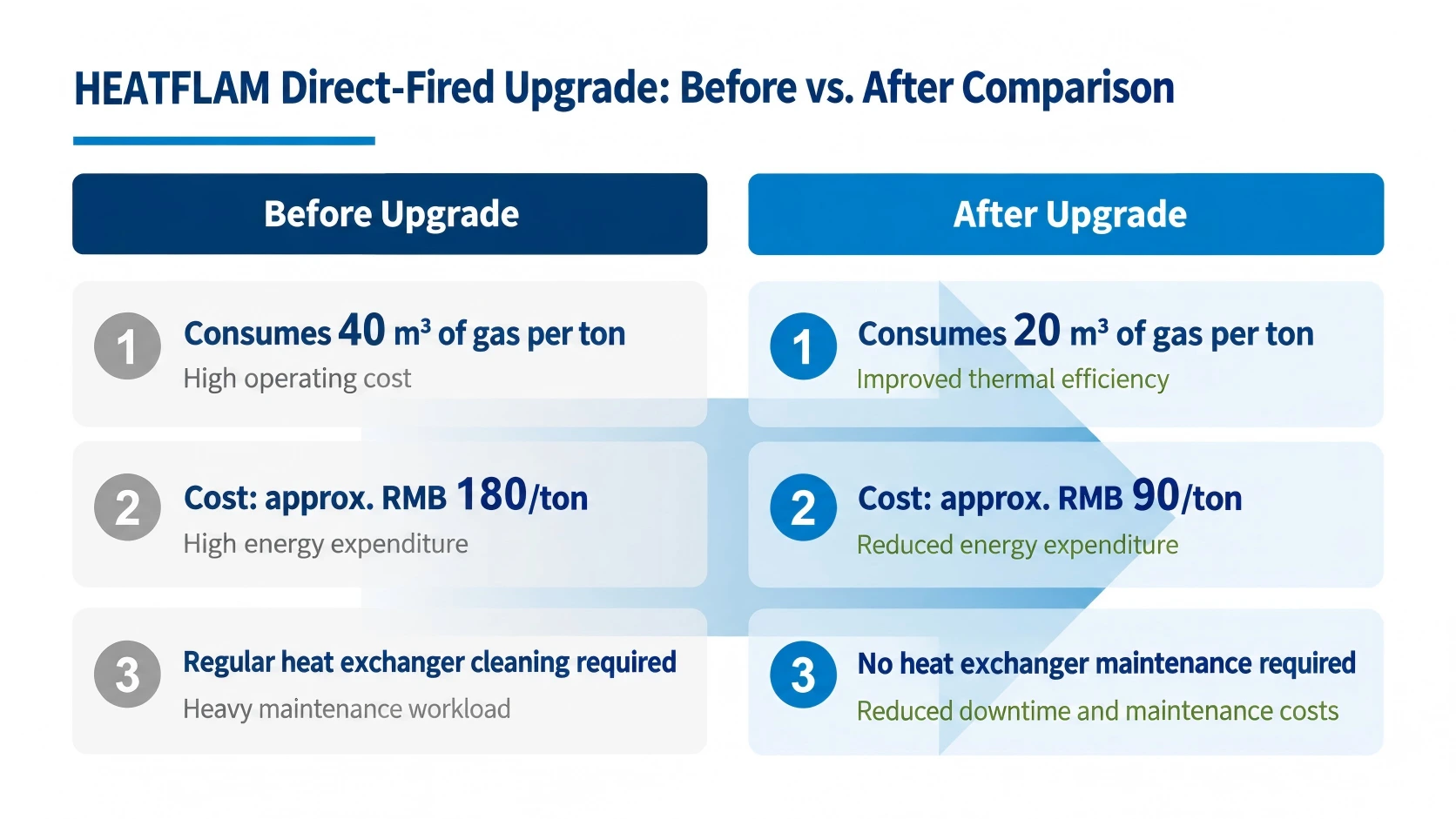
Heatflam also reports a 1–2 year payback period for this upgrade example. These are project-specific figures, not a guaranteed result for another installation. Gas-use reduction is not automatically the same as total plant energy savings. Actual savings and payback depend on the operating conditions, energy prices, annual production, installed cost, and the costs that remain after conversion.
For a new project, confirm the tonnage and gas-volume measurement bases and compare equivalent inlet and outlet moisture conditions. An engineering assessment and energy balance are needed before using the example as an investment benchmark.
Measure steam consumption, steam pressure, condensate conditions, fan electricity, production hours, and moisture removal. Convert these records into a consistent baseline. Compare proposed gas consumption on the same fuel-energy basis and report electrical consumption separately.
For a shared boiler, distinguish allocated steam cost from avoidable cost. Boiler standing losses, staffing, and common distribution costs may remain after one dryer disconnects. Include only supported reductions in the investment calculation.
Annual net operating savings = Existing annual operating cost − Proposed annual operating cost
Simple payback, years = Total installed retrofit cost ÷ Annual net operating savings
Installed cost should include equipment, gas infrastructure, site modifications, shutdown work, commissioning, and product validation. Test the calculation against changes in gas price, operating hours, and production loading. Simple payback applies when net savings are positive and is different from discounted project ROI.
Track thermal energy per kilogram of water evaporated as well as annual cost. No universal percentage or payback period applies: savings must follow a site-specific engineering assessment and energy balance.
Key Engineering and Safety Considerations
Define responses to flame failure, abnormal gas pressure, inadequate airflow, excessive temperature, exhaust failure, and interrupted material movement. A burner management system retrofit must address safety functions separately from ordinary process temperature control.
Purpose-designed burner controls provide functions such as ignition supervision, pressure monitoring, valve proving, and pre-purge. Honeywell’s BCU 570 is one documented example; this reference does not establish suitability for a particular dryer. [6]
Evaluate combustible fines, deposits, hot surfaces, and connected dust-handling equipment. OSHA identifies grain dust as a fire and explosion hazard in feed-related operations. Use the site hazard assessment and applicable local requirements to determine protection measures. [7]
Assess any Low NOx target alongside flame stability, CO, and the operating range. Emissions acceptance and process-air suitability require their own verification.
How Heatflam Engineers Dryer Retrofit Systems
Heatflam develops customized industrial combustion systems around fuel, process temperature, thermal load, airflow, installation constraints, controls, and safety requirements. For a dryer conversion, the objective is a coordinated burner, gas train, and control solution.
The engineering discussion begins with existing drawings and operating data. These establish the heating duty, minimum-load requirement, available gas pressure, and connection points. Burner selection then needs to match the mixing space and dryer airflow rather than heat output alone.
Mechanical integration should define the transition section, mounting, maintenance access, and site piping boundaries. Control integration should define the temperature demand, startup permissives, trip signals, operator interface, and communication with the existing dryer PLC.
Heatflam can support combustion selection and commissioning planning. Agree the scope of equipment supply, installation support, documentation, and acceptance checks in the proposal. Confirm responsibilities for dryer modifications and product validation with the plant team and equipment manufacturer.
This approach helps purchasing teams compare complete technical scopes and gives maintenance teams a clear basis for future inspection and troubleshooting. Explore Heatflam’s industrial burners and combustion components as part of that system-level assessment.
Frequently Asked Questions
Can every steam-heated dryer be converted to direct-fired gas heating?
Can a dryer burner retrofit save 50% and pay back in 1–2 years?
Is direct-fired heating suitable for pet food and aquafeed?
Can the existing dryer PLC be retained?
Will removing steam coils reduce fan electricity consumption?
What determines the retrofit payback period?
Request a Dryer Retrofit Assessment
Send Heatflam your existing dryer information and operating parameters so our engineers can evaluate whether a direct-fired burner retrofit is technically suitable. Please include:
- Dryer manufacturer and model.
- Product or material and production capacity.
- Existing heating method and steam consumption.
- Fuel type and available gas pressure.
- Operating temperature.
- Inlet and outlet moisture, including the measurement basis.
- Existing drawings and photos.
Airflow records, operating hours, utility prices, PLC details, and site safety requirements will help refine the assessment. Identify the main objective—energy cost, maintenance, temperature control, or capacity—so the proposal addresses the actual constraint.
Share your dryer information and operating parameters with Heatflam to discuss technical suitability, system integration, and the next engineering steps.
REFERENCES AND DATA SOURCES:
- U.S. Department of Energy — What Are the Different Kinds of Process Heating Systems? (accessed September 10, 2026).
- Australian Government — Process heat and steam (accessed September 10, 2026).
- U.S. Department of Energy — Improving Fan System Performance: A Sourcebook for Industry (accessed September 10, 2026).
- U.S. Department of Energy — Improving Process Heating System Performance: A Sourcebook for Industry (accessed September 10, 2026).
- ANDRITZ — Combi-zone Dryer for Extruded Pellets (accessed September 10, 2026).
- Honeywell — Burner Control Unit BCU 570 (accessed September 10, 2026).
- OSHA — Grain Handling (accessed September 10, 2026).
- Heatflam — Direct-Fired Upgrade: Before vs. After Comparison (gas consumption and cost comparison) (accessed September 10, 2026).