
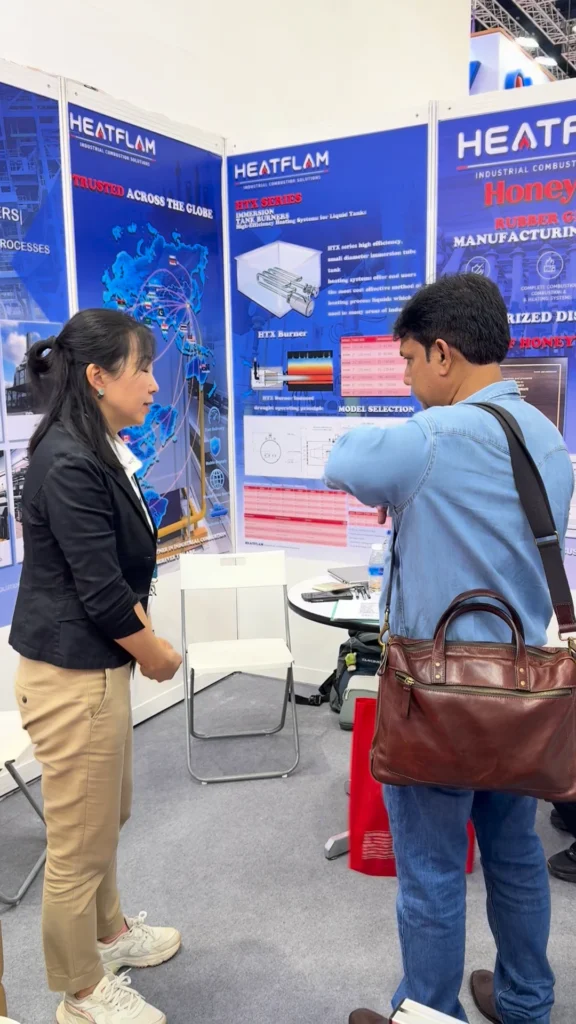
What did HEATFLAM bring to IRGCE 2026?
The 12th International Rubber Glove Conference & Exhibition took place on 8–10 September 2026, according to the official IRGCE conference page. As an IRGCE 2026 exhibitor, HEATFLAM met industry professionals to discuss production requirements and practical approaches to industrial heating.
At Booth 438A, Hall 4, conversations began with the application: the fuel available, the heat required, the operating temperature and the control requirements. These inputs guide the selection of burners, components and a customized combustion system.
HEATFLAM, the brand of Shanghai Yan Controlled Industrial Technology Co., Ltd., provides customized combustion engineering alongside standard burners and spare parts. For glove manufacturers and production-line equipment builders, that means a single discussion covering equipment selection and the interfaces around it.
Watch our HEATFLAM IRGCE 2026 exhibition recap below.
Watch the HEATFLAM exhibition recap on YouTube
Why do drying and curing need separate heating specifications?
A rubber glove production heating system serves a defined process stage. A rubber glove drying oven burner and a burner serving rubber glove curing oven heating therefore need specifications tied to their respective duties.
Drying removes free moisture; curing uses controlled heating to promote a chemical reaction. These are distinct process-heating functions in the U.S. Department of Energy sourcebook. The production recipe and oven design establish the temperature and residence-time requirements for each stage.
Research on rubber-glove former conveyor ovens also shows why air distribution deserves attention. A Mahidol University study examined hot-air delivery around moving formers and redesigned branch ducts to improve temperature distribution. The work supports reviewing the oven airflow alongside the heat source, rather than judging the heating system solely by burner capacity. See the university’s peer-reviewed publication record.
For an industrial burner for drying process applications, start with the moisture-removal duty and air circuit. For an industrial burner for curing process applications, start with the validated thermal recipe and operating cycle. Supply the oven supplier’s process limits with the enquiry.
How should industrial burners for rubber glove manufacturing be selected?
HEATFLAM starts selection with a process brief. The following checklist is a practical RFQ framework for discussing a new burner system for a drying oven or an existing line upgrade.
| Selection input | Information to send | Purpose of the review |
|---|---|---|
| Process stage | Former drying, glove drying or curing; material and recipe | Define the heating duty and process limits |
| Fuel supply | Fuel type, composition where available, minimum and maximum supply pressure | Check burner and fuel-system requirements |
| Thermal duty | Required heat input and useful heat duty, clearly distinguished; startup and steady operation | Establish the load range for selection |
| Oven conditions | Zone temperatures, line speed, residence time, airflow and chamber pressure | Review the burner within the complete oven |
| Installation | Drawings, mounting dimensions, duct arrangement and service access | Assess physical integration |
| Controls and site | Existing controller, signals, electrical supply, destination and applicable requirements | Define controls interfaces and project responsibilities |
For a replacement enquiry, include the existing burner nameplate, component photographs and drawings. State the problem to be resolved, such as repeated trips, an obsolete component or a changed production requirement. A matching nominal capacity alone is insufficient information for a replacement decision.
Explore the HEATFLAM burner and combustion-system catalogue as a starting point, then submit the operating data for model review. This keeps a HEATFLAM industrial burner enquiry connected to the actual application.
What belongs in a complete combustion system for glove production?
A customized industrial burner system needs an agreed equipment boundary. HEATFLAM supports enquiries covering the burner, gas and oil valve trains, piping assemblies, ignition equipment, combustion controls and hot-air heating equipment. The final quotation should identify the items included and the interfaces retained by the oven builder or plant team.
When specifying a gas train for an industrial burner, provide the fuel, required flow, available pressure and connection details. Review the industrial gas valve train together with the burner and combustion control system. ISO 13577-2:2023 addresses combustion and fuel-handling safety for industrial thermoprocessing equipment, including fuel pipework, combustion-air supply, burners, ignition and safety-related control functions. Its official scope provides a useful reference for defining the engineering review; project applicability depends on the equipment and destination requirements.
For the heat-delivery arrangement, discuss both direct-fired and indirect-fired options with the oven designer. HEATFLAM’s hot-air heater solution range provides an entry point for that discussion. Record the process-air requirements before selecting the arrangement.
An industrial drying combustion system enquiry should also identify responsibility for ductwork, fans, temperature sensing and commissioning. A clear scope makes supplier proposals easier to compare.
How does HEATFLAM turn operating requirements into a proposal?
Our engineering workflow begins by reviewing the application, available fuel and site conditions. We then match the burner and components to the requested duty and define the system configuration with the customer.
For process heating for the rubber glove industry, the discussion should cover three deliverables:
- A selection basis: the process conditions and operating range used for the recommendation.
- An equipment scope: the burner, fuel train, controls and supporting components included in the offer.
- An integration plan: drawings, interfaces, installation responsibilities and the agreed commissioning support.
For existing equipment, send operating records before setting an improvement target. DOE recommends a systems approach to process heating, including review of air-to-fuel ratios, heat-transfer surfaces and heat losses. Its process-heating guidance supports assessing the complete thermal process. Establish the operating baseline and acceptance criteria for the particular line before specifying a savings or performance target.
Our wider industrial drying solutions offer related application context. Each glove-production enquiry receives its own process and equipment review.
What information should you send after IRGCE 2026?
Continue the exhibition conversation with a concise project brief. Tell us whether you need a burner replacement, spare parts, a fuel-train assembly or a complete integrated system. Include your application, fuel, heat requirement, temperature range, available pressure, site location and desired controls interface.
For an existing oven, add its layout, burner nameplate and photographs. For a new line, include the oven designer’s heating specification and project schedule. These details give HEATFLAM a practical basis for discussing industrial process heating solutions and preparing a defined proposal.
Thank you to everyone who visited Booth 438A, Hall 4. We look forward to continuing the technical discussions started at IRGCE 2026.
Frequently Asked Questions
Does HEATFLAM supply individual burners or complete systems?
Both enquiry types are supported. HEATFLAM supplies standard burners and components as well as customized combustion systems. Specify the required equipment boundary when requesting a proposal.
What temperature should I specify for a glove curing oven?
Use the temperature profile and residence time established for your material and production recipe. Send these requirements with the oven design data; this article does not prescribe a universal curing temperature.
Can I replace an existing burner with the same rated capacity?
Rated capacity is one selection input. Send the existing model, fuel and pressure data, operating range, mounting details and controls information so the replacement can be reviewed against the installation.
Does the gas valve train come with the burner?
The quotation determines the supply scope. State whether you need the burner only, a burner with a fuel train, or an integrated package including controls and piping. Request an itemized scope and interface list.
How do I start a project discussion after the exhibition?
Use the HEATFLAM enquiry page and identify the application as rubber glove drying or curing. Attach your technical brief, drawings and existing equipment information, and mention IRGCE 2026 if we met at the exhibition.
Send your fuel type, required heat input, process temperature, supply pressure, oven layout, site location and control requirements. HEATFLAM will review your application for burner selection and customized system integration.
References and Data Sources
- IRGCE — Conference (accessed 2026-09-11).
- U.S. Department of Energy — Improving Process Heating System Performance: A Sourcebook for Industry, Second Edition (accessed 2026-09-11).
- Mahidol University — Improvement of thermal distribution in the rubber-glove former conveyor oven by openFOAM, Suvanjumrat and Loksupapaiboon, Engineering Journal 24(2), 109–120 (2020).
- ISO — ISO 13577-2:2023: Industrial furnaces and associated processing equipment — Safety — Part 2: Combustion and fuel handling systems (published 2023-12; accessed 2026-09-11).
- U.S. Department of Energy, Better Plants — Process Heating (accessed 2026-09-11).