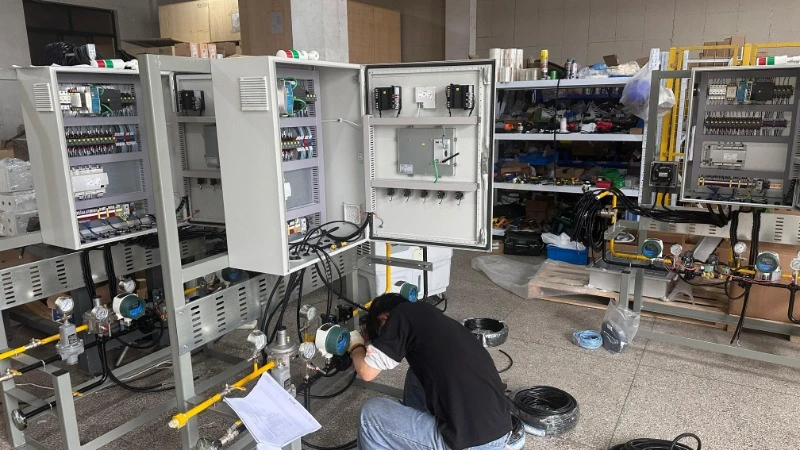
See the real workshop footage, control-panel wiring, fuel-train assemblies, and engineering drawings used for this project.
What Was Supplied for This Gypsum Board Drying Project?
This Somalia project required three industrial combustion packages for a gypsum board production line. Heatflam configured the burner systems as project-specific assemblies rather than treating the burners, controls, and fuel trains as unrelated components. The workshop scope shown in the project footage includes electrical wiring, control-system integration, control cabinets, piping, valve-train equipment, burners, and assembled structural frames.
The result is an industrial combustion solution prepared around the thermal duties identified for the project. Final burner selection and control logic for any gypsum board drying system must be based on the actual dryer arrangement, fuel conditions, airflow, temperature profile, production rate, safety requirements, and site standards.
| Project Unit | Burner Model | Rated Capacity | Integration Scope Shown |
|---|---|---|---|
| Unit 01 | BBC 2110 | 3,000,000 kcal/h | Burner, fuel train, piping, and control system |
| Unit 02 | BBC 2106 | 1,500,000 kcal/h | Burner, fuel train, piping, and control system |
| Unit 03 | BBC 2110 | 3,000,000 kcal/h | Burner, fuel train, piping, and control system |
How Does an Industrial Burner Support Gypsum Board Drying?
After wet gypsum board is formed and rough-cut, it must pass through a drying stage before finishing and shipment. The U.S. Environmental Protection Agency describes gypsum wallboard entering a multideck kiln dryer, where drying may use direct contact with hot combustion gases or indirect steam heating. This means the combustion package must be considered as part of the complete drying process rather than selected only from a nominal burner output.
An industrial burner for gypsum board drying must deliver heat in a way that matches the dryer design and the production line’s operating sequence. The engineering review normally considers how heat is introduced, how process air moves through the dryer, how temperature is controlled across drying zones, and how the burner responds when line demand changes. These factors influence burner turndown, fan and airflow coordination, valve-train configuration, ignition sequence, flame supervision, and control-panel logic.
Why Integrate the Burner, Fuel Train, and Control System?
A customized burner system connects several functions that must operate in the correct sequence. In this project, the real workshop footage shows the control cabinets, organized terminal wiring, controllers, electrical components, fuel-train assemblies, pressure instruments, valves, and piping mounted with the burner equipment.
- Burner package: provides the combustion duty selected for each dryer zone or process requirement.
- Fuel train system: conditions, isolates, regulates, and controls the fuel supply according to the confirmed fuel and site design.
- Burner control system: coordinates permissives, ignition, flame supervision, modulation, alarms, and interfaces with the production line.
- Factory assembly: allows wiring, terminal organization, component placement, and system interfaces to be reviewed before shipment.
- Commissioning support: addresses the final site-specific checks, operating sequence, combustion adjustment, and coordination with the dryer and production line.
What Was Completed Before Shipment?
The project video documents pre-shipment work at the workshop. An engineer is shown completing electrical wiring and control-panel assembly. Close-up views show terminals, controllers, protective devices, wiring ducts, and internal cabinet organization. Wider shots show the control cabinet together with the burner, valve train, pressure instruments, piping, and supporting structure.
This factory-integration stage helps define the physical and electrical interfaces before the equipment reaches the gypsum board production line. It does not replace site commissioning: installation conditions, utilities, interlocks, ventilation, process signals, and the final operating sequence still need to be checked at the project site.
What Information Is Needed to Select a Gypsum Board Drying Burner System?
For a new gypsum board drying system or a retrofit, useful selection data goes beyond a single heat-output figure. A technical enquiry should include:
- Gypsum board production rate, board dimensions, product mix, and expected moisture conditions.
- Dryer type, number of zones, temperature profile, airflow arrangement, and available installation space.
- Required heat duty for each zone, including the calculation basis and operating range.
- Fuel type, composition where relevant, inlet pressure, permitted pressure variation, and available flow.
- Power supply, plant PLC or DCS interface, modulation signal, alarm requirements, and shutdown philosophy.
- Site altitude, ambient conditions, hazardous-area classification if applicable, and required local codes or standards.
- For a retrofit: existing burner nameplate, photos, drawings, chamber dimensions, current operating issues, and available performance records.
Frequently Asked Questions
Send your fuel type and pressure, dryer layout, production rate, heat duty, temperature profile, airflow data, power supply, control interface, site conditions, and applicable standards. Heatflam can review the inputs for a project-specific burner, fuel-train, and control-system proposal.
REFERENCES AND DATA SOURCES:
- U.S. Environmental Protection Agency — AP-42, Section 11.16: Gypsum Manufacturing (July 1993; reformatted January 1995; accessed August 12, 2026).
