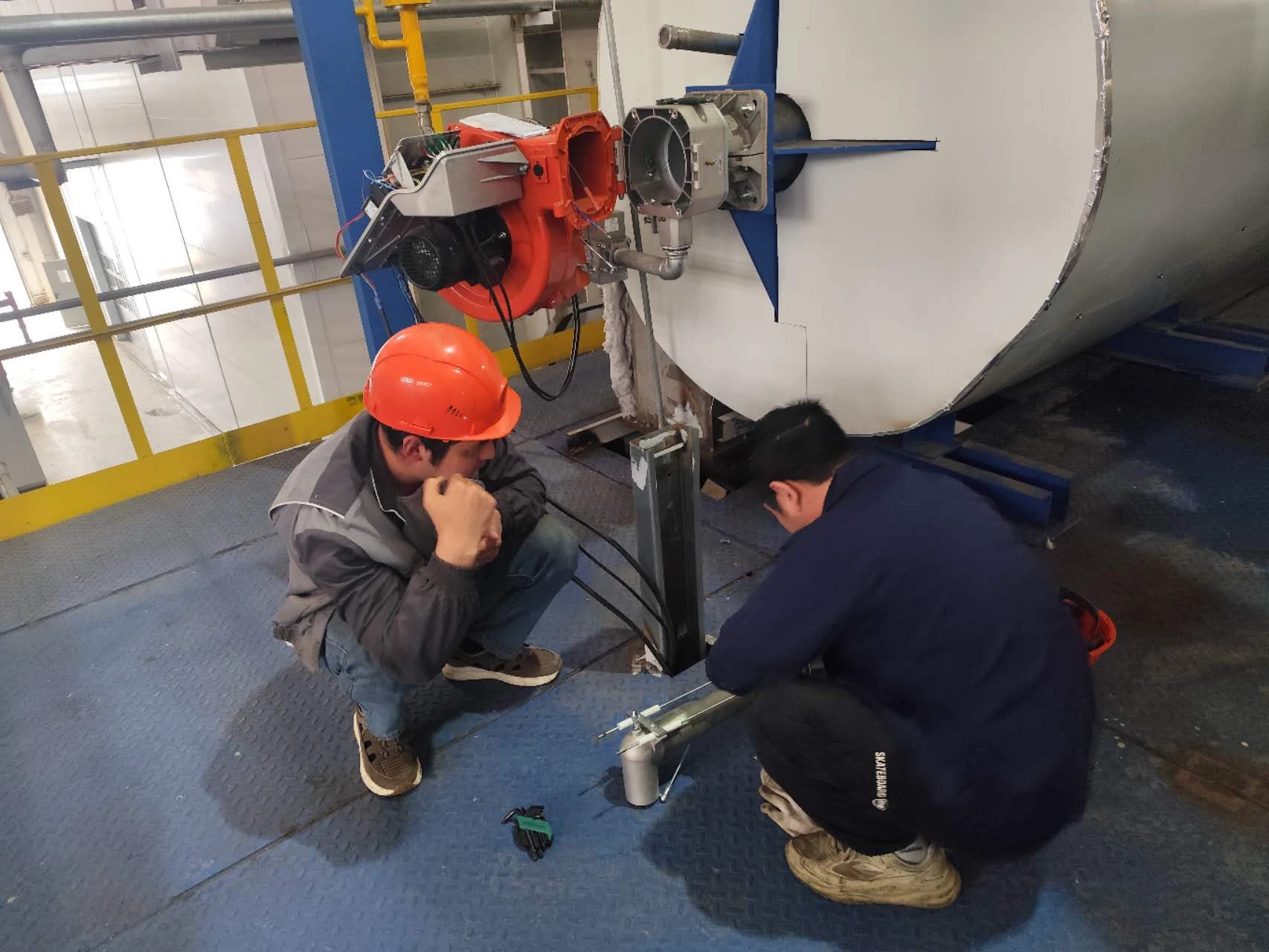
Industrial burner commissioning is the point at which individual components must operate as one coordinated process system. At this rock wool plant in Moscow, the work involved four Baltur TBG 80 LX P burners and one Baltur TBG 200 burner. The assignment was not limited to starting the burners: it connected field wiring, burner settings, control commands, furnace response, and operator understanding.
This case explains the completed burner installation and commissioning scope, the on-site issues addressed, and the operating checks used before handover. It also shows why a rock wool plant burner system should be verified at both equipment and production-line levels.
Project Overview
| Project Item | Confirmed Scope |
|---|---|
| Location | Moscow, Russia |
| Industry | Rock wool production |
| Burner configuration | 4 × Baltur TBG 80 LX P; 1 × Baltur TBG 200 |
| Engineering scope | Installation checks, startup settings, troubleshooting, training, relay modification, control integration, and functional testing |
| Verified outcome | Stable repeated ignition, stable low-fire temperature control, high-fire setpoint achieved, and remote signals functioning normally |
The models are identified here only as the equipment installed in this project. Selection for another furnace requires confirmation of the process duty, fuel, required heat output, furnace pressure, electrical supply, control method, installation geometry, and local requirements.
From Burner Installation to System Commissioning
A burner can be mechanically installed while the wider industrial combustion system is still not ready for production. Commissioning closes that gap. For this project, the burners, field terminals, temperature controls, interlocks, remote commands, and hot-air furnace interfaces had to be checked as connected parts of the same operating sequence.
The work began with wire-number verification. Each field connection was checked against its intended signal so that commands and feedback could be traced before repeated startup tests. This reduced uncertainty when diagnosing later behavior: a burner response could be evaluated against a known wiring condition instead of an assumed one.
The startup sequence then moved to ignition-position setup and high-fire-position setting. These adjustments were completed on the installed equipment under site conditions. The objective was to establish reliable ignition, controlled low-fire operation, and sufficient high-fire output for the process to reach its required temperature setpoint.
Completed Commissioning Scope
- Field wiring verification: checked on-site connections and wire numbers before functional testing.
- Ignition-position setup: established the burner position used during the ignition sequence.
- High-fire-position setting: adjusted high-fire operation for the installed furnace and required process setpoint.
- Industrial burner troubleshooting: investigated and resolved abnormal noise observed during operation.
- On-site training: demonstrated removal and reinstallation of the ignition assembly for the plant team.
- Remote burner control integration: connected and checked remote start/stop, alarm reset, and temperature-setpoint signals.
- Pressure-switch relay modification: changed the relay arrangement associated with the air-pressure switch to meet the required control logic.
Burner Control System Integration
For a production plant, local burner operation is only one layer of acceptance. The burner control system integration also has to exchange the correct commands and status signals with the wider plant control architecture. In Moscow, the team connected the remote interface and verified three functions: start/stop commands, alarm-reset commands, and the temperature-setpoint signal.
These checks were performed as functional tests, not as visual confirmation at the terminals. A command had to create the intended response, and the burner system had to remain stable while moving through the required operating states. This system-level approach is central to customized combustion-system integration, particularly when several burners serve connected sections of a production line.
Troubleshooting Under Operating Conditions
An abnormal operating sound was identified during the startup work. Rather than treating it as an isolated noise issue, the commissioning process considered it alongside burner position, mechanical installation, airflow-related behavior, and the surrounding furnace interface. The issue was resolved before the final repeated-start tests.
The pressure-switch relay change was also completed as part of the control-side correction. After modification, the relevant sequence and remote functions were tested again. This is an important distinction in industrial burner troubleshooting: a component change is not the end of the task. The complete operating sequence must be rechecked after the change.
Verified Test Results
Final acceptance focused on repeatable behavior rather than a single successful start. The completed Baltur burner commissioning work produced the following observed results:
- Ignition remained stable through repeated start-stop testing.
- Low-fire temperature control remained stable, with no observed temperature overshoot.
- High-fire operation raised the process to the required temperature setpoint.
- Remote start/stop, alarm reset, and temperature-setpoint signals functioned normally.
These results describe the tests completed at this site. They are not general performance guarantees for other furnaces or operating conditions.
What This Case Shows
For a multi-burner rock wool production line, commissioning is most useful when it follows the actual signal and energy path: confirm wiring, establish ignition, verify low-fire control, set high-fire operation, resolve abnormal behavior, integrate remote commands, and repeat the full sequence. That sequence links each hot air furnace burner to the production requirement it serves.
The Moscow project also demonstrates the value of including operator training in the handover. Showing the plant team how to remove and reinstall the ignition assembly gave them a practical reference for future inspection work without representing training as a substitute for qualified burner service.
Frequently Asked Questions
Send the application, fuel, required heat output, furnace pressure, electrical supply, control signals, installation drawings, site location, and project schedule. HEATFLAM can review the burner, controls, interfaces, and commissioning scope as one engineering package.
Baltur is referenced solely to identify the equipment used in this project. No affiliation or authorization is implied.
REFERENCES AND DATA SOURCES:
- Baltur — TBG LX P two-stage gas burner series (accessed 2026-08-06).
- HEATFLAM — Moscow rock wool plant burner commissioning video (accessed 2026-08-06).
