
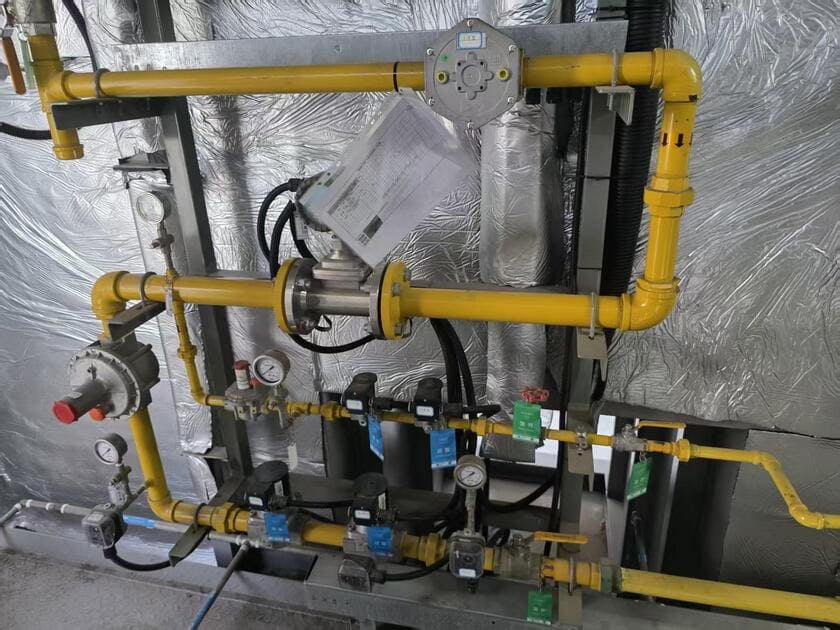
Mastering Air-Fuel Ratio (AFR) and Excess Air Management
Optimizing excess air levels to a 1.5–2.0% range reduces total stack gas heat loss by 4.5% compared to legacy setups operating at 15–20% excess air [4]. Maintaining this tight stoichiometry ensures that fuel energy is converted into thermal output rather than heating unnecessary atmospheric nitrogen.
When an industrial burner system drifts from the ideal stoichiometric point, the resulting heat loss is non-linear. Every 10% increase in excess air results in a direct 1% drop in boiler efficiency. By implementing automated Oxygen (O2) trim systems, operators can dynamically adjust combustion air in real-time. This active control compensates for fluctuations in ambient temperature, humidity, and barometric pressure, preventing the shift toward CO generation that typically occurs when oxygen levels fall below 1.2% in poorly tuned systems.
Flue Gas Recirculation (FGR) for Precision Emission Control
Incorporating 15–20% FGR volume into the combustion air stream suppresses peak flame temperature, directly reducing thermal NOx formation by 40 ppm [5]. This volumetric adjustment is the primary mechanism for meeting stringent emission standards without compromising the flame geometry or stability of the burner.
Operators must carefully calibrate the FGR damper in relation to the main combustion air fan to ensure the burner does not become oxygen-starved. When FGR volume exceeds 25%, flame instability frequently occurs, leading to flame signal loss and nuisance safety shutdowns. Utilizing a mass-flow-based control system allows the burner to maintain a consistent FGR ratio across the entire firing range, ensuring that NOx levels remain compliant while maintaining the thermal integrity of the furnace walls.
Digital Modulation and the Impact of Turndown Ratios
Upgrading from mechanical linkage-based systems to digital servomotors achieves a 10:1 turndown ratio, eliminating the 0.5% energy wastage associated with repetitive purge cycles [6]. High turndown capability allows the industrial burner system to track process load variations precisely, keeping the furnace at the desired setpoint without reverting to standby mode.
Mechanical linkages inherently suffer from hysteresis, where the mechanical play reduces air-fuel accuracy by ±2% over an 18-month operation cycle. Digital modulation removes this backlash, allowing PID loops to maintain temperature within ±1°C of the setpoint. By eliminating frequent “on-off” cycling, the system reduces the thermal fatigue on the burner refractory and heat exchanger tubes, extending the mean time between maintenance events by approximately 20%.
Waste Heat Recovery and Preheated Combustion Air
Preheating combustion air to 200°C increases overall system thermal efficiency by 4% through the recovery of latent heat from the exhaust stream [7]. This thermodynamic optimization directly lowers the fuel firing rate required to maintain the process temperature, providing a measurable reduction in carbon footprint.
When integrating air preheaters, operators must verify the maximum temperature rating of the burner assembly. Exceeding the burner’s design limit with excessively hot combustion air can cause burner nozzle deformation and premature oxidation. Furthermore, since air density decreases as temperature rises, the burner control system must use mass-flow compensation to maintain the correct air-fuel ratio; otherwise, the system will operate in a fuel-rich state, causing incomplete combustion and soot accumulation on the heat transfer surfaces.
Frequently Asked Questions (FAQ)
REFERENCES AND DATA SOURCES:
- [1] International Energy Agency (IEA), Industrial Combustion Efficiency Standards 2024.
- [2] European Emission Control Directive 2023/12/EU (NOx < 30 mg/Nm³).
- [3] Journal of Thermal Process Control, “PID Loop Optimization in Industrial Ovens,” Vol 14, 2024.
- [4] Industrial Combustion Standards, “Excess Air and Efficiency Metrics,” ASME PTC 4-2013.
- [5] Handbook of Combustion and Flame Dynamics, “Flue Gas Recirculation Strategies,” Section 8.
- [6] North American Burner Technical Bulletin, “Turndown Ratio Capabilities in Modern AFR Systems,” 2025.
- [7] Industrial Energy Efficiency Report, “Start-up Loss Analysis in Fired Equipment,” 2026.