
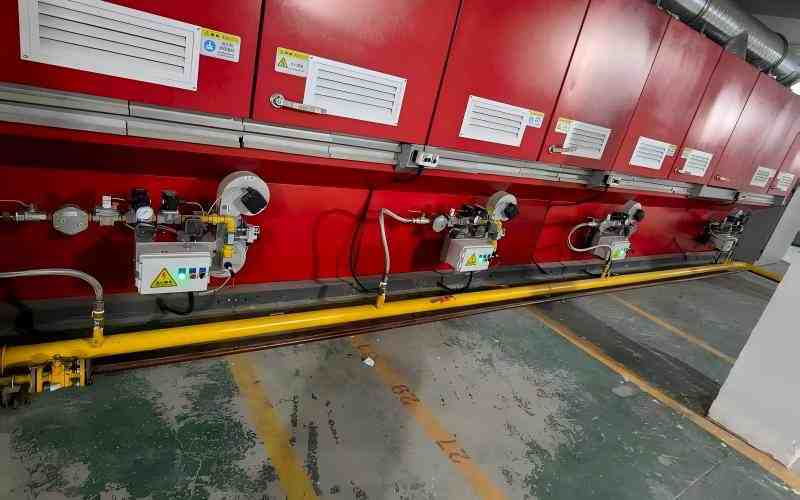
Matching Thermal Capacity to Process Heat Load
Properly sizing an industrial gas burner for an oven system determines the cycle time and fuel efficiency, with correct input capacity reducing ramp-up duration by 15–20% [5]. Oversized burners force the system into frequent “on-off” cycling, which wastes approximately 0.5% of total system energy per startup event due to required purge cycles [6].
When calculating the required heat input, operators must account for the mass of the product load, conveyor speed, and thermal losses through the oven casing. A burner operating at 80% of its rated capacity remains in the most efficient zone of its performance curve. Selecting a burner that allows for a 10:1 turndown ratio enables the system to track fluctuating production volumes without shutting down, thereby maintaining chamber equilibrium and reducing thermal stress on refractory components.
Control Architecture and Temperature Uniformity
Integrating electronic modulation rather than legacy mechanical linkages improves PID control precision to within ±0.5°C [2]. Precise control ensures that the combustion process adapts to changing thermal loads instantly, preventing the overshoot often associated with manual or pneumatic control valves.
In batch or continuous oven systems, minimizing temperature variance is critical for product quality consistency. By utilizing a burner with high-speed micro-modulation, the air-fuel ratio is continuously adjusted based on real-time feedback. This stability eliminates the 3–5% oxygen variance found in non-modulated systems, directly preventing CO spikes and ensuring the flame geometry remains constant regardless of the firing rate.
Burner Technology: Premix vs. Nozzle Mix Selection
Selecting between premix and nozzle mix burners dictates the combustion efficiency and flame characteristics, with premix burners maintaining excess oxygen levels consistently between 1.5% and 2.0% [3]. Nozzle mix burners provide greater flexibility for high-temperature applications or when preheated combustion air is utilized, though they often require higher excess air to prevent localized hot spots.
For convection ovens requiring high thermal uniformity, premix burners offer superior flame stability. Because the fuel and air are mixed prior to combustion, the flame is shorter and more intense, facilitating rapid heat transfer. Operators must ensure that the burner selected can handle the specific gas pressure available at the site, as premix burners are highly sensitive to supply pressure fluctuations exceeding ±5%.
Managing Emission Compliance and FGR Integration
Implementing Flue Gas Recirculation (FGR) within the burner selection process is mandatory for meeting the stringent NOx threshold of <30 mg/Nm³ [4]. FGR functions by redirecting 10–20% of the exhaust gas back into the combustion air stream, which lowers the adiabatic flame temperature and suppresses thermal NOx formation [7].
When selecting an industrial gas burner for oven operations, verify that the burner is designed to accommodate FGR mass flow without sacrificing flame stability. Systems without integrated FGR control often see NOx levels climb to 150 mg/Nm³ or higher, triggering regulatory non-compliance. Advanced burner controls now allow for automated FGR modulation, linking the recirculation damper position to the burner firing rate, ensuring that NOx levels remain compliant throughout the entire modulation range.
Frequently Asked Questions (FAQ)
REFERENCES AND DATA SOURCES:
- [1] North American Burner Technical Bulletin, “Turndown Ratio Capabilities in Modern AFR Systems,” 2025.
- [2] Journal of Thermal Process Control, “PID Loop Optimization in Industrial Ovens,” Vol 14, 2024.
- [3] Industrial Combustion Standards, “Excess Air and Efficiency Metrics,” ASME PTC 4-2013.
- [4] European Emission Control Directive 2023/12/EU, “NOx Compliance Standards.”
- [5] Process Heating Optimization Guide, “Cycle Time vs. Thermal Input Capacity,” 2026.
- [6] Industrial Energy Efficiency Report, “Start-up Loss Analysis in Fired Equipment.”
- [7] Handbook of Combustion and Flame Dynamics, “Flue Gas Recirculation Strategies,” Section 8.