
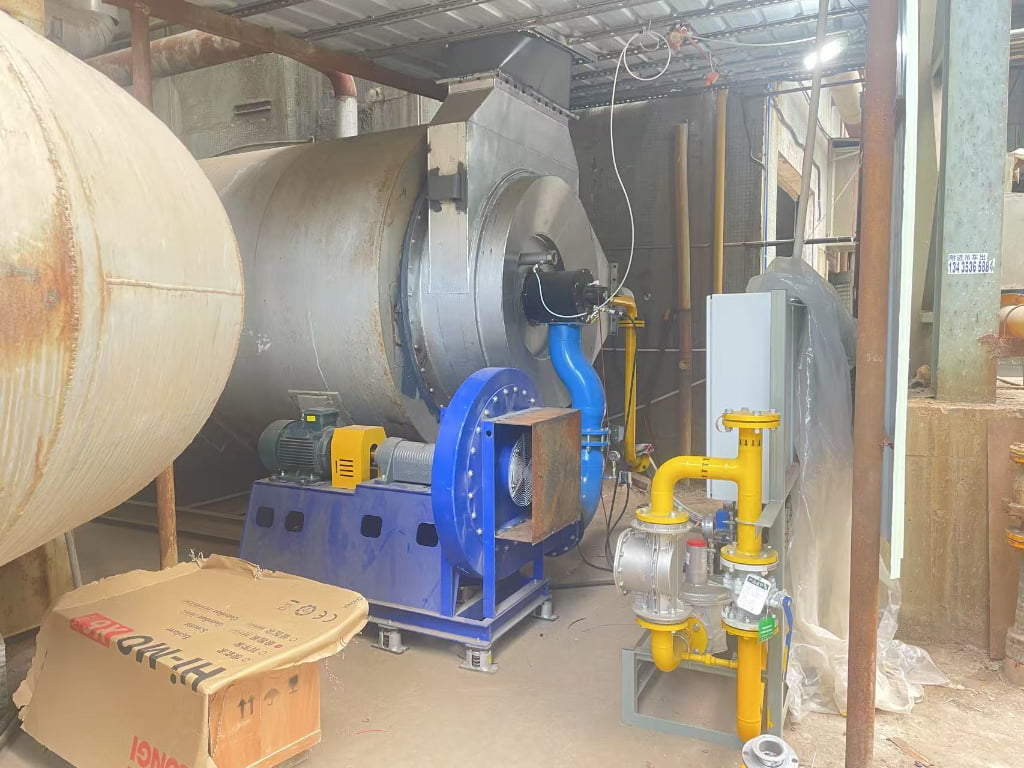
How to Choose the Right Industrial Burner for Your Boiler or Heating System
Start with Heat Load, Fuel, and Combustion Duty
A suitable industrial burner should cover 100% of the required maximum firing rate while remaining stable at the lowest expected load. If the burner cannot modulate below the process minimum, a 10:1 turndown target can reduce cycling because low fire equals about 10% of maximum input rather than 20% for a 5:1 burner [4].
For a boiler, the selection point is not only the burner capacity in kW, MW, Btu/h, or kg/h steam. It is the combination of fuel pressure, furnace volume, back pressure, draught arrangement, air density, altitude, and required steam or hot-water ramp rate. An oversized burner may meet peak output but increase purge losses, thermal cycling, and unstable low-fire operation. An undersized burner can leave the boiler below design output during winter peaks or production start-up.
For heating systems such as thermal oil heaters, drying ovens, kilns, and process air heaters, the flame shape and heat-release profile matter as much as total input. A short, intense flame can impinge on refractory or tube surfaces; a long, lazy flame may overheat the rear chamber or produce uneven temperature zones. The burner supplier should confirm the furnace geometry, allowable back pressure, required flame length, and available combustion-air temperature before final sizing.
Use Oxygen and Excess Air as Selection Criteria
For many well-designed natural-gas boiler systems, 2-3% flue-gas O2 and about 10-15% excess air are practical tuning targets when CO and flame stability remain acceptable [4]. DOE guidance also states that 10% excess air can be attainable on well-designed natural-gas systems, and that too little excess air creates unburned combustibles while too much sends heat up the stack [1].
This means the industrial burner should be selected with enough fan pressure, linkage resolution, servo accuracy, and burner-head stability to hold the air-fuel ratio through the real operating range. Lower oxygen is not automatically better. If oxygen is driven down without stable mixing, CO, soot, rumbling, flame failure, and delayed ignition risk can rise. The correct setpoint is the lowest stable excess-air level that meets OEM limits, local code, insurer requirements, emission permits, and site safety procedures.
During procurement, ask for a combustion-performance table at low, mid, and high fire. The table should list O2, CO, NOx, stack temperature, combustion efficiency, gas pressure, fan speed or damper position, and test conditions. This data is more useful than a catalog statement because it shows whether the selected burner can stay efficient outside the single best operating point.
Calculate Efficiency Impact Before Buying Hardware
DOE’s steam tip sheet gives a practical rule: boiler efficiency can increase by about 1 percentage point for each 15 percentage-point reduction in excess air or each 40 F reduction in stack-gas temperature, when other conditions are comparable [1]. If a burner upgrade lowers excess air from 30% to 15%, the expected gain is roughly 1 percentage point before site-specific losses, controls, and operating hours are considered [1].
This rule is useful for screening burner economics, but it should not replace a full heat balance. Stack temperature, feedwater temperature, boiler cleanliness, economizer performance, blowdown, and load profile can all change the result. A burner with precise air control can deliver limited value if the boiler has fouled heat-transfer surfaces or if the process runs mostly at short, intermittent loads.
For B2B procurement, compare burners using annual fuel cost rather than only purchase price. A higher-priced burner with oxygen trim, VFD fan control, and stable low-fire operation may pay back faster where the boiler runs 6,000-8,000 hours per year. A simpler burner may be more rational for standby equipment that runs fewer than 500 hours per year, provided it still meets safety and emissions requirements.
Match NOx Performance to the Permit, Not the Brochure
For new EU medium combustion plants other than engines and gas turbines, Directive (EU) 2015/2193 lists a 100 mg/Nm3 NOx emission limit for natural gas in Part 2, Table 1, subject to the directive’s scope, oxygen reference basis, exemptions, and national transposition [3]. EPA AP-42 also reports that low-NOx burners on natural-gas-fired boilers have shown NOx reductions of 40-85% relative to uncontrolled levels [2].
These numbers show why “low NOx” is not a complete specification. A burner that is acceptable for one jurisdiction, fuel, oxygen basis, or boiler size may fail another permit. The purchase specification should state the required NOx limit in mg/Nm3 or ppm, the reference oxygen basis, dry or wet basis, fuel composition, test load points, and whether the guarantee applies across the turndown range.
NOx control also interacts with efficiency and stability. Low-NOx burners reduce peak flame temperature and oxygen availability in staged combustion zones, while flue-gas recirculation dilutes the flame and can lower thermal NOx formation [2]. If the burner is pushed too far toward low flame temperature, CO or unburned hydrocarbons can increase. A balanced design gives the buyer a tested operating window, not a single lab result.
Decide Whether FGR, O2 Trim, and VFD Control Are Needed
FGR should be evaluated when the required NOx value is below the standard burner’s tested guarantee, such as a 100 mg/Nm3 natural-gas MCPD duty for new EU medium combustion plants [3]. EPA identifies two prevalent combustion NOx control techniques for natural-gas-fired boilers: low-NOx burners and flue-gas recirculation, with FGR mixing part of the stack gas back into the burner windbox before combustion [2].
O2 trim is most useful where fuel quality, ambient air temperature, barometric pressure, or load swings change the air-fuel ratio across the day. A VFD combustion-air fan can reduce electrical demand at low fire and improve control resolution compared with a fixed-speed fan and mechanical damper alone. For sites with stable load and fuel, the additional sensors and maintenance may not be justified.
Specify the control package in functional terms: target O2 range, CO trip or alarm thresholds, purge sequence, flame-safeguard type, valve-proving requirements, data logging, remote I/O, and integration with the boiler management system. This prevents a low-cost burner quote from omitting the controls needed to achieve the stated efficiency or emissions result.
Check Safety Systems Before Commercial Terms
The National Board’s boiler maintenance guidance lists daily checks that include testing low-water cutoffs for steam boilers, checking control linkage, checking for leaks, and checking burner flame, while also stating that manufacturer recommendations should be followed [5]. For buyer evaluation, this means the selected burner should support repeatable daily, weekly, monthly, and annual safety checks rather than making testing difficult after installation.
Safety review should cover the fuel train, shutoff valves, pressure switches, flame detector, purge airflow proving, ignition transformer, pilot arrangement, burner management logic, emergency stop circuit, and permissive interlocks. The acceptance test should prove that the burner shuts down on flame failure, low gas pressure, high gas pressure, low air pressure, blocked draught, and other site-specific trip conditions.
Build a Practical Procurement Checklist
A strong industrial burner RFQ should include at least 8 operating data points: maximum heat input, minimum stable heat input, fuel type and pressure, furnace pressure, target O2, allowable CO, required NOx limit, and available electrical supply. If these items are missing, vendors will quote different technical assumptions and the prices will not be comparable.
The checklist should also define responsibility. The buyer should provide boiler drawings, current combustion-test reports, fuel analysis, operating hours, load profile, emission permit, and preferred control interface. The burner supplier should provide sizing calculations, fan curves, burner performance data, safety sequence, commissioning scope, and acceptance-test criteria.
For overseas B2B purchasing, request a technical submittal before discussing final discount. The submittal should confirm the duty point, standards basis, accessory scope, packing method, commissioning support, documentation language, and spare-parts availability. This reduces the risk of receiving a burner that fits the flange but fails the process, permit, or maintenance requirement.
Frequently Asked Questions (FAQ)
REFERENCES AND DATA SOURCES:
- U.S. Department of Energy / National Renewable Energy Laboratory, “Improve Your Boiler’s Combustion Efficiency: Office of Industrial Technologies Steam Energy Tips No. 4,” OSTI program document, supports excess-air, stack-temperature, O2/CO, and 1% efficiency rule-of-thumb data.
- U.S. Environmental Protection Agency, “AP-42: Compilation of Air Emissions Factors from Stationary Sources,” Chapter 1 external combustion sources, supports natural-gas boiler NOx control methods and low-NOx burner reduction ranges.
- EUR-Lex, “Directive (EU) 2015/2193 on the limitation of emissions of certain pollutants into the air from medium combustion plants,” official HTML legal text, supports EU MCPD scope and NOx emission-limit values.
- U.S. Department of Energy, “Upgrade Boilers with Energy-Efficient Burners,” Steam Tip Sheet PDF, direct file link used because the DOE public tip-sheet source is available as a hosted PDF and supports 2-3% O2, 10-15% excess air, and common gas-burner turndown ratios.
- The National Board of Boiler and Pressure Vessel Inspectors, “Suggested Daily, Weekly, Monthly, Semi-Annual, and Annual Boiler Maintenance,” public guidance, supports burner flame, control linkage, low-water cutoff, and maintenance-frequency checks.