
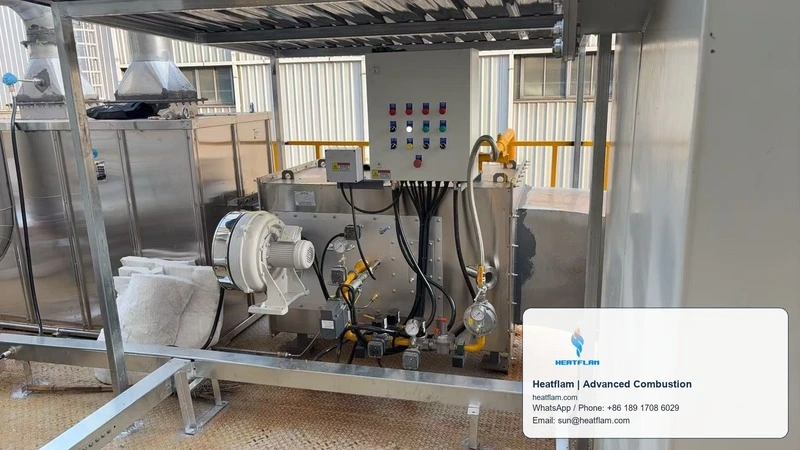
Low NOx Burner Retrofit Guide for Industrial Boilers and Furnaces
Why a Low NOx Burner Retrofit Starts With Baseline Testing
A credible Low NOx Burner retrofit starts with measured baseline NOx, O2, CO, excess air, stack temperature, load, and fuel data from at least low, normal, and high firing conditions. For many well-designed natural-gas boiler systems, about 10% excess air is attainable, while excessive air increases flue-gas mass flow and stack heat loss [1].
Baseline testing matters because a retrofit is not only a burner swap. The existing furnace geometry, refractory condition, burner throat, register pressure drop, draft control, fuel pressure stability, combustion air temperature, and boiler heat-transfer surfaces all affect final emissions and efficiency. If the starting point is unknown, a supplier may quote a burner that can meet a laboratory rating but fails to meet the plant’s field permit condition.
The baseline package should include:
- NOx and CO at operating load: Record ppm or mg/Nm3, correction oxygen basis, fuel, load, and stack O2.
- O2 and excess air: Record whether the current system runs near 10-15% excess air or far above it under normal load.
- Stack temperature: Record stable values and compare them with heat-recovery, corrosion, and draft constraints.
- Control repeatability: Record whether the burner repeats the same O2 and CO after load changes.
- Physical constraints: Check windbox pressure, burner tile condition, flame scanner sighting, furnace draft, and available FGR duct routing.
Retrofit Targets: NOx, O2, CO, and Efficiency Must Be Treated Together
Low NOx burners on natural-gas-fired boilers have shown NOx reductions of 40-85% relative to uncontrolled levels in EPA AP-42 data [2]. Boiler efficiency can often improve by about 1 percentage point for each 15 percentage-point reduction in excess air or each 40 degrees F reduction in stack gas temperature, when other conditions are comparable [1].
Those two numbers explain why retrofit specifications should not chase NOx alone. A staged-flame burner lowers peak flame temperature and oxygen availability in the hottest reaction zone, which suppresses thermal NOx. However, if the burner is pushed too far toward fuel-rich operation, CO can rise, flame stability can weaken, and unburned fuel risk can increase.
For a practical industrial specification, define acceptance targets as a combined envelope:
- NOx target: State ppm or mg/Nm3, dry or wet basis, reference O2, fuel type, and load range.
- O2 target: Avoid a single lowest-O2 target; define an acceptable range that keeps CO and flame stability inside limits.
- CO limit: State the maximum allowable CO at each load point, not only at full fire.
- Efficiency target: Link excess-air reduction and stack-temperature management to fuel savings.
- Operating range: Require proof at turndown, normal production load, and maximum continuous rating.
Burner Selection: Match the Flame to the Furnace, Not Just the Nameplate
A 40-85% NOx reduction range is technically possible for low-NOx staged-air or staged-fuel burners, but the achievable result depends on furnace residence time, heat-release density, excess air, fuel nitrogen, and load profile [2]. For flue gas recirculation, 10-30% of exhaust gas may be recycled in some boiler designs, with roughly 40-50% NOx reduction possible at 20-30% recirculation in gas- and oil-fired boilers under suitable conditions [6].
The burner must fit the combustion chamber. A flame that is acceptable in a large water-tube boiler can impinge on tubes in a compact firetube boiler or overheat refractory in a furnace vestibule. A kiln, dryer, thermal oil heater, annealing furnace, and steam boiler may all burn natural gas, but they do not share the same furnace aerodynamics.
Key engineering checks include:
- Heat release and flame length: Confirm that the low-NOx flame does not hit tubes, refractory, product, or furnace walls.
- Turndown ratio: A 10:1 turndown ratio can help avoid purge-and-restart cycles, but it must be proven with stable O2 and CO at minimum fire.
- Draft and pressure drop: Low-NOx registers, swirlers, and FGR mixers can require higher fan margin.
- Fuel flexibility: Natural gas, LPG, diesel, heavy oil, and mixed process gas require different burner heads and control logic.
- Maintenance access: Staged fuel tips, air registers, FGR dampers, and scanners need inspection access after installation.
When existing fans, fuel trains, or burner management systems are undersized, the retrofit scope should include them. A burner that meets emissions at the factory but starves for air or gas pressure on site will not meet acceptance tests reliably.
Controls and FGR: The Retrofit Is a Combustion System Upgrade
Electronic ratio control can hold O2 within a narrower operating band than worn mechanical linkages, while FGR rates above about 20-30% require careful flame-stability verification [6]. Excess air above the combustion requirement dilutes hot gas, lowers flame temperature, and increases exhaust mass flow, which reduces efficiency if the additional air is not needed for complete combustion [5].
For many retrofit projects, the controls package determines whether the Low NOx Burner performs consistently after commissioning. Mechanical jackshafts can drift with linkage wear, temperature, and operator adjustment. Modern systems commonly use servo-driven fuel and air actuators, O2 trim, VFD combustion air fans, FGR damper feedback, and data logging.
FGR can be internal, external, or a combination of both. It reduces peak flame temperature by mixing inert flue gas with combustion air or fuel-air zones. However, more FGR is not automatically better. Excessive FGR can destabilize flame, raise CO, delay ignition, reduce turndown, and create cold-end condensation problems if stack temperature is not managed.
A robust control scope should define:
- Purge and light-off logic: Verify purge airflow, ignition timing, pilot reliability, and flame-safeguard response.
- O2 trim authority: Limit trim range so the controller cannot mask mechanical faults.
- FGR interlocks: Prove damper position, fan status, and minimum temperature constraints before enabling high FGR.
- Load-change response: Test O2, CO, flame signal, and draft stability during ramp-up and ramp-down.
- Data retention: Record combustion values during commissioning and use them as the operating baseline.
Compliance Planning: Permit Limits Must Be Converted Into Test Conditions
For new EU medium combustion plants other than engines and gas turbines, Directive (EU) 2015/2193 lists a NOx limit of 100 mg/Nm3 for natural gas and 200 mg/Nm3 for gaseous fuels other than natural gas, under the directive’s stated reference conditions [3]. In the United States, EPA AP-42 documents low-NOx burner mechanisms and observed reduction ranges, but final enforceable limits are set by federal, state, local, and permit-specific requirements [2].
This distinction is important for B2B purchasing. A catalog statement such as “30 ppm NOx” or “ultra-low NOx” is not enough unless the oxygen correction, fuel, load, furnace type, altitude, ambient conditions, and test method are stated. A permit may require an emissions value corrected to 3% O2, 15% O2, or another basis depending on jurisdiction and equipment category.
Before issuing a purchase order, convert the permit requirement into a supplier acceptance table:
- Pollutant: NOx as NO2, CO, O2, and any local VOC or particulate requirement.
- Unit basis: ppmvd, mg/Nm3, dry basis, wet basis, reference O2, and averaging period.
- Operating points: Minimum stable fire, normal load, maximum load, and process-specific high-temperature conditions.
- Test method: Local stack-test method, analyzer calibration gas, sample location, and data averaging.
- Guarantee boundary: Identify whether the guarantee covers burner only, burner plus controls, or full combustion system.
If the plant sells into regulated markets or operates under a strict air permit, the contract should require supplier support during third-party emissions testing and define retest responsibility if CO, NOx, or flame stability fails.
Installation and Commissioning: Acceptance Is a Measured Envelope
Commissioning should verify NOx, CO, O2, stack temperature, flame signal, draft, and safety trips at no fewer than three load points. EPA boiler tune-up guidance emphasizes measuring oxygen, carbon monoxide, stack temperature, and operating conditions during combustion optimization, rather than relying only on visual flame judgment [4].
The commissioning plan should be written before the shutdown begins. A retrofit outage typically includes burner removal, tile or throat repair, fan or duct modification, fuel-train changes, control panel work, cable testing, purge verification, ignition testing, cold checks, hot tuning, and emissions runs. Compressing all decisions into the startup day increases risk.
Use an acceptance matrix with numeric values:
- Low fire: Stable ignition, no flameout, acceptable scanner signal, CO below the project limit, and O2 inside the agreed range.
- Mid fire: Verified ratio curve, stable furnace pressure, repeatable O2, and emissions near the expected operating target.
- High fire: Full-load NOx and CO at permit-relevant conditions, no flame impingement, and acceptable stack temperature.
- Load transitions: No unsafe draft swing, flame failure, CO spike beyond the agreed transient limit, or actuator hunting.
- Safety checks: Prove low gas pressure, high gas pressure, fan failure, flame failure, purge, and emergency stop functions.
Commercial Evaluation: ROI Should Include Fuel, Compliance, and Downtime Risk
A 1 percentage-point boiler-efficiency improvement can be economically material on a plant operating 6,000-8,000 hours per year, especially when fuel use is high [1]. A Low NOx Burner retrofit should therefore be evaluated with fuel savings, emissions compliance, maintenance labor, avoided penalties, and production downtime in the same model.
For procurement teams, the lowest burner price is often not the lowest project cost. If the quote excludes fan upgrades, FGR ducting, stack testing, controls integration, burner management interface, refractory repair, or commissioning days, the project can exceed budget after installation begins.
Ask each supplier to provide:
- Scope boundary: Burner, fuel train, fan, FGR, controls, flame safeguard, field wiring, refractory, and commissioning.
- Performance guarantee: NOx, CO, O2, turndown, capacity, pressure drop, and applicable fuel.
- Site requirements: Minimum gas pressure, combustion air temperature range, fan static pressure, and stack draft.
- Downtime plan: Required outage days, hot commissioning sequence, and contingency time.
- Measurement plan: Instruments, calibration, test points, report format, and responsibility for third-party testing.
The decision should be based on verified lifecycle value. In B2B boiler and furnace retrofits, reliable operation, permit compliance, fuel reduction, and service response usually matter more than a single advertised NOx number.
Frequently Asked Questions (FAQ)
REFERENCES AND DATA SOURCES:
- U.S. Department of Energy, “Improve Your Boiler’s Combustion Efficiency,” Steam Tip Sheet, states that 10% excess air is attainable on well-designed natural-gas systems and that boiler efficiency can rise by about 1% for each 15% excess-air reduction or 40 degrees F stack-temperature reduction.
- U.S. Environmental Protection Agency, AP-42 Section 1.4, “Natural Gas Combustion,” documents staged low-NOx burner mechanisms and observed 40-85% NOx reductions for natural-gas-fired boilers.
- Directive (EU) 2015/2193 of the European Parliament and of the Council, Medium Combustion Plant Directive, lists emission limit values for medium combustion plants including NOx limits for natural gas and other gaseous fuels.
- U.S. Environmental Protection Agency, “Boiler Tune-up Guide,” discusses combustion optimization measurements including oxygen, carbon monoxide, stack temperature, and boiler operating conditions.
- ACEEE Summer Study paper, “Common Boiler Excess Air Trends and Strategies to Optimize Efficiency,” explains that excess air dilutes combustion gas, lowers temperature, and decreases efficiency.
- U.S. EPA Air Pollution Training Institute, “Control of Nitrogen Oxides Emissions,” Chapter 6, describes flue gas recirculation for boilers, including 10-30% recirculation and possible 40-50% NOx reduction at 20-30% recirculation for suitable gas- and oil-fired boilers.