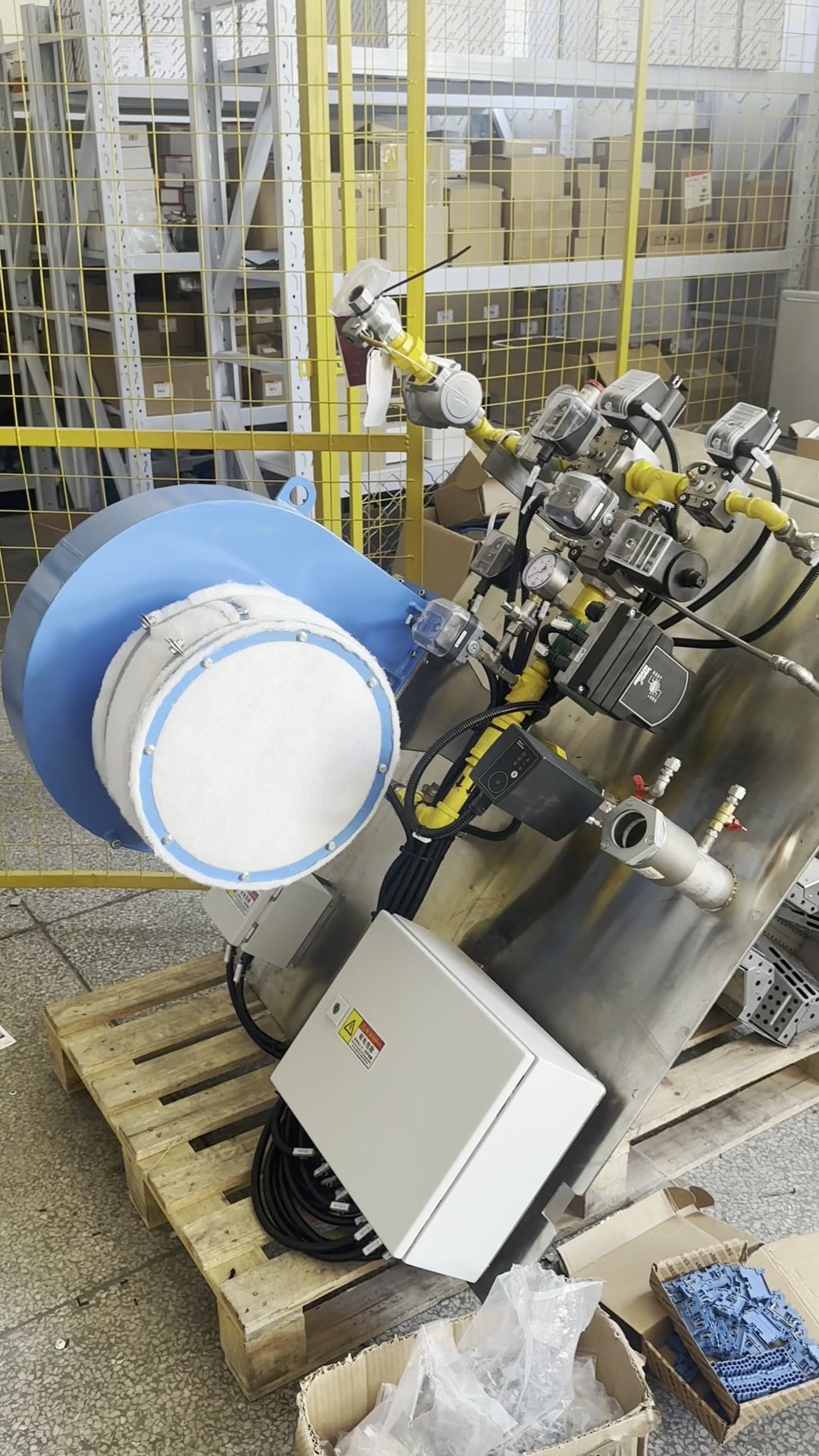
What Is an Industrial Burner Valve Train?
An industrial burner valve train is the fuel-side assembly that sits between a gas or oil supply and the burner. It may be supplied as individual field-installed components, a piped assembly, or a skid. In practical terms, it creates a managed fuel route that can be isolated, filtered, regulated, monitored, modulated, and automatically closed when the combustion safeguard detects an unsafe condition.
For a combustion system, the valve train must work together with the burner management system, combustion-air equipment, flame detection, ignition sequence, and process controls. A valve train alone does not make a burner system safe; its protective functions depend on correct design, installation, commissioning, testing, and maintenance.
Typical Gas Valve Train Components and Their Functions
The exact sequence varies by application. A common industrial gas train may include the following functions:
| Component or function | Purpose in the fuel path |
|---|---|
| Manual shutoff valve | Provides a positive, manually operated means to isolate the fuel supply for emergency response, service, or planned shutdown. |
| Gas filter or strainer | Helps keep particulate contamination away from regulators, solenoid valves, and burner components. |
| Pressure regulator | Reduces and maintains pressure within the burner system’s required operating range. |
| High- and low-gas-pressure switches | Signal the combustion safeguard when gas pressure is outside the approved operating window. |
| Automatic safety shutoff valves | Close the fuel path automatically on a safety trip, such as flame failure, ignition failure, air failure, or a fault detected by the burner management system. |
| Valve-proving or leak-test function | Where required, checks whether safety shutoff valves are sealing as intended before a firing sequence proceeds. |
| Modulating control valve | Adjusts fuel flow to match the firing-rate demand while coordinating with combustion-air control. |
How an Oil Valve Train Differs
Oil-fired systems use the same basic safety objective—controlled delivery and reliable shutoff—but the fuel-handling arrangement is different. Depending on the fuel grade and burner design, an oil system can include supply and return piping, isolation valves, filters, pumps, pressure-regulating or pressure-relief functions, flow-control valves, safety shutoff valves, and, for heavier fuels, heating and temperature-control equipment.
Fuel viscosity, temperature, contamination, supply pressure, return-line conditions, and atomization method all affect selection. A gas valve train layout should therefore not be copied directly to an oil installation. Dual-fuel systems require additional sequencing so that the inactive fuel is positively isolated and the transition logic is defined by the approved burner-control design.
The Safety Functions That Matter Most
- Emergency fuel isolation: A readily accessible manual shutoff function allows the fuel supply to be isolated independently of automatic controls.
- Automatic fuel cutoff: Safety shutoff valves close when the burner management system identifies a trip condition.
- Flame-failure response: If flame is not proven or is lost during operation, the fuel path must be shut down according to the applicable safety sequence.
- Combustion-air interlock: A loss of combustion air can require fuel shutoff, because proper air flow is part of a stable and safe combustion condition.
- Pressure supervision: Pressure switches help prevent firing when available fuel pressure is too low or too high for the approved operating range.
- Purge and restart discipline: The control system must follow the approved purge, ignition, flame-proving, lockout, and reset sequence before fuel is admitted to the main burner.
Why Double Block and Bleed May Be Used
In applications that require a higher level of fuel isolation, a gas train may use two automatic safety shutoff valves in series with a bleed or vent connection between them. This arrangement is commonly described as double block and bleed. Its purpose is to reduce the likelihood of fuel passing to the burner through a single leaking shutoff valve and to provide a defined route for the inter-valve space.
An OSHA investigation of a boiler explosion identified the absence of a double-block-and-bleed arrangement as one of several control deficiencies. That finding should not be read as a universal design prescription: whether this arrangement is required depends on the process hazard assessment, applicable standards, jurisdiction, and approved combustion-system design.
What to Confirm Before Selecting a Valve Train
A valve train should be selected from a verified operating basis, not only from pipe size or burner capacity. Before engineering a gas, oil, or dual-fuel train, confirm:
- Fuel type and composition, including whether the supply is natural gas, LPG, diesel, fuel oil, or another approved fuel.
- Required burner heat input, turndown, firing method, and operating cycle.
- Minimum and maximum available supply pressure, plus allowable pressure drop.
- Burner model, combustion-air arrangement, ignition system, flame detector, and burner management system.
- Applicable local code, customer specification, hazardous-area requirements, and approval/listing requirements.
- Installation space, pipe routing, vent routing, access for inspection, and maintenance isolation requirements.
For projects requiring burner selection, fuel-train design, controls, and field integration, Heatflam can support customized industrial combustion-system integration based on the confirmed fuel, process, control, and installation conditions.
Frequently Asked Questions
Send the fuel type, burner model, required heat input, supply pressure, control requirements, and installation drawing for an engineering review.
REFERENCES AND DATA SOURCES:
- U.S. Occupational Safety and Health Administration, 29 CFR 1910.263 — Bakery Equipment. Referenced for selected industrial-oven fuel shutoff, air-failure, ignition-failure, and flame-failure safeguards; accessed July 27, 2026.
- U.S. Occupational Safety and Health Administration, Technical Information Bulletin: Boiler Explosion. Referenced for investigation observations concerning combustion controls and double block and bleed; accessed July 27, 2026.
- U.S. Occupational Safety and Health Administration, Technical Manual. Referenced for the importance of purging and unit-specific startup/emergency procedures; accessed July 27, 2026.
