
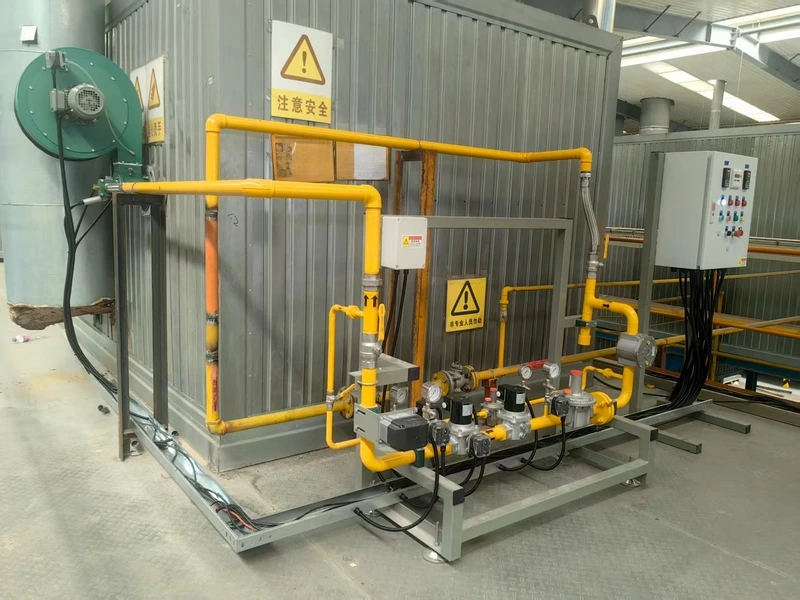
Combustion System Troubleshooting: Common Burner Problems and Solutions
Root-Cause Diagnosis
Burner troubleshooting usually finds root causes in air-fuel ratio, flame proving, ignition energy, fuel pressure, draft, or controls repeatability. For natural-gas boiler service, about 10% excess air may be attainable on well-designed systems, but lower O2 is acceptable only when CO, flame stability, OEM limits, and permit basis remain compliant [1].
Field Troubleshooting Priorities
- If excess air is high: Compare O2 and stack temperature because each 15 percentage-point excess-air reduction or 40°F stack-temperature reduction may recover about 1 efficiency point under comparable conditions [1].
- If flame fails during trial: Verify purge, pilot, scanner signal, and safety shut-off valve closure because the example sequence requires at least four air changes before ignition [4].
- If NOx is over target: Confirm burner type and FGR operation because low-NOx burners with FGR can reduce NOx by 60% to 90% only when stable flame is maintained [2].
- If EU permit compliance is involved: Check the plant category because new natural-gas medium combustion plants other than engines and turbines list 100 mg/Nm3 NOx in Directive (EU) 2015/2193 [3].
- If low-fire trips repeat: Compare minimum input with turndown because a 10:1 boiler turndown means operation at 10% of full capacity at minimum fire [5].
Start With Measurements
Well-tuned natural-gas boiler systems can often reach about 10% excess air, while too little excess air can create CO, soot, smoke, and unburned fuel risk [1]. A useful efficiency rule is about 1 percentage point gain for each 15 percentage-point reduction in excess air or each 40°F reduction in stack gas temperature, when other conditions remain comparable [1].
This makes flue-gas oxygen, stack temperature, CO trend, firing rate, draft, and fuel pressure the first checks in burner troubleshooting. Do not treat lower oxygen as automatically better. The stable point is the lowest practical excess-air level that still maintains complete combustion, reliable light-off, permitted emissions, and OEM-approved flame stability.
Diagnose Flame Failure
Flame failure is a safety event, not just a nuisance trip; the flame safeguard must shut fuel valves when the flame is not proven during the timed ignition or main-flame sequence [4]. Public boiler-safety guidance describes pre-purge, air-flow proving, pilot ignition, main safety shut-off valve operation, and a flame-failure proof test using actual fuel pressure while preventing main-burner firing [4].
Common causes include dirty or misaligned flame scanners, weak pilot flame, unstable pilot gas pressure, grounding faults, poor scanner sighting, refractory glow interference, or a flame that lifts off during transition from pilot to main. The solution is not to bypass the flame safeguard. Verify the scanner signal, pilot stability, purge sequence, safety shut-off valve closure, and OEM trial-for-ignition timing.
Fix Ignition Failure
Ignition failure should be isolated within the first trial-for-ignition cycle, before repeated resets mask the real cause or load the furnace with unburned fuel. Pre-purge guidance for fuel-fired equipment commonly requires programmed air changes before pilot ignition, and National Board guidance describes at least four air changes for the example flame-safeguard sequence [4].
Check for spark strength, electrode gap, ignition transformer output, pilot regulator setting, pilot orifice blockage, fuel pressure at light-off, air damper position, and pilot-to-main flame carryover. On oil burners, add atomizing pressure, oil viscosity, nozzle condition, and combustion-air temperature to the list.
Correct Instability
Unstable combustion often appears when the air-fuel ratio, draft, FGR rate, or minimum firing rate moves outside the burner envelope. EPA AP-42 states that FGR reduces NOx mainly by lowering flame temperature and partly by reducing oxygen concentration in the primary flame zone, but it also requires burners capable of stable flame with added inert gas [2].
Do not tune for NOx alone. Low-NOx burners have documented NOx reductions of 40% to 85%, and low-NOx burners combined with FGR can reduce NOx by 60% to 90%, but poor application can increase CO or destabilize flame [2].
Check Permit Basis
For new medium combustion plants in the EU, Directive (EU) 2015/2193 lists a NOx limit of 100 mg/Nm3 for natural-gas plants other than engines and gas turbines, while new natural-gas engines list 95 mg/Nm3 and new natural-gas gas turbines list 50 mg/Nm3 under the directive tables [3]. These figures are regulatory reference values, not universal burner acceptance limits, and oxygen basis, load condition, plant type, dates, and national implementation must be confirmed [3].
Burner troubleshooting must therefore connect field symptoms to the permit basis. A flame that is stable at 4% to 6% O2 may still fail a NOx guarantee, while a low-O2 setting that helps efficiency can raise CO risk if mixing is poor. For retrofit projects, confirm whether the target is combustion stability, fuel savings, NOx reduction, CO compliance, process temperature uniformity, or all four.
Before Replacing the System
- Application fit: Confirm burner type, fuel, chamber pressure, process temperature, load profile, and required turndown before treating flame failure as a hardware-selection problem.
- Limits: Do not apply FGR, low-O2 tuning, or higher turndown unless the burner, fan, controls, scanner, and furnace geometry are approved for that operating range.
- Operational risks: Watch CO rise, flame instability, high stack temperature, NOx permit basis, fuel-train faults, downtime exposure, and control-loop interaction.
- Required confirmation: Request OEM manuals, local code checks, permit conditions, insurer requirements, site-engineer approval, and a combustion commissioning report before purchase or retrofit.
Terms That Affect Diagnosis
- Industrial burner: A fuel-firing device used in boilers, furnaces, kilns, dryers, ovens, and thermal oil heaters; diagnosis depends on the process chamber and control method.
- Flue-gas O2: A combustion indicator used to estimate excess air and mixing quality, but it must be evaluated together with CO, flame signal, and stack temperature.
- Flame safeguard: A safety control that supervises purge, pilot, main flame, and fuel shut-off valve action during start-up and flame-failure events.
- FGR: Flue gas recirculation returns a portion of exhaust gas to the combustion air stream to reduce flame temperature and thermal NOx formation.
- Turndown ratio: The ratio between maximum and minimum stable firing rate; a 10:1 ratio means 10% of full capacity at low fire.
- NOx basis: A regulatory or guarantee condition stated by plant type, fuel, load, reference oxygen, dry gas basis, and jurisdiction.
Verified Troubleshooting Data
| Issue | Condition | Value | Evidence | Action |
|---|---|---|---|---|
| Excess air | Well-designed natural-gas boiler | About 10% excess air | DOE/NREL combustion efficiency guidance [1] | Measure O2, CO, and stack temperature before reducing air. |
| Stack loss | Comparable boiler conditions | 1% efficiency per 15% excess-air or 40°F stack-temperature reduction | DOE/NREL rule of thumb [1] | Tune only after load, draft, and CO are stable. |
| NOx control | Low-NOx burner plus FGR | 60% to 90% NOx reduction | EPA AP-42 natural gas combustion chapter [2] | Verify FGR rate, flame stability, and CO trend. |
| Flame failure | Pre-purge and flame-safeguard test | At least four air changes in cited example | National Board public testing guidance [4] | Confirm purge timing, airflow proving, scanner signal, and valve closure. |
| EU NOx limit | New natural-gas medium plant, not engine or gas turbine | 100 mg/Nm3 NOx | Directive (EU) 2015/2193 Annex II [3] | Confirm jurisdiction, oxygen basis, fuel, date, and plant category. |
| Turndown mismatch | Boiler or burner firing below stable low fire | 10:1 equals 10% of full capacity | U.S. Boiler turndown explainer [5] | Compare actual low-fire input with the approved burner data sheet. |
Practical Workflow
A defensible service workflow should reduce repeat trips within 1 to 2 test cycles by separating safety interlocks, ignition, flame proving, combustion tuning, and load-control faults. For most burner troubleshooting cases, the first pass should capture at least six readings: O2, CO, stack temperature, fuel pressure, draft or chamber pressure, and flame signal.
Use the alarm history to sort faults by sequence. Pre-purge failure points to airflow proving, pressure switches, fan status, or damper position. Pilot failure points to ignition energy, pilot fuel, air setting, or flame detection. Main flame failure points to fuel-valve operation, scanner sighting, main flame carryover, or unstable air-fuel ratio.
Frequently Asked Questions
REFERENCES AND DATA SOURCES:
- National Renewable Energy Laboratory / U.S. Department of Energy, “Improve Your Boiler’s Combustion Efficiency: Office of Industrial Technologies Steam Energy Tips No. 4,” OSTI record, supports excess-air, stack-temperature, oxygen, CO, and boiler-efficiency relationships.
- U.S. Environmental Protection Agency, “AP-42 Compilation of Air Emissions Factors from Stationary Sources,” technical emissions resource, supports FGR, low-NOx burner, thermal NOx, and NOx-reduction ranges in Section 1.4.
- European Union, “Directive (EU) 2015/2193 on the limitation of emissions of certain pollutants into the air from medium combustion plants,” official legal text, supports applicability dates and NOx emission limit values for medium combustion plants.
- The National Board of Boiler and Pressure Vessel Inspectors, public boiler fuel-train and flame-safeguard testing guidance, supports pre-purge, pilot proving, safety shut-off valve, and flame-failure test concepts.
- U.S. Boiler Company, “What Does Boiler Turndown Ratio Mean?,” technical explainer, supports the definition and practical meaning of 5:1 and 10:1 boiler turndown ratios.