
What does this Denmark aquafeed drying project include?
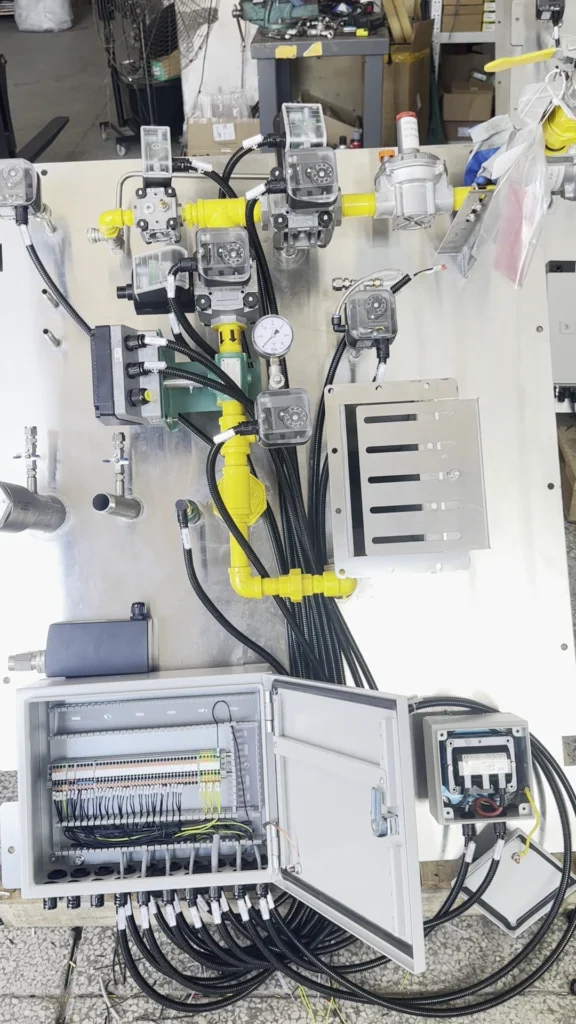
The project comprises six CAH160 systems for aquafeed drying in Denmark. This video concentrates on one assembly, moving from an overall view to the junction box, cable routing, gas pipework, pressure instruments and burner nameplate.
For a buyer reviewing an aquafeed drying burner system, these views help establish what is physically included and how the components are arranged. The video is an equipment close-up; it does not document shipment, commissioning or dryer performance.
What does the CAH160 burner system wiring show?
The open junction box reveals terminal rows, labelled wiring and the way cables enter and leave the enclosure. The CAH160 burner system wiring close-ups make these physical details easier to review than an overall equipment photograph.
For procurement and engineering review, use these views alongside the electrical drawings and terminal schedule. Useful checks include:
- Identification: Do wire markers and terminal references correspond to the drawings?
- Interfaces: Which power, control and field connections belong to the burner assembly, and which belong to the dryer or site?
- Access: Can the planned installation leave room to inspect terminals and service cable entries?
These are review questions for the project documentation. A photograph alone cannot establish electrical conformity or verify a control sequence.
What should buyers review in the CAH160 gas piping?
The CAH160 gas piping views show the pipework, round pressure instruments and the relationship between piping and adjacent components. The layout provides a useful starting point for discussing connection locations and maintenance access.
Before finalizing an assembly, request the piping and instrumentation diagram, the available gas supply conditions, and the required connection details. Confirm instrument ranges and component settings from the applicable documents rather than reading them into a general view. Site space and access requirements should be reviewed against the installation layout.
Which industrial burner components are included?
The assembly includes products from Honeywell, DUNGS, Eclipse and Kromschröder. The video places these industrial burner components in the context of the complete assembly: wiring, gas piping, instruments and the burner are shown as connected parts of a system.
Brand names identify the products included; they do not establish that every product from those brands is interchangeable. Component selection still depends on the actual model, duty and interfaces. Explore HEATFLAM’s industrial burners and combustion-system products when discussing the required assembly scope.
What does the CAH160 burner nameplate specify?
The nameplate on the pictured burner provides three key identification details:
| Nameplate field | Marked value | Meaning |
|---|---|---|
| Model | CAH160 | Identification of the pictured burner |
| Fuel | Natural Gas (N.G) | Fuel marked on the nameplate |
| Maximum rating | 586 kW | Maximum rating of the pictured burner |
For model-family background, the Eclipse CAH data sheet includes a “160 CAH” catalog entry. The values above reproduce the pictured unit’s nameplate; catalog information does not replace the project-specific equipment record.
How does combustion system integration support aquafeed drying?
HEATFLAM supports burner selection, combustion system integration and project-specific engineering. The task is to connect the selected burner, piping, instruments and electrical interfaces to the requirements of the drying process. See HEATFLAM’s combustion engineering solutions and industrial drying applications for the broader application context.
The U.S. Department of Energy distinguishes direct and indirect fuel-fired process heating: combustion gases contact the material in direct heating, while a separating surface keeps them apart in indirect heating. A drying enquiry should therefore define the intended heat-transfer arrangement; the component close-up does not establish that process configuration.
FAO’s aquaculture feed guidance distinguishes dry and moist feed forms and discusses their handling and storage characteristics. For equipment selection, specify the actual feed product and moisture targets instead of treating burner power as a stand-alone measure of drying capacity.
To start a technical discussion, provide the feed throughput and inlet/target moisture, required process-air temperatures and airflow, available fuel and supply conditions, installation space, electrical supply and control-interface requirements. This gives the integration review a defined process basis.
What company credentials are shown?
The video also presents HEATFLAM’s Honeywell authorized distributor status and ISO 9001:2015 quality management system certification. These credentials concern the company and the scope stated on the respective certificates.
ISO explains quality management systems in terms of organizational processes, responsibilities and consistent delivery. The ISO certificate should therefore be read as a quality management credential, not as certification of this individual burner. The Honeywell distributor certificate does not imply authorization from the other component brands or joint product development.
Frequently Asked Questions
Does the video show all six systems?
Is 586 kW the power of the complete project?
Can a component be replaced using its brand name alone?
Does the close-up prove drying output or successful commissioning?
What should I send with a project enquiry?
Message HEATFLAM to discuss burner selection, system integration and your project requirements.
REFERENCES AND DATA SOURCES:
- Eclipse — AirHeat Burners, Model CAH, Version 1 (Data sheet Edition 01.15; January 2015).
- U.S. Department of Energy — What Are the Different Kinds of Process Heating Systems? (Accessed 2026-09-16).
- FAO — What feeds can I use on my farm? Section 4.3 (Accessed 2026-09-16).
- ISO — Quality management systems: An introduction (Accessed 2026-09-16).