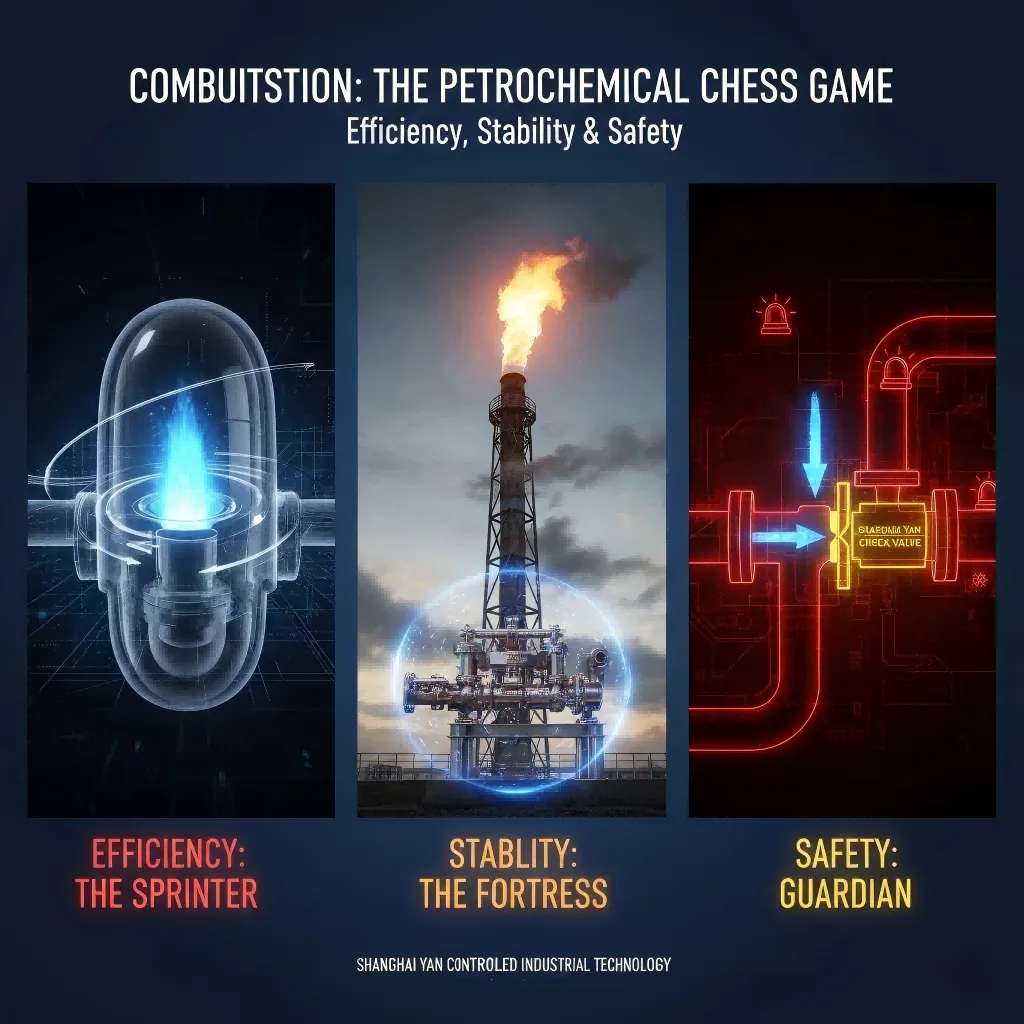
What Are the Three Main Petrochemical Combustion Methods and Why Do They Matter?
The three primary petrochemical combustion methods—premixed, diffusion, and partially premixed—serve as the strategic foundation for balancing heat output, operational stability, and plant safety. Choosing the correct method is critical because a mismatch between equipment and combustion type can lead to catastrophic flashbacks, excessive soot production, or expensive environmental fines. In modern refineries, managers must move beyond looking at price tags and instead evaluate the physics of the flame to ensure long-term profitability.
At Shanghai Yan Controlled Industrial Technology, we emphasize that combustion is not just about burning fuel; it is about controlling the chemical reaction to fit the specific needs of the hardware. For instance, a gas turbine requires high-intensity heat, whereas a safety flare requires absolute reliability under extreme weather conditions.
Why is Premixed Combustion Considered the Most Efficient Yet Risky Method?
Premixed combustion delivers the highest thermal efficiency by blending fuel and air thoroughly before they reach the ignition point, though it poses a significant risk of flashback. Because the mixture is already flammable inside the burner housing, it creates a short, intense blue flame with minimal unburned fuel. This makes it the preferred choice for high-performance gas turbines where maximizing energy output is the primary objective.
However, this efficiency comes with a dangerous trade-off. If the flow velocity of the gas drops below the flame’s burning velocity, the fire can travel backward into the mixing chamber. Premixed burners can reach adiabatic flame temperatures exceeding 2,000°C [1], making thermal management and flow control vital. To mitigate explosion risks, these systems require advanced sensors and rapid-response safety valves to prevent hardware damage.
| Feature | Premixed Combustion |
|---|---|
| Mixing Point | Before ignition (inside the burner) |
| Primary Benefit | Maximum Thermal Efficiency |
| Primary Risk | Flashback (Internal Explosion) |
| Typical Use | Gas Turbines, specialized high-heat heaters |
How Does Diffusion Combustion Ensure Stability for Safety Flares?
Diffusion combustion prioritizes flame stability over efficiency by mixing fuel and air only at the nozzle tip during the burning process. This method produces a long, soft yellow or orange flame that is incredibly difficult to extinguish, even under fluctuating pressures or high winds. It is the industry standard for safety flares because the flame “anchors” itself at the burner tip, ensuring that emergency gas releases are safely incinerated.
While diffusion flames are stable, they are prone to incomplete combustion, which results in black smoke or soot. According to API 521 standards, diffusion flames in flare systems are designed to remain stable in crosswinds exceeding 100 km/h [2], a level of resilience premixed flames cannot match. For managers, the goal with diffusion systems is environmental compliance through technologies like steam injection to reduce visible emissions.
Why is Partially Premixed Combustion the Standard for Industrial Tubular Heaters?
Partially premixed combustion acts as the “golden mean” by mixing a portion of air (primary air) with fuel before ignition and adding the rest (secondary air) at the flame root. This hybrid approach provides a manageable, efficient flame that is safer than fully premixed systems but cleaner than pure diffusion. It is the most common method used in core refinery equipment like tubular heaters and boilers.
This method allows for precise control over the flame shape, which is essential to prevent “hot spots” that can rupture expensive furnace tubes. Modern refinery tubular heaters utilizing partially premixed burners typically achieve a thermal efficiency range of 80% to 92% [3]. By balancing safety and heat transfer, this method ensures that heaters can run 24/7 without the risk of flashback or excessive carbon buildup.
How Do These Combustion Types Impact Emission Control and NOx Reduction?
Understanding combustion logic is the key to modern Low-NOx strategies, where “staged combustion” (a variation of partially premixed logic) is used to lower peak flame temperatures. By deliberately delaying the mixing of air and fuel, the system reduces the formation of thermal nitrogen oxides. This transition from simple burning to precision chemical management is essential for meeting strict international environmental standards.
For example, implementing staged-air combustion technology can reduce NOx emissions by 40% to 60% compared to traditional diffusion burners [4]. Furthermore, in units like Fluid Catalytic Crackers (FCC), understanding heterogeneous turbulent combustion allows plants to turn waste coke into usable heat, directly impacting the facility’s bottom line.
| System Type | Primary Management Focus | Key Technical Goal |
|---|---|---|
| Premixed | Safety & Hardware Integrity | Prevent Flashback/Explosion |
| Diffusion | Environmental Compliance | Prevent Black Smoke/Soot |
| Partially Premixed | Operational Optimization | Balance Heat Transfer & Fuel Use |
References & Data Footnotes
- Adiabatic Flame Temperatures: Premixed gas combustion temperatures are calculated based on stoichiometric ratios; 2,000°C is a standard benchmark for high-intensity methane-air mixtures.
- API Standard 521 (Pressure-relieving and Depressuring Systems): The American Petroleum Institute provides guidelines for flare systems, specifying wind-load stability requirements to prevent blowout.
- DOE Industrial Heating Efficiency Benchmarks: Based on Department of Energy data for process heaters; the 80-92% range accounts for standard heat recovery configurations.
- EPA Clean Air Technology Center – NOx Controls: The Environmental Protection Agency cites that staged burner configurations are the primary method for significant NOx reductions in heavy industry.
