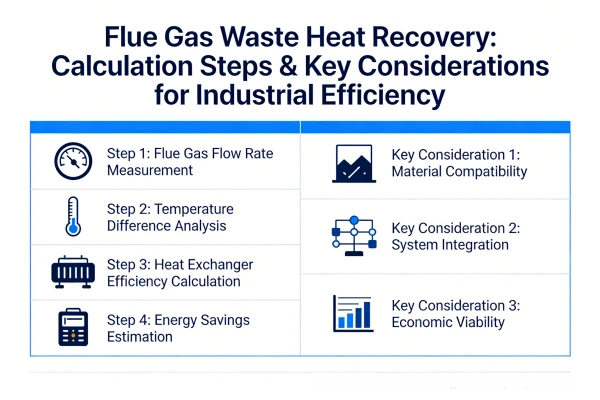
Industrial Flue Gas Waste Heat Recovery: Calculation Guide for Maximum Energy Efficiency
What Is the Primary Benefit of Flue Gas Waste Heat Recovery Systems?
Industrial flue gas waste heat recovery systems primarily reduce operational costs by reclaiming residual thermal energy to achieve fuel savings of 30% or more [1]. These systems capture heat from exhaust streams emitted by boilers, kilns, and furnaces, repurposing it to preheat combustion air or water. This process not only slashes energy bills but also helps facilities meet stringent environmental regulations, such as the EU 50mg/m³ NOx emission standard [2], by optimizing the overall combustion cycle.
At Heatflam, we integrate these recovery units into end-to-end thermal systems. By utilizing advanced heat exchange technologies, manufacturers can enhance production stability while significantly reducing their carbon footprint.
How Is the Heat Balance Calculated for Industrial Thermal Systems?
The heat balance calculation is the fundamental step used to quantify the energy transfer between the hot flue gas and the cold working fluid. This calculation ensures that the system is sized correctly to capture available energy without over-investing in hardware. The process relies on solving for the unknown variable among six key parameters: flow rates, inlet temperatures, and outlet temperatures for both the hot and cold sides.
The core formulas used in industrial engineering are:
- Heat released (Q_out): Flow rate × (Inlet enthalpy – Outlet enthalpy)
- Heat absorbed (Q_in): Flow rate × (Outlet enthalpy – Inlet enthalpy)
Enthalpy values are determined based on the medium (gas, steam, air, or thermal oil). For complex fuels like biomass or synthetic gas, specialized thermal software is often used to ensure precision in the design of skid-mounted combustion systems.
Why Is the Mean Temperature Difference (ΔT) Critical for Recovery Efficiency?
The mean temperature difference determines the rate of heat transfer, with countercurrent flow configurations offering the highest efficiency for industrial waste heat recovery. In a countercurrent system, the flue gas and the working fluid move in opposite directions, maintaining a consistently high ΔT across the heat exchanger. This maximizes energy recovery compared to concurrent or crossflow arrangements.
- Countercurrent Flow: Highest ΔT; ideal for high-efficiency regenerative combustion.
- Concurrent Flow: Lowest ΔT; typically used to prevent dew point corrosion by keeping wall temperatures higher.
- Crossflow: Mid-range efficiency; common in specific kiln and dryer applications.
How Can You Prevent Dew Point Corrosion in Exhaust Gas Recovery Units?
Preventing dew point corrosion requires maintaining the internal tube wall temperature above the acid dew point of the flue gas. When flue gas (especially from heavy oil or coal) cools too much, sulfur oxides can condense into sulfuric acid, which rapidly destroys equipment. To mitigate this risk, Heatflam utilizes concurrent flow configurations or heat pipe structures to ensure that metal surfaces remain at safe operating temperatures.
In corrosive environments, material selection is equally vital. While carbon steel is cost-effective for standard conditions, stainless steel or specialized alloys are mandatory for waste incineration or high-sulfur applications to ensure a service life exceeding 10 years.
What Safety and Compliance Standards Are Mandatory for These Systems?
Industrial waste heat recovery systems must comply with international pressure vessel regulations and environmental standards, including maintaining external insulation temperatures at or below 50°C [4]. Beyond thermal performance, engineers must verify the structural strength of tube sheets and the discharge capacity of safety valves to prevent catastrophic failures.
For facilities using skid-mounted solutions, choosing prefabricated and pre-tested systems can result in a 40% reduction in on-site installation time [3]. These systems are designed to meet global standards like CE, UL, and ISO 9001, ensuring that energy-saving goals do not compromise plant safety.
| Component | Verification Focus | Compliance Standard |
|---|---|---|
| Pressure Vessel | Structural Strength | ASME / CE / ISO |
| Insulation | Surface Temperature | ≤50℃ [4] |
| Emission Control | NOx Levels | EU 50mg/m³ [2] |
| Safety Valve | Discharge Capacity | Global Pressure Regs |
References & Data Footnotes
- Industrial Fuel Savings Benchmarks: Waste heat recovery implementation in heavy industry typically yields between 20% and 50% energy savings depending on the exhaust temperature.
- EU Emission Standards (Medium Combustion Plant Directive): Strict limits for nitrogen oxides (NOx) are set at 50mg/m³ for certain new plants to improve air quality.
- Skid-Mounted System Advantages: Modular, prefabricated thermal units significantly decrease project timelines by shifting construction to a controlled factory environment.
- OSHA & Industrial Insulation Standards: For personnel protection, the surface temperature of insulated pipes and equipment should not exceed 50°C (122°F).
FAQ: Common Questions on Waste Heat Recovery
Partner with Heatflam for Optimized Waste Heat Recovery
To learn how our Low NOx burners and customized waste heat recovery integrations can help you cut fuel costs and meet emission targets, contact us today:
