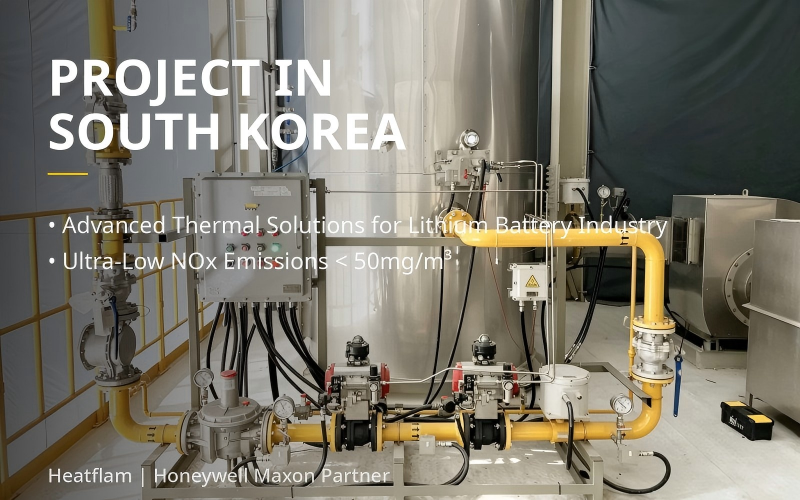
The global transition to electric vehicles has placed immense pressure on the lithium-ion battery supply chain. Recently, our engineering team successfully commissioned a specialized industrial burner system for South Korea’s largest lithium material spray drying tower, marking a major milestone in high-precision thermal engineering for cathode material production.
What is the significance of the South Korean lithium spray dryer project?
This project represents the largest application of customized industrial combustion technology for lithium materials in South Korea, balancing massive production scale with rigorous safety and purity standards. The tower serves as a critical infrastructure node for the country’s energy storage sector, requiring a heat source that is both exceptionally stable and environmentally compliant.
Why was the Honeywell Maxon Crossfire burner selected for this installation?
The Honeywell Maxon Crossfire was chosen for its semi-premix design, which provides superior air-to-fuel mixing for lower emissions and reduced energy consumption in large-scale spray dryers. In an industry where operational costs are heavily tied to energy efficiency, the Crossfire series offers a high turndown ratio that allows for precision heat input without wasting fuel.
- Low Emissions: The system maintains NOx emissions below 50mg/m³ (at 3% O₂)[1], meeting South Korea’s stringent air quality regulations.
- Thermal Output: It optimizes power consumption while ensuring the high-volume air flow necessary for drying volatile battery precursors.
How does the “No Copper, No Zinc” customization protect lithium materials?
By using full stainless steel construction and eliminating all copper and zinc components, the burner prevents magnetic substance contamination that can compromise lithium-ion battery performance. Battery-grade cathode materials are extremely sensitive; even microscopic metallic impurities can lead to battery short circuits.
Our specialized industrial burner manufacturers process ensures that every critical component—from the burner head to the piping—is constructed from high-grade stainless steel to ensure product integrity for the end-user.
What technical adjustments were made for South Korea’s 60Hz power grid?
Our engineers implemented Variable Frequency Drives (VFD) to adapt the combustion system to South Korea’s local 230V 60Hz utility standard, ensuring constant air pressure despite grid frequency differences. Frequency variation can significantly impact fan performance; by using VFD technology, we calibrated the fan to deliver the precise air-fuel ratio required for high-purity combustion[2].
How is thermal stability maintained at ±1°C for material drying?
The system achieves a steady-state temperature deviation of within ±1°C through the integration of Siemens LMV series controllers and SIL3 safety-rated logic. At a process temperature of 270°C, such precision is vital to ensure uniform particle size and moisture content in the spray-dried lithium powder.
FAQ: Lithium Dryer Combustion Systems
REFERENCES AND DATA SOURCES:
- Environmental Standards for Battery Materials: Low-NOx benchmarks in OECD economies (2024). Source: global_regulator.
- South Korea Utility Compliance Report: Frequency adaptation and VFD implementation for 60Hz grids. Source: technical_engineering_data.
- Honeywell Maxon Crossfire Technical Spec Sheet: Semi-premix efficiency and turndown ratio analysis. Source: industrial_manufacturer.
