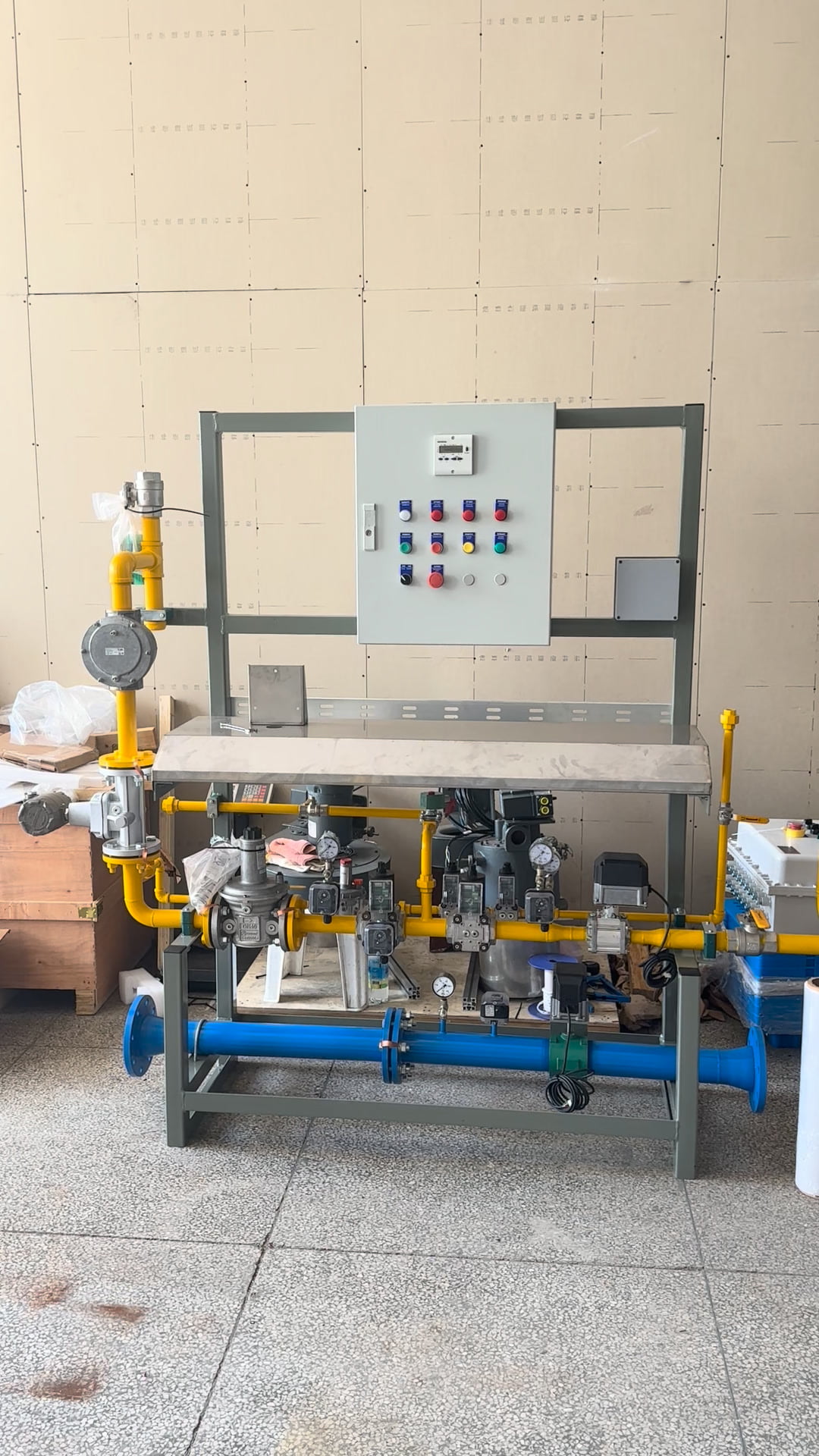
An automotive oven combustion system is not selected by burner capacity alone. The burner, gas train, combustion air, ignition sequence, safety-related controls, oven airflow, and process demand must work as one engineered package. This project shows a 700 kW natural gas system at the pre-shipment stage and explains what must still happen before final commissioning.
What Was Prepared for This Automotive Oven Project?
The photographed equipment is a pre-shipment assembly for an automotive factory oven application. It was shown in the warehouse after the main mechanical package had been assembled but before the final electrical wiring and delivery inspection were complete.
| Project item | Confirmed project detail |
|---|---|
| Application | Automotive factory oven |
| Fuel | Natural gas |
| Rated heat input | 700 kW |
| Specified gas supply pressure | 300–400 mbar |
| Documented stage | Pre-shipment assembly; final electrical wiring and inspection pending |
See the 700 kW automotive oven combustion system during pre-shipment preparation, before final electrical wiring and delivery inspection.
The 700 kW value describes this project configuration; it is not a universal sizing recommendation for every automotive oven. A different oven chamber, production load, operating temperature, exhaust rate, heat-up time, or recirculation arrangement can require a different heat input and control strategy.
How Is an Automotive Oven Burner System Configured?
An automotive oven burner system brings several functions together. The burner releases heat, the gas train system regulates and isolates the fuel path, the combustion-air system supports the required firing conditions, and the controls coordinate start-up, firing, shutdown, and fault response. ISO 13577-2:2023 identifies fuel pipework, combustion-air supply, flue-gas systems, burners, ignition devices, and safety-related control functions within the scope of industrial furnace combustion and fuel-handling safety.[1]
- Burner package: selected for the fuel, required firing range, oven heat demand, chamber arrangement, and available installation space.
- Gas train system: engineered around the available inlet pressure, required downstream pressure, operating sequence, and applicable safety requirements.
- Combustion and process controls: coordinated with the oven control system, permissives, operating demand, and shutdown logic.
- Mechanical integration: arranged around piping access, service clearances, airflow, and the final connection points.
This system-level approach is why a customized combustion system should be reviewed as an integrated package instead of treating the burner, gas train, controls, and oven as unrelated purchases.
What Should Be Verified Before Shipment?
Pre-shipment preparation establishes whether the industrial oven combustion system is ready to move into final installation. It does not replace site commissioning. The engineering team should close the following items against the approved drawings, component documentation, applicable code, and agreed supply scope:
- Confirm the mechanical assembly, support structure, piping orientation, labels, and access for service.
- Complete the specified electrical wiring and verify terminal identification against the electrical drawings.
- Review the control interface, operating permissives, alarm points, shutdown chain, and connection responsibilities.
- Check that the documented gas-supply conditions match the basis used to select the regulator, valves, switches, and burner.
- Record outstanding site work so the installation and commissioning teams receive a clear handover.
Why Must Burner Commissioning Be Planned Before Delivery?
Burner commissioning connects the packaged equipment to real site conditions. NFPA 86:2023 places commissioning, operation, maintenance, inspection, and testing in a dedicated chapter for ovens and furnaces.[2] The UK Health and Safety Executive also states that furnace and boiler systems should be designed and maintained to relevant codes and that commissioning and verification should be managed within the safety-management process.[3]
A practical combustion system commissioning plan should define responsibility for installation verification, fuel and electrical checks, control-sequence testing, first ignition, firing-rate adjustment, combustion measurement, alarm and shutdown verification, and the final settings record. The exact sequence must follow the approved design, component instructions, local regulations, and the site risk assessment.
What Happens During On-Site Burner Commissioning?
On-site burner commissioning starts only after the equipment is installed, connected, and released for testing. The commissioning engineer verifies the installation basis, proves the required control sequence, establishes stable ignition and firing, and adjusts the system under the actual oven airflow and process demand.
| Stage | Primary purpose |
|---|---|
| Pre-shipment preparation | Complete the agreed package, wiring, documentation, and inspection before dispatch. |
| Installation verification | Confirm that the installed fuel, air, electrical, exhaust, control, and oven interfaces match the approved basis. |
| Combustion adjustment | Set and document stable operating points under actual site conditions using appropriate combustion instruments. |
| Functional handover | Record settings, test results, outstanding actions, and operating responsibilities. |
The U.S. Department of Energy identifies checking burner air-to-fuel ratios as a core process-heating measure and explains that flue-gas measurements can be used to assess combustion conditions.[4] For a natural gas burner for industrial oven service, the final settings must still respect the oven process, the burner manufacturer’s limits, the approved safety sequence, and the applicable site requirements.
What Should a Buyer Provide for an Automotive Oven Combustion System?
To review an automotive oven combustion system or a 700 kW natural gas burner, provide the engineering team with the actual operating basis rather than capacity alone:
- Oven application, chamber dimensions, operating temperature, heat-up time, and production load.
- Fuel composition, available inlet pressure, and permitted pressure variation.
- Direct-fired or indirect-fired arrangement, combustion-air source, exhaust, and recirculation details.
- Electrical supply, control platform, communication requirements, and interface list.
- Installation country, applicable code, site classification, required documentation, and commissioning scope.
Frequently Asked Questions
Send your fuel, heat output, oven temperature, gas pressure, control requirements, drawings, installation country, and commissioning scope to the HEATFLAM engineering team. WhatsApp: +86 189 1708 6029.
REFERENCES AND DATA SOURCES:
- International Organization for Standardization — ISO 13577-2:2023, Industrial furnaces and associated processing equipment — Safety — Part 2: Combustion and fuel handling systems (Published 2023-12).
- National Fire Protection Association — NFPA 86: Standard for Ovens and Furnaces, 2023 Edition (2023 edition).
- UK Health and Safety Executive — Design Codes: Plant (Accessed 2026-08-18).
- U.S. Department of Energy — Improving Process Heating System Performance: A Sourcebook for Industry, Second Edition (2007).
