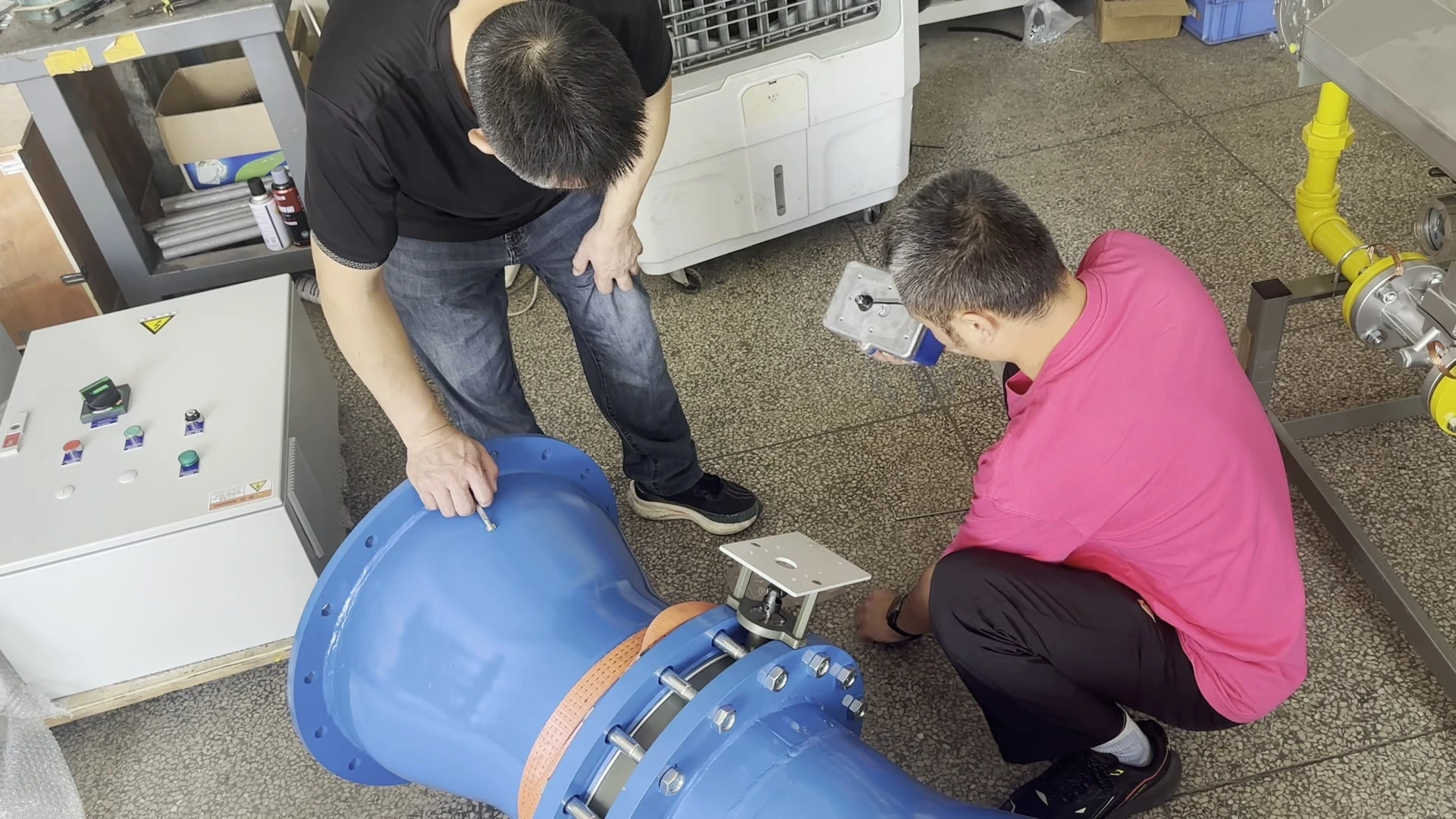
A large industrial drying project is not defined by burner capacity alone. The heat source, fuel train, controls, airflow, safeguards, and downstream process must work as one coordinated system. That systems approach is central to this HEATFLAM project: a 14,000,000 kcal/h combustion system for gypsum powder drying, now being prepared for shipment to Spain.
Before delivery, two senior engineers are reviewing the assembled equipment and confirming key engineering details. The objective is not a repair response. It is a planned technical review before the system leaves the workshop and enters the next stage of the project.
Watch the Engineering Review
This project video shows the two senior engineers reviewing the combustion-system assembly before delivery to Spain.
Project at a Glance
| Project item | Confirmed information |
|---|---|
| Application | Gypsum powder drying |
| Specified heat load | 14,000,000 kcal/h |
| Destination | Spain |
| Current project stage | Pre-delivery engineering review |
| Planned site support | Commissioning, combustion tuning, and technical support in Spain |
Why Gypsum Drying Requires a System-Level View
Gypsum processing can place heat generation directly inside a wider material-handling and thermal process. The U.S. Environmental Protection Agency describes gypsum operations in which ore is dried in rotary dryers or heated roller mills and notes that hot gas may contact gypsum during drying, grinding, and calcining. The exact arrangement varies from plant to plant, which is why an industrial burner for gypsum drying cannot be selected responsibly from heat load alone.
The U.S. Department of Energy defines industrial process heat as energy transferred from a heat source, such as a burner, to a material. Its process-heating sourcebook also distinguishes direct and indirect heating and treats controls and auxiliary systems as part of overall performance. For a gypsum powder drying combustion system, this points to a practical engineering question: how will the heat source interact with the customer’s actual dryer, airflow path, material behavior, and operating sequence?
What the Senior Engineers Are Reviewing
The workshop review brings the combustion equipment, control hardware, and mechanical interfaces into the same discussion. For this Spain gypsum drying project, the review focuses on five areas:
- Combustion stability: checking the configuration and operating logic needed to support controlled burner operation across the intended project conditions.
- Gas train configuration: reviewing the arrangement of the valve-train assembly and its interfaces with the burner and controls.
- Control logic: confirming how start-up, operation, shutdown, alarms, and process commands are coordinated.
- Safety functions: checking that the planned protective sequence and system interfaces are addressed before delivery.
- System integration: reviewing mechanical, electrical, and process interfaces so the combustion package can be connected to the customer’s drying line.
This is also why HEATFLAM positions the project as a custom combustion system, not simply a standalone burner sale. Burner hardware is one part of the delivery; engineering coordination, the combustion control system, the gas train system, and project support all affect how the package is applied.
From Workshop Review to On-Site Commissioning in Spain
The pre-delivery review is one checkpoint in a longer project sequence. After the equipment arrives in Spain, HEATFLAM engineers are scheduled to travel to the site for commissioning, combustion tuning, and technical support.
Commissioning connects the manufactured package with real site conditions. The work is expected to include checking installation interfaces, confirming the operating sequence, supporting initial operation, and tuning the combustion system against the available project conditions. Final settings and acceptance criteria depend on the customer’s process data, site installation, fuel supply, and agreed commissioning scope.
For an overseas industrial project, this continuity matters. The same engineering team that understands the package before shipment can support the transition from equipment delivery to site operation. It also gives the customer a direct technical channel when the combustion system is integrated with the gypsum drying line.
Information Needed to Engineer a Gypsum Drying Burner System
A useful RFQ for an industrial drying combustion system should describe the process, not only the requested burner model. At an early stage, buyers should prepare the following information:
- Fuel type, available pressure, and fuel-quality information.
- Required heat load and whether it represents nominal, maximum, or design capacity.
- Gypsum throughput, inlet moisture, target outlet moisture, and material residence time.
- Required air or gas temperature, airflow, pressure, and direct- or indirect-heating arrangement.
- Dryer type, duct layout, installation space, and mechanical connection drawings.
- Electrical supply, control-system architecture, I/O list, communication protocol, and site interlocks.
- Destination-country requirements, applicable standards, documentation expectations, and commissioning scope.
These inputs help define whether the project requires a standalone burner package, a burner with a fuel train and control cabinet, or a wider hot-air and process-integration scope. They also reduce the risk of treating a combustion system for gypsum drying as a catalog-only selection.
A Project Built Around the Process
The 14,000,000 kcal/h heat load establishes the scale of this project, but engineering credibility comes from how the complete package is reviewed, integrated, and supported. For HEATFLAM, the current workshop discussion and the planned on-site commissioning in Spain are connected parts of the same delivery approach.
The result at this stage is a Spain-bound industrial combustion system that has reached pre-delivery engineering review. Site commissioning and final operating adjustments will follow after the equipment is installed at the customer’s facility.
Frequently Asked Questions
Share your heat-load basis, fuel conditions, dryer configuration, process temperatures, airflow, controls, and site requirements. HEATFLAM can review the application and prepare a project-specific combustion-system proposal.
REFERENCES AND DATA SOURCES:
- U.S. Environmental Protection Agency — AP-42, Section 11.16: Gypsum Manufacturing (July 1993; reformatted January 1995).
- U.S. Department of Energy — Improving Process Heating System Performance: A Sourcebook for Industry, Third Edition (2016).
- U.S. Department of Energy — Process Heat Basics (accessed August 19, 2026).
- International Organization for Standardization — ISO 13577-2:2023, Safety of Combustion and Fuel Handling Systems (published December 2023; accessed August 19, 2026).
- European Commission — CE Marking: Manufacturers (accessed August 19, 2026).
