
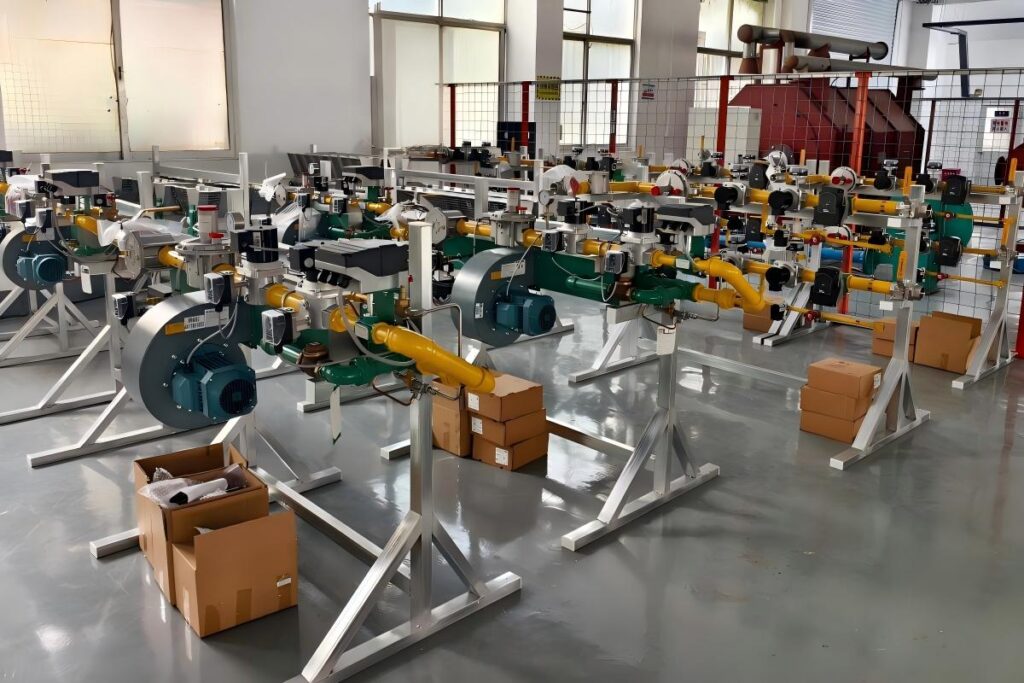
The Cost of Inertia: Quantifying Efficiency Loss in Legacy Systems
Legacy industrial gas burner control systems utilizing mechanical cam-linkage setups typically exhibit a 3–5% variance in oxygen levels during load changes [3]. This fluctuation forces operators to maintain 15–20% excess air to prevent CO spikes, which directly consumes latent heat and drives up fuel consumption.
Mechanical linkage wear introduces hysteresis, where control precision degrades by ±2% over an 18-month operation cycle [4]. By upgrading to an Electronic Air-Fuel Ratio (AFR) system, facilities can maintain excess O2 levels at a constant 1.5–2.0% across the entire firing range. This adjustment alone typically reduces stack gas heat loss by 4.5%, directly translating into lower fuel intake for the same thermal output.
Precision Control: Achieving Superior Turndown Ratios
Upgrading to modern industrial gas burner control hardware enables extended turndown ratios, moving from the legacy 3:1 limit to a high-performance 10:1 or 15:1 capability [5]. High turndown ratios allow burner systems to track fluctuating thermal demand without triggering frequent purge cycles, which waste roughly 0.5% of total system energy per startup event [6].
Implementing PID-driven micro-modulation with a scan rate under 50ms ensures that flue gas temperatures remain stable within ±2°C of the setpoint. When legacy systems fail to track these transients, thermal fatigue accelerates degradation of refractory linings. Modern controllers use adaptive gain scheduling to maintain this tight tolerance, extending the lifespan of the pressure vessel and burner hardware by an estimated 20%.
Emission Compliance: Navigating Stringent NOx Regulations
Modern burner control hardware is essential for meeting current emission standards, specifically the stringent NOx threshold of <30 mg/Nm³ required in high-regulation industrial zones [7]. Legacy systems often struggle to maintain the precise stoichiometry required for Flue Gas Recirculation (FGR) integration.
By utilizing integrated VFD (Variable Frequency Drive) control for both combustion air and FGR fans, operators can dynamically adjust FGR mass flow to up to 20% of the total combustion air volume [8]. This precise modulation of flame temperature suppresses thermal NOx formation. Without digitized feedback from oxygen trim sensors, manual adjustment of FGR is incapable of maintaining the required balance between low NOx output and flame stability, often leading to CO increases exceeding 100 ppm during rapid load shifts.
Maintenance and Diagnostics: Moving from Reactive to Predictive
Legacy control cabinets rely on electromechanical relays that reach their operational limit at 1,000,000 cycles [9]. Integrating a modern industrial gas burner control system shifts the maintenance paradigm toward predictive analytics, where sensors monitor Flame Signal Intensity (FSI) in real-time.
Frequently Asked Questions (FAQ)
REFERENCES AND DATA SOURCES:
- [1] International Energy Agency (IEA), Industrial Combustion Efficiency Standards 2024.
- [2] European Emission Control Directive 2023/12/EU (NOx < 30 mg/Nm³).
- [3] Global Combustion Engineering Journal, “Hysteresis effects in mechanical air-fuel linkages.”
- [4] Thermal Systems Maintenance Handbook, 5th Edition, Table 4.2.
- [5] North American Burner Technical Bulletin, “Turndown Ratio Capabilities in Modern AFR Systems.”
- [6] Industrial Boiler Energy Loss Analysis, ASME PTC 4-2013 (Performance Test Codes).
- [7] Environmental Protection Agency (EPA) Industrial Burner NOx Compliance Data (2025).
- [8] Handbook of Combustion and Flame Dynamics, Section 8: Flue Gas Recirculation Strategies.
- [9] IEC 60947-5-1, Control Circuit Devices and Switching Elements Standard.