
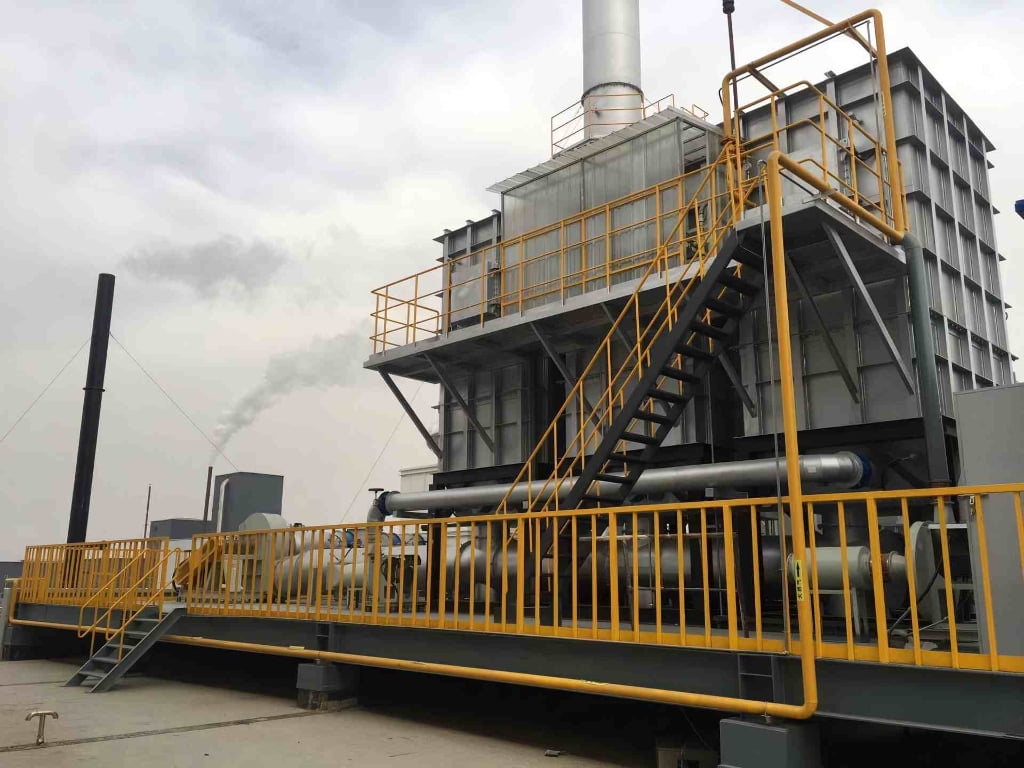
Industrial Hot Air Heater Systems for Drying, Ovens and Process Heating
Root-Cause Diagnosis
Industrial hot air heater failures usually trace to the wrong fit between air cleanliness, excess air, temperature control, and emissions basis. For natural-gas systems, 10% excess air may be attainable, but too little excess air raises CO and flame-stability risk under real site conditions [1].
Field Troubleshooting Priorities
- If CO rises at low fire: verify O2, burner position, and minimum airflow before reducing excess air below the proven 10% excess-air basis [1].
- If stack loss is high: compare excess air and stack temperature because a 15 percentage-point excess-air reduction or 40 F stack-temperature reduction can indicate about 1% efficiency improvement [1].
- If NOx is near permit: confirm whether low-NOx burners or FGR are suitable because EPA reports 40-85% and 60-90% NOx reduction ranges under stated natural-gas boiler conditions [2].
- If product quality changes: reject direct flame contact for heat-sensitive material until dryer testing confirms moisture profile, gas sampling, retention time, and temperature profile [6].
- If the oven handles volatiles: verify NFPA 86 classification, exhaust, interlocks, and LFL monitoring before approving a Class A process oven change [4].
System Selection Drivers
An industrial hot air heater is usually selected around 3 measurable constraints: process-air contamination tolerance, heat release rate, and temperature-control range. For many natural-gas combustion systems, 10% excess air is attainable on well-designed equipment, while too little excess air increases CO, soot, and unburned fuel risk [1].
A direct fired hot air heater places combustion products in the heated air stream, so it can be efficient for mineral drying, aggregate drying, coating lines with suitable exhaust, and high-volume makeup air. An indirect fired hot air heater uses a heat exchanger to keep combustion gas out of the process air, which is often required for food, pharmaceutical, sanitary, sealed-room, or product-sensitive drying.
Direct Fired Fit
Direct fired systems can reach approximately 92-100% fuel-to-heat transfer in suitable air-heating applications because the flame and combustion products heat the process stream directly [5]. In rotary drying, direct fired designs can increase heat-transfer intensity through radiation plus convection, but flame contact can damage heat-sensitive or high-value materials [6].
Use a direct fired hot air heater when the process has enough ventilation, the product can tolerate combustion products, and the exhaust treatment system can handle moisture, NOx, CO, and entrained dust. Typical candidates include aggregates, minerals, fertilizers, some coatings, and high-throughput drying where product discoloration or odor pickup is not critical.
Indirect Fired Fit
Indirect fired systems separate the flame from the delivered process air, so the buyer should expect lower transfer efficiency than direct fired air heating but cleaner heated air. The tradeoff is justified when contamination, humidity, odor, or combustion gas exposure would create product loss, worker exposure, or a compliance failure [5].
An indirect fired hot air heater is usually the better fit for controlled drying, recirculating ovens, clean process rooms, food ingredients, pharmaceutical materials, sensitive fibers, and applications where the heated air must not contain combustion byproducts. Buyers should request heat-exchanger material, allowable skin temperature, leakage test method, and flue-gas-side inspection access before approving a hot air furnace package.
Efficiency Checks
Combustion efficiency should be checked with flue-gas O2 or CO2, stack temperature, CO, and excess-air calculation rather than burner nameplate efficiency alone. DOE/NREL guidance states that stack temperature and flue-gas oxygen or carbon dioxide are primary indicators, and that 1% efficiency improvement is a common rule of thumb for each 15 percentage-point reduction in excess air or 40 F reduction in stack temperature under comparable conditions [1].
For an industrial hot air heater, lower O2 is not automatically better. If excess air is driven too low, the system can create CO, soot, smoke, flame instability, or delayed ignition risk; if excess air is too high, heated air and flue gas leave through the exhaust with avoidable energy loss.
NOx Basis
NOx control must be specified against the legal basis: fuel, rated input, oxygen correction, new or existing plant status, and local permit limit. EPA AP-42 reports that low-NOx burners can reduce NOx by 40-85% relative to uncontrolled natural-gas boiler combustion, and low-NOx burners combined with FGR can reduce NOx by 60-90% where the burner is designed to sustain stable flame with recirculated inert gas [2].
For EU medium combustion plants from 1 MWth to less than 50 MWth, the Medium Combustion Plant Directive sets emission-limit frameworks and monitoring duties, with different dates and limits for new and existing plants [3]. The buyer should not compare a vendor’s ppm figure against a permit mg/Nm3 limit unless the oxygen basis, dry/wet basis, temperature, pressure normalization, and load point are stated.
Controls and Turndown
A turndown ratio of 10:1 is often a useful procurement target for variable drying loads, but the accepted value must be supported by the burner, fan, valve train, flame safeguard, and temperature-control loop. Temperature stability within +/-1 to +/-3 C may be feasible in well-designed recirculating ovens, while bulk dryers often need a wider tolerance because moisture load and exhaust flow change continuously.
The control system should modulate fuel and combustion air together, prove airflow before ignition, supervise flame, and shut fuel valves on unsafe conditions. For indirect fired systems, add heat-exchanger high-limit protection and flue-pressure monitoring because a blocked flue or exchanger leak can move risk from the burner room into the process area.
Safety Checks
Oven and furnace safety cannot be accepted from a burner datasheet alone; it must be verified against the complete heated enclosure, exhaust system, controls, fuel train, and process material. NFPA 86 is publicly described as covering Class A, B, C, and D ovens, dryers, furnaces, thermal oxidizers, and related heated enclosures used for processing materials [4].
Before Replacing the System
- Application fit: direct fired heating fits ventilated, product-tolerant processes; indirect fired heating fits clean, recirculated, sanitary, or contamination-sensitive air loops.
- Limits: quoted efficiency, NOx, and turndown values are not acceptance values unless fuel, load, oxygen basis, and test method are stated.
- Operational risks: verify CO, flame stability, stack temperature, fan capacity, exchanger leakage, and downtime risk before changing heater type.
- Required confirmation: request the OEM manual, local code review, permit basis, insurer requirements, site-engineer approval, and combustion commissioning report.
Terms That Affect Diagnosis
- Industrial hot air heater: a burner-based air-heating package used to deliver heated air to dryers, ovens, furnaces, or process ducts.
- Direct fired hot air heater: a system where combustion products enter the heated air stream, requiring product and ventilation compatibility.
- Indirect fired hot air heater: a system where a heat exchanger separates combustion gas from process air, improving air cleanliness at added equipment cost.
- Excess air: combustion air above stoichiometric demand; too little can create CO, while too much increases stack loss.
- FGR: flue gas recirculation returns part of exhaust gas to the burner air stream to lower flame temperature and reduce thermal NOx.
- Hot air furnace: a broader term for an enclosure or package that generates hot air for process heating, drying, or oven circulation.
Verified Troubleshooting Data
| Issue | Condition | Value | Evidence | Action |
|---|---|---|---|---|
| High stack loss | Comparable fuel and load | 1% efficiency per 15 percentage-point excess-air or 40 F stack-temperature reduction | [1] | Measure O2, CO, and stack temperature before tuning. |
| Low excess air risk | Insufficient combustion air | 10% excess air attainable on well-designed natural-gas systems | [1] | Do not lower air without CO and flame-stability proof. |
| NOx control | Natural-gas boiler combustion controls | 40-85% low-NOx burner reduction; 60-90% with low-NOx burner plus FGR | [2] | Confirm oxygen basis, fuel, load, and stack-test method. |
| Regulatory scope | EU medium combustion plants | 1 MWth to less than 50 MWth | [3] | Check local permit limit and new/existing plant status. |
| Oven safety | Dryers, ovens, furnaces, heated enclosures | NFPA 86 scope includes Class A-D equipment | [4] | Verify purge, interlocks, flame supervision, and LFL monitoring. |
Specification Checklist
A buyer should request at least 8 values before approving an industrial hot air heater: rated heat input, delivered airflow, maximum outlet temperature, turndown ratio, expected excess air, O2 or CO2 range, CO limit, NOx basis, pressure drop, and permitted fuel type. Missing any one of these values can make two hot air furnace quotations look comparable when their operating cost, safety basis, and emissions result are not comparable.
For direct fired systems, also request moisture addition from combustion, dilution-air requirement, exhaust volume, and product-contact risk. For indirect fired systems, request heat-exchanger efficiency, material, cleanout access, leakage criteria, flue temperature, and thermal expansion allowance.
Frequently Asked Questions
REFERENCES AND DATA SOURCES:
- National Renewable Energy Lab., “Improve Your Boiler’s Combustion Efficiency: Office of Industrial Technologies Steam Energy Tips No. 4,” OSTI program document, states the cited excess-air, stack-temperature, O2/CO2, CO-risk, and efficiency rule-of-thumb data.
- U.S. Environmental Protection Agency, “AP-42, Chapter 1.4: Natural Gas Combustion,” PDF technical chapter; direct EPA file link is used because the chapter is published as the accessible source file and supports FGR, low-NOx burner, and NOx reduction data.
- European Union, “Directive (EU) 2015/2193 on the limitation of emissions of certain pollutants into the air from medium combustion plants,” EUR-Lex legal text, defines the 1-50 MWth framework and compliance basis.
- Control Instruments Corporation, “Understanding NFPA 86,” technical note, publicly describes NFPA 86 coverage for ovens, dryers, furnaces, thermal oxidizers, and heated enclosures.
- Power Flame, “Direct vs. Indirect Fired Heating,” technical article, describes direct fired air-stream heating, indirect heat-exchanger separation, and typical efficiency considerations.
- FEECO International, “Direct-Heat and Direct-Fired Rotary Dryers,” technical article, explains flame-contact risk, direct heat transfer, material sensitivity, and process testing factors for drying systems.
- U.S. Department of Energy, “Process Heating Systems,” resource page, lists process-heating assessment tools, tip sheets, and sourcebooks used for industrial furnace and process-heating performance review.