
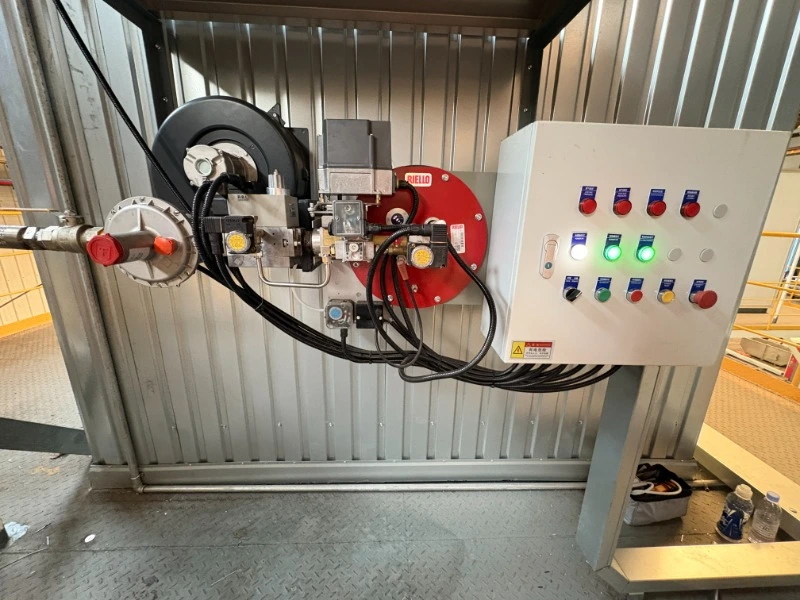
Industrial Burner Systems for Boilers: Selection, Control and Safety
Root-Cause Diagnosis
A boiler burner system succeeds only when burner capacity, furnace geometry, fuel, controls, emissions basis, and safety code are matched as one package. For gas-fired hot-water boilers, DOE recommends at least 5:1 turndown, but the verified minimum must still fit the plant load and stable combustion envelope [2]. Confirm the operating envelope before selecting or retrofitting equipment.
Field Troubleshooting Priorities
- Frequent cycling: If normal demand is below the verified low-fire input, compare the load profile with a minimum 5:1 gas-boiler turndown and evaluate sequencing [2].
- High stack loss: When excess air or stack temperature rises, investigate the fuel-air curve because DOE estimates about 1% efficiency gain per 15-percentage-point excess-air reduction or 40 deg F stack-temperature reduction under comparable conditions [1].
- Low-O2 tuning: If oxygen is reduced toward the low-single-digit range, measure CO and flame stability at every load instead of assuming lower O2 is always better [1].
- Unsafe water-level protection: For steam boilers, verify the daily low-water cutoff check and semiannual slow-drain test in the site procedure [7].
- Code mismatch: If input is near 12,500,000 Btu/h, confirm whether ASME CSD-1 scope, NFPA 85, local code, or insurer requirements govern the installation [3][4].
Define the Boiler Duty
A gas-fired hot-water boiler should generally provide at least 5:1 turndown when it spends substantial time at part load [2]. At 10 MW maximum input, 5:1 turndown still means a nominal 2 MW minimum, so a plant regularly requiring 0.8 MW needs deeper verified turndown, cycling, or boiler sequencing. Use measured demand rather than nameplate capacity alone.
Record steam flow, pressure, feedwater temperature, return-water temperature, and fuel consumption through representative production periods. Define normal load, peak duration, minimum stable demand, standby duty, ramp rate, and future expansion separately. Firetube, watertube, thermal-fluid, and waste-heat units also impose different furnace dimensions, draft behavior, and heat-release limits. The burner supplier must verify flame length and diameter against the actual furnace and refractory condition.
Match Fuel and Burner
ASME CSD-1:2024 covers automatically operated boilers directly fired by gas, oil, gas-oil, or electricity below 12,500,000 Btu/h input within its stated scope [3]. Above or outside that scope, NFPA 85, another standard, and local requirements may apply [4]. State fuel pressure, heating value, temperature, viscosity, contaminants, and backup-fuel conditions before selecting hardware.
| Burner type | Best fit | Key check |
|---|---|---|
| Monoblock | Compact packaged boilers | Fan margin, access, noise, furnace pressure |
| Duoblock | Higher airflow or flexible fan layout | Duct loss, VFD range, airflow proving |
| Register | Large watertube or multi-burner furnaces | Flame interaction, furnace draft, BMS integration |
| Dual-fuel | Sites with justified backup-fuel duty | Independent trains, atomization, changeover logic |
Size the Operating Range
DOE recommends at least 5:1 turndown for gas-fired hot-water boilers and notes that modulation reduces cycling losses [2]. A higher brochure ratio is useful only if the industrial boiler burner maintains stable flame detection, acceptable CO and NOx, correct furnace pressure, and controllable fuel flow at verified low fire.
- Maximum rating: Verify capacity at worst-case fuel pressure, combustion-air temperature, elevation, boiler backpressure, and fan margin.
- Minimum input: Compare tested low fire with minimum plant demand and the boiler’s heat-absorption limit.
- Ignition input: Prove light-off at the code- and OEM-approved condition.
- Ramp capability: Confirm stable steam pressure and water level through planned load changes.
Control Air and Fuel
DOE reports that about 10% excess air is attainable on well-designed natural-gas systems, but the safe target must be established by testing each firing point [1]. Its rule of thumb is about 1% boiler-efficiency improvement for each 15-percentage-point reduction in excess air or 40 deg F reduction in stack temperature when other conditions are comparable [1].
Electronic parallel positioning independently controls fuel and air servos. Oxygen trim should make a limited bias to a commissioned curve, not replace it. Too much air increases flue-gas mass and stack loss; too little can raise CO, soot, flame instability, and unburned fuel. Map O2, CO, NOx where required, stack temperature, fuel and air pressure, flame signal, and furnace pressure across the operating range.
A DOE demonstration on a 25 MMBtu/h steam boiler reported 4% natural-gas fuel savings over one year using continuous O2, CO, and NOx feedback [5]. This documented case is not a universal guarantee; results depend on baseline tuning, load profile, sensor maintenance, and allowed control movement.
Protect Every Firing State
ASME CSD-1:2024 publishes a 12,500,000 Btu/h upper input boundary for boilers within its stated scope [3]. NFPA 85 includes separate chapters for single-burner, multiple-burner, and other boiler combustion systems [4]. The site engineer must identify the adopted code and edition before finalizing the cause-and-effect logic.
Separate process modulation from safety shutdown. The combustion controller regulates steam pressure or water temperature. The burner management system sequences purge, pilot, main flame, and shutdown while supervising permissives and trips. The fuel train regulates and isolates fuel. Independent boiler limits protect water level, pressure, and temperature.
National Board guidance identifies gas-pressure switches, airflow proving, flame sensing, low-fire position proving, furnace-pressure switches, high limits, and low-water cutoffs as typical protections [6]. It also notes that larger gas trains may use two safety shutoff valves in series, with the final arrangement governed by code, insurer, and authority requirements.
Specify Boiler Burner Parts
A maintainable package needs a complete bill of materials and clear interfaces. At minimum, separate the burner head, fan, fuel train, controls, flame safeguard, boiler limits, field instruments, wiring, and commissioning scope. Critical replacement parts must preserve the approved ratings, fail positions, response, and safety function.
- Combustion hardware: Burner head, diffuser, air register, ignition assembly, flame scanner, fan, motor, damper or VFD, and flexible connection.
- Fuel equipment: Isolation, regulation, filtration, pressure protection, safety shutoff, valve proving, venting, oil pumping, heating, atomization, and recirculation as applicable.
- Control equipment: Burner management, modulation, servos, transmitters, operator interface, boiler limits, and plant-system communication.
- Service provisions: Test ports, flue-gas sampling points, valve-position indication, final drawings, setpoint records, and critical spares.
Define Emissions Guarantees
EU Directive 2015/2193 covers combustion plants from 1 MW to less than 50 MW rated thermal input and regulates SO2, NOx, and dust through registration, permitting, and emission limits [8]. Every guarantee must state pollutant, limit, fuel, load range, reference oxygen, dry or wet basis, normalization conditions, and test method.
Low-NOx burners, staged combustion, and flue-gas recirculation can reduce peak flame temperature or oxygen availability. They also alter flame shape, fan duty, and stability. EPA AP-42 identifies low-NOx burners and FGR as established natural-gas boiler controls and warns that off-design or improperly tuned operation can increase CO and reduce efficiency [9]. Do not accept a ppm figure without its measurement basis.
Commission the Full Curve
For a wide-range modulating burner, use at least 5 planned load points as a project acceptance practice: low fire, intermediate points, and full fire, plus any transition where instability appears. This is not presented as a universal code minimum. It ensures that O2, CO, NOx, stack temperature, fuel pressure, flame signal, and furnace pressure are checked across the curve rather than at one favorable point.
- Inspect: Mounting, furnace clearance, refractory, fan rotation, valve orientation, instruments, and wiring.
- Prove: Leak tightness, purge, pilot, main flame, normal shutdown, emergency shutdown, permissives, and master fuel trips.
- Measure: Capacity, steam stability, water-level response, turndown, emissions, noise, and combustion data on each agreed fuel.
- Document: Final setpoints, cause-and-effect matrix, drawings, certificates, test reports, spare parts, passwords, and training.
Before Replacing the System
- Application fit: Confirm boiler type, furnace geometry, fuel range, measured load profile, draft, heat-release limits, and required ramp rate before choosing a new burner.
- Limits: A burner-only retrofit may not correct fouled heat-transfer surfaces, undersized fans, restricted gas supply, poor boiler sequencing, damaged refractory, or unstable process demand.
- Operational risks: Re-map CO, O2, NOx, flame signal, furnace pressure, stack temperature, and all trips because a new head or control curve changes the combustion envelope.
- Required confirmation: Obtain the OEM furnace review, current permit basis, local code and insurer acceptance, site-engineer approval, combustion test report, and signed commissioning record.
Terms That Affect Diagnosis
- Boiler burner system: The burner, fan, fuel train, controls, flame safeguard, boiler limits, and interfaces that release and regulate heat.
- Turndown ratio: Maximum verified input divided by minimum stable input under stated fuel, emissions, and furnace conditions.
- Oxygen trim: A limited feedback correction to a commissioned fuel-air curve based on measured flue-gas oxygen.
- Burner management system: Safety logic that sequences purge, ignition, firing, and shutdown and supervises combustion permissives and trips.
- Flame safeguard: A controller and detector arrangement that proves flame and closes fuel safety valves when flame is not safely established.
- Reference oxygen: The O2 basis used to correct an emissions concentration, required when comparing NOx or CO guarantees.
Verified Troubleshooting Data
| Issue | Condition | Value | Evidence | Action |
|---|---|---|---|---|
| Cycling | Gas hot-water boiler at part load | 5:1 minimum recommended turndown | [2] | Compare minimum demand with tested low fire. |
| High excess air | Well-designed natural-gas system | About 10% excess air attainable | [1] | Map O2 and CO before reducing air. |
| Efficiency loss | Comparable operating conditions | About 1% per 15 points excess air or 40 deg F stack temperature | [1] | Trend O2, CO, fuel use, and stack temperature. |
| Control retrofit | 25 MMBtu/h gas steam-boiler demonstration | 4% fuel savings over one year | [5] | Estimate savings from the site’s baseline, not this case alone. |
| Low water | Steam-boiler cutoff testing | Daily check; semiannual slow drain | [7] | Verify procedure, competence, records, and jumper removal. |
| Regulatory scope | EU medium combustion plant | 1 MW to less than 50 MW | [8] | Confirm national permit, fuel, plant age, and limits. |
Frequently Asked Questions
REFERENCES AND DATA SOURCES:
- U.S. Department of Energy, “Improve Your Boiler’s Combustion Efficiency,” Steam Tip Sheet No. 4, supports the excess-air, stack-temperature, efficiency, and combustion-risk data.
- U.S. Department of Energy FEMP, “Purchasing Energy-Efficient Boilers,” provides the 5:1 turndown recommendation and air-fuel control guidance.
- ASME, “CSD-1 – Controls and Safety Devices for Automatically Fired Boilers,” 2024 scope page, defines the listed fuel types and input boundary.
- National Fire Protection Association, “NFPA 85: Boiler and Combustion Systems Hazards Code,” 2023 preview, shows the code structure for boiler combustion systems.
- U.S. Department of Energy FEMP, “Boiler Combustion Control and Monitoring System,” reports the 25 MMBtu/h demonstration and 4% fuel savings.
- National Board of Boiler and Pressure Vessel Inspectors, “Top Ten Boiler and Combustion Safety Issues to Avoid,” describes fuel trains, interlocks, and inspection-frequency examples.
- National Board of Boiler and Pressure Vessel Inspectors, “Secondary Low-Water Fuel Cutoff Probe: Is It as Safe as You Think?” supports low-water protection and test-frequency statements.
- European Union, Directive (EU) 2015/2193 on medium combustion plants, establishes the 1 MW to less than 50 MW scope and emissions framework.
- U.S. Environmental Protection Agency, “AP-42, Fifth Edition, Volume I, Chapter 1: External Combustion Sources,” Section 1.4 Natural Gas Combustion, supports the low-NOx burner, FGR, and off-design CO discussion.