
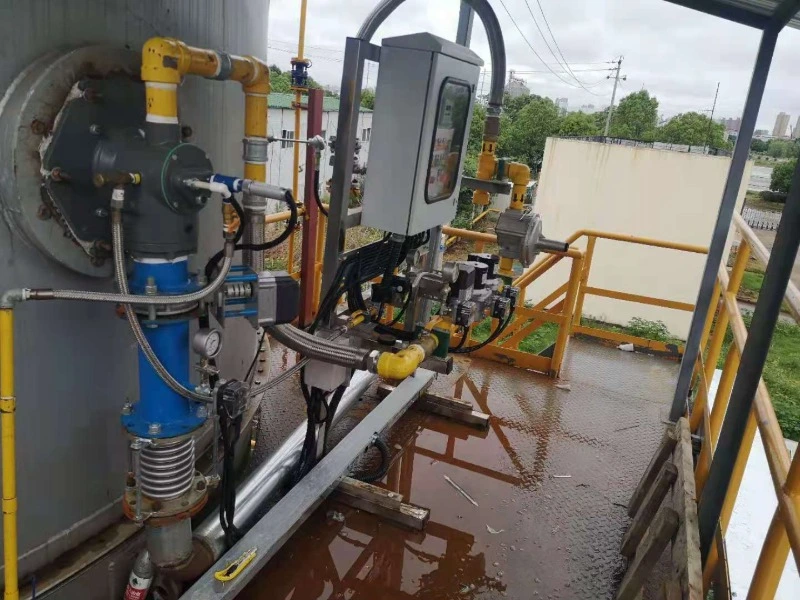
Root-Cause Diagnosis
Industrial burner low heat output is usually caused by restricted fuel delivery, excessive combustion air, insufficient burner capacity, or control settings that hold the firing rate below demand. For many natural-gas boiler cases, 2-3% flue-gas O2 corresponds to about 10-15% excess air, but acceptance depends on fuel, OEM data, local code, permit, and site load [1].
Fuel Supply Checks
A burner with low inlet pressure or restricted fuel flow can lose more than 10% of expected heat input before the flame becomes obviously unstable. Verify the measured pressure at low fire, high fire, and during other plant loads because regulator droop, clogged strainers, undersized piping, or low gas supply pressure can appear only at demand peaks [3].
Fuel pressure must be checked against the burner nameplate, valve-train drawings, and commissioning sheet. If manifold pressure reaches the required value but heat remains low, the limiting point may be an orifice, control valve travel, regulator capacity, dirty nozzle, or fuel-BTU mismatch.
Combustion Air
Too much combustion air can reduce useful heat transfer even when fuel pressure is correct. DOE guidance states that boiler efficiency improves by about 1 percentage point for each 15 percentage-point reduction in excess air or each 40 degrees F reduction in stack-gas temperature, when other operating conditions are comparable [1].
Combustion air must still remain high enough to avoid CO, flame instability, and unsafe ignition. For many natural-gas systems, 2-3% O2 can be a practical tuning range at steady load, but oil firing, low-NOx burners, high furnace draft, wet process loads, or local permits may require a different value [1].
Burner Capacity
If the process load exceeds burner rating, no fuel-pressure or temperature-control adjustment will restore full heat output. A burner selected at 10:1 turndown still must meet required high-fire input, furnace backpressure, and process heat demand at the design operating point [1].
Capacity problems often appear after production changes: higher line speed, wetter material, colder make-up air, larger batch mass, or a retrofit that adds heat loss. Compare actual heat demand, burner maximum input, fan curve, furnace pressure, and heat-transfer surface condition before treating the problem as a burner failure.
Temperature Control
Temperature control can hold a healthy burner below required output when sensors, setpoints, PID tuning, high-limit circuits, or permissives restrict firing rate. A control loop with a 2-5 degrees C deadband may be acceptable for some heating processes, while heat treatment, curing, or drying applications may require tighter tolerance and a documented ramp-rate profile [3].
Check whether the controller output, actuator travel, flame safeguard, VFD fan command, high-limit controller, and process interlocks agree. If the controller demands 100% but the fuel valve opens only 70%, the fault is probably in actuator linkage, calibration, or permissive logic.
Field Troubleshooting Priorities
- Fuel pressure: If pressure drops at high fire, compare static and firing pressure against OEM data before adjusting combustion air [3].
- O2 level: If natural-gas flue-gas O2 is far above 2-3% at steady load, test for excess air and stack loss [1].
- Stack temperature: If stack temperature rises more than 40 degrees F above baseline, inspect excess air and heat-transfer fouling [1].
- Control demand: If controller demand is 100% but actuator travel is below 90%, verify linkage, calibration, and permissive logic [3].
- NOx basis: If a permit uses 100 mg/Nm3 or 200 mg/Nm3 NOx, confirm fuel, plant size, date, and oxygen basis before changing firing settings [2].
Before Replacing the System
- Application fit: Confirm the burner is rated for the actual fuel, required heat input, furnace pressure, process load, and modulation range.
- Limits: A fuel or air adjustment will not solve low heat output if the process load exceeds burner capacity or heat-transfer surfaces are fouled.
- Operational risks: Incorrect correction can increase CO, flame instability, stack loss, NOx non-compliance, or fuel-train safety risk.
- Required confirmation: Request the OEM manual, commissioning report, local code basis, permit condition, insurer requirement, and combustion-test record before replacement.
Terms That Affect Diagnosis
- Industrial burner: A combustion device that releases heat into a boiler, furnace, kiln, dryer, oven, or thermal oil heater.
- Fuel pressure: The measured pressure available to the burner valve train and manifold under actual firing demand.
- Combustion air: The air supplied for fuel combustion; too little can create CO, while too much increases stack loss.
- Excess air: Air above stoichiometric requirement, commonly inferred from flue-gas O2 during combustion testing.
- Temperature control: The sensor, controller, actuator, and permissive logic that determine requested firing rate.
- NOx limit: A regulated emission value that depends on jurisdiction, fuel, plant size, date, and reference oxygen basis.
Verified Troubleshooting Data
| Issue | Condition | Value | Evidence | Action |
|---|---|---|---|---|
| Excess air | Natural-gas boiler tuning | 2-3% O2, about 10-15% excess air | DOE combustion-efficiency guidance [1] | Combustion-test before changing damper or linkage. |
| Stack loss | Comparable boiler operation | 1 percentage point efficiency per 40 degrees F stack-temperature reduction | DOE rule of thumb [1] | Compare current stack temperature with clean baseline. |
| NOx compliance | EU medium combustion plant limits | 100 mg/Nm3 or 200 mg/Nm3 examples, depending on category | EU MCPD framework [2] | Confirm jurisdiction, fuel, size, date, and O2 basis. |
| Fuel train | Low and high firing demand | OEM value required; not universal | National Board safety guidance [3] | Request valve-train drawing and commissioning pressure record. |
| NOx formation | Natural-gas combustion | Depends on flame temperature and oxygen availability | EPA AP-42 natural-gas combustion chapter [4] | Do not trade low heat output for CO or NOx non-compliance. |
Diagnostic Checklist
The fastest troubleshooting sequence is to prove heat input first, then prove air-fuel ratio, then prove controls. This avoids replacing a burner when the real problem is fuel pressure, combustion air, temperature control, or process heat demand.
| Check | Normal Evidence | Low-Output Warning | Action |
|---|---|---|---|
| Fuel pressure | Pressure matches OEM data at high fire | Pressure falls during demand peaks | Inspect regulator, strainer, valve train, and supply pipe sizing [3] |
| Combustion air | O2 near site-approved target | O2 far above target, with high stack temperature | Adjust air-fuel linkage only after combustion testing [1] |
| Controls | Controller demand matches actuator position | Demand and actuator position disagree by more than 10 percentage points | Calibrate actuator, sensor, and PID output [3] |
Frequently Asked Questions
REFERENCES AND DATA SOURCES:
- U.S. Department of Energy, “Improve Your Boiler’s Combustion Efficiency,” Steam Tip Sheet, supports excess-air, O2, stack-temperature, and combustion-efficiency rules of thumb.
- EUR-Lex, Directive (EU) 2015/2193 on medium combustion plants, provides the regulatory framework for NOx limits by fuel, plant size, date, and oxygen basis.
- National Board of Boiler and Pressure Vessel Inspectors, public boiler and combustion-safety guidance, supports verification of fuel-train condition, combustion air, operating controls, and safety devices before field changes.
- U.S. Environmental Protection Agency, AP-42 Compilation of Air Emissions Factors, Chapter 1.4 Natural Gas Combustion, supports NOx formation factors and combustion-modification context for natural-gas burners.