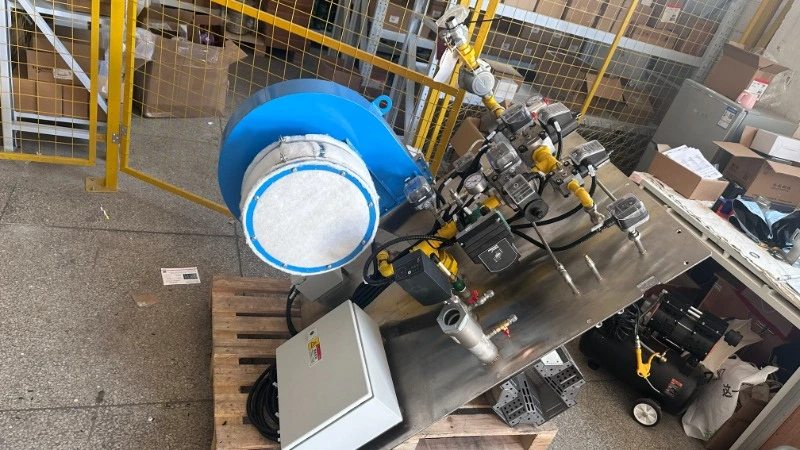
A Customized Combustion System for Fish Feed Drying
Fish feed drying is a thermal-process application where equipment configuration must match the process, site conditions and control requirements. For this Denmark project, Heatflam supplied a repeatable configuration of 10 identical combustion systems for fish feed drying. The customer is presented anonymously.
The published case scope states the application, destination market, quantity and heat-duty figure. It does not disclose a fuel specification, drying-line throughput, inlet or outlet moisture, air temperature, emissions target, commissioning scope or a measured operating result. Those items are therefore not claimed here.
Confirmed Project Parameters
| Item | Confirmed information |
|---|---|
| Application | Fish feed drying |
| Destination market | Denmark |
| System quantity | 10 identical customized systems |
| Heat duty per system | 400,000 kcal/h |
| Calculated combined heat duty | Approximately 4,000,000 kcal/h (10 × 400,000 kcal/h; arithmetic total, not a measured plant result) |
Why Repeatable System Design Matters
When several drying lines need the same thermal input, a consistent system configuration can simplify the engineering discussion across the project. The final design still needs to reflect the actual fuel, available pressure, required air temperature, dryer arrangement, electrical supply, installation space, safeguarding philosophy and local requirements.
Heatflam provides customized combustion systems for industrial thermal processes. For a drying project, selection should be based on verified process inputs rather than a nominal heat-duty figure alone.
Fish Feed Drying: Process Context
As an industry reference, ANDRITZ describes aqua-feed drying as a process that uses controlled temperature, air flow and retention time to support gentle and uniform drying of extruded feed pellets. This is general process context only; it is not a performance statement about the Danish project.
- Thermal input should be matched to the dryer and its operating profile.
- Air delivery and temperature control should be considered together with retention time.
- The required burner, fuel train and controls depend on site-specific engineering data.
Feed Hygiene and Control Considerations
For feed businesses within its scope, EU Regulation (EC) No 183/2005 requires permanent written procedures based on HACCP principles, in addition to feed-hygiene and traceability requirements. This is a regulatory reference, not a statement that any individual site or system is compliant.
For the thermal portion of a drying line, the practical engineering task is to define how heat input, process-air flow, temperature measurement, interlocks and operating records will connect to the wider feed-manufacturing controls. The applicable responsibility and acceptance criteria remain with the feed business operator and the competent authority.
Information Needed for a Fish Feed Drying Enquiry
- Fuel type, composition and available inlet pressure
- Required heat duty and whether it is a design, rated or measured value
- Dryer type, process air temperature and airflow requirements
- Electrical supply, control interface and safety requirements
- Site layout, installation constraints and applicable local codes
Frequently Asked Questions
Send Heatflam your fuel, required heat duty, process temperature, dryer information, control requirements and site conditions for an engineering discussion.
REFERENCES AND DATA SOURCES:
- European Union, Regulation (EC) No 183/2005 on feed hygiene. Official consolidated text covering feed hygiene, traceability and HACCP-based procedures. Accessed 30 July 2026.
- FAO/WHO Codex Alimentarius, CXC 54-2004: Code of Practice on Good Animal Feeding. International guidance on feed safety, good manufacturing practice and feed hygiene. Accessed 30 July 2026.
- ANDRITZ Combi-zone dryer, public technical reference on aqua-feed drying controls, airflow and retention-time adjustment. Accessed 30 July 2026.
- Heatflam Solutions, company solution overview. Accessed 30 July 2026.
