
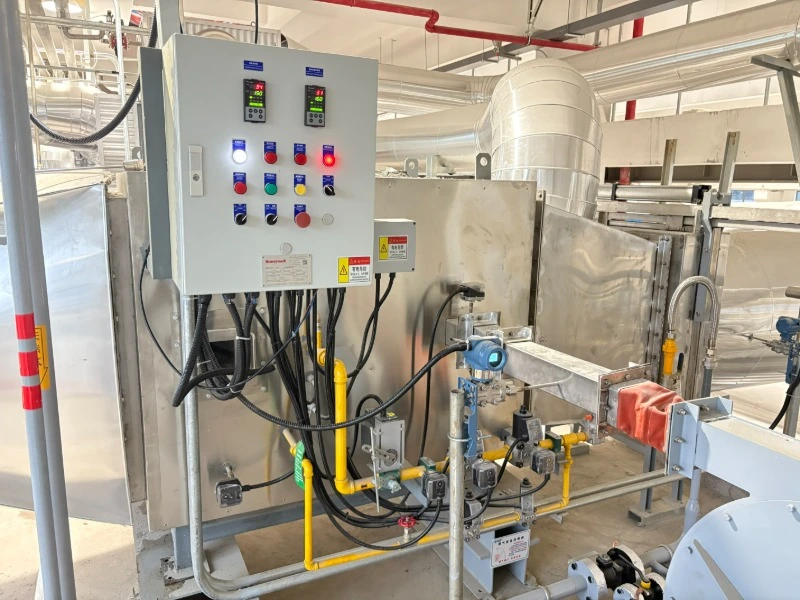
Root-Cause Diagnosis
A burner retrofit for old industrial boiler equipment is preferable to replacement when the pressure vessel and furnace remain serviceable, while measured combustion or controls losses are correctable. For natural gas, DOE’s table shows 83.1% combustion efficiency at 3% O2 and a 300 deg F stack-to-combustion-air temperature difference, versus 80.4% at 5% O2 under the same conditions [1]. Acceptance still depends on OEM limits, local code, permit, insurer, and site test results.
When Retrofit Fits
At a 300 deg F temperature difference, DOE data show 80.4% combustion efficiency at 5% O2 and 80.9% at 3% O2 for natural gas, a 0.5-point difference [1]. DOE also cites about 1% efficiency improvement for each 15-percentage-point excess-air reduction or 40 deg F stack-temperature reduction when other conditions are comparable [1].
An old boiler burner is a reasonable upgrade candidate when inspection confirms serviceable pressure parts, the firing rate still fits demand, and the new flame can suit furnace geometry. Scope may include the burner, fan or drive changes, controls, O2 trim where justified, burner management, flame detection, valves, and proof testing.
Field Troubleshooting Priorities
- High O2 At a 300 deg F temperature difference, compare 5% O2 / 28.1% excess air with the 3% O2 / 15.0% reference before specifying controls [1].
- Hot stack: Treat a 40 deg F reduction as a screening opportunity of about 1% efficiency only after confirming comparable operating conditions [1].
- NOx requirement: For a 1-50 MW EU medium combustion plant, verify the exact Annex II category; 100 mg/Nm3 applies to natural gas in one new-plant table [3].
- Boiler size: Capture heat input against EPA’s 100 MMBtu/h data-review grouping before asking for FGR or low-NOx evidence [2].
Measure Losses First
At a 300 deg F stack-to-combustion-air temperature difference, DOE shows 83.1% combustion efficiency at 2% O2 and 82.1% at 7% O2 a 1.0-point spread [1]. At 5% O2 the same reference falls from 84.7% at 200 deg F to 74.0% at 600 deg F, a 10.7-point spread [1].
Take steady-load readings for fuel flow, output, stack temperature, O2, CO, NOx, draft, and cycling. A boiler retrofit will not restore heat lost through fouled tubes, leaking dampers, failed economizer performance, or excessive blowdown. Do not lower O2 without monitoring CO and flame stability.
Low NOx Retrofit
EU Directive 2015/2193 lists 100 mg/Nm3 NOx for natural gas in its table for new medium combustion plants other than engines and gas turbines [3]. The same directive has other tables and conditions, so the number must be checked against plant type, date, national implementation, and permit basis [3].
EPA documentation identifies controlled low-NOx burners and controlled FGR as natural-gas boiler categories [2]. The procurement specification should define fuel, load range, reference O2, averaging period, test method, CO limit, and the commissioning witness-not simply request “low NOx.”
Before Replacing the System
A 40 deg F stack-temperature reduction is only a screening opportunity of about 1% efficiency when other conditions are comparable [1]. It does not correct vessel defects, inadequate capacity, or a furnace that cannot accommodate the required flame geometry.
- Application fit: Confirm fuel, firing rate, load profile, furnace dimensions, draft, and outage window before approving a retrofit.
- Limits: Replace when pressure parts, capacity, or structural condition-not combustion adjustment-are the governing constraint.
- Operational risks: Verify CO, flame stability, stack temperature, NOx basis, fuel-train safety, and controls integration at all agreed loads.
- Required confirmation: Obtain OEM, qualified engineer, local-code, permit-authority, and insurer requirements before modifying firing or safety circuits.
Terms That Affect Diagnosis
- Old boiler burner: The combustion assembly supplying fuel and air to an existing boiler; its compatibility depends on furnace geometry and firing duty.
- Excess air: Air supplied above the stoichiometric amount; insufficient air can produce CO, while excess air increases flue-gas heat loss [1].
- Flue-gas O2 An analyzer reading used with stack temperature to evaluate combustion efficiency [1].
- FGR: Flue-gas recirculation, a combustion-control approach documented by EPA for natural-gas boiler NOx categories [2].
- NOx basis: The stated emission value together with fuel, load, reference oxygen, averaging period, and test method; it must match the permit.
Verified Troubleshooting Data
DOE’s natural-gas table provides O2, excess-air, and combustion-efficiency comparisons from 2% to 10% O2 [1]. Emission targets require a separate jurisdictional check because legal values apply only to the stated equipment category and conditions [3].
| Issue | Condition | Value | Evidence | Action |
|---|---|---|---|---|
| Excess air | Natural gas | 3% O2 = 15.0% | [1] | Compare with site test. |
| Excess air | Natural gas | 5% O2 = 28.1% | [1] | Check linkage and draft. |
| Stack loss | Comparable conditions | 40 deg F approximately 1% | [1] | Check heat transfer first. |
| NOx control | Natural-gas boiler | LNB and FGR categories | [2] | Request site guarantee. |
| EU NOx | New MCP, natural gas | 100 mg/Nm3 | [3] | Confirm applicability. |
Frequently Asked Questions
REFERENCES AND DATA SOURCES:
- U.S. Department of Energy, “Improve Your Boiler’s Combustion Efficiency,” Energy Tips: STEAM Tip Sheet #4. Direct PDF used because the tabulated O2, excess-air, stack-temperature, and efficiency data are contained in the technical tip sheet.
- U.S. Environmental Protection Agency, “Emission Factor Documentation for AP-42 Section 1.4: Natural Gas Combustion,” describes low-NOx burner and FGR categories for natural-gas boiler data.
- European Parliament and Council, Directive (EU) 2015/2193, Annex II, provides medium-combustion-plant emission-limit tables and conditions.