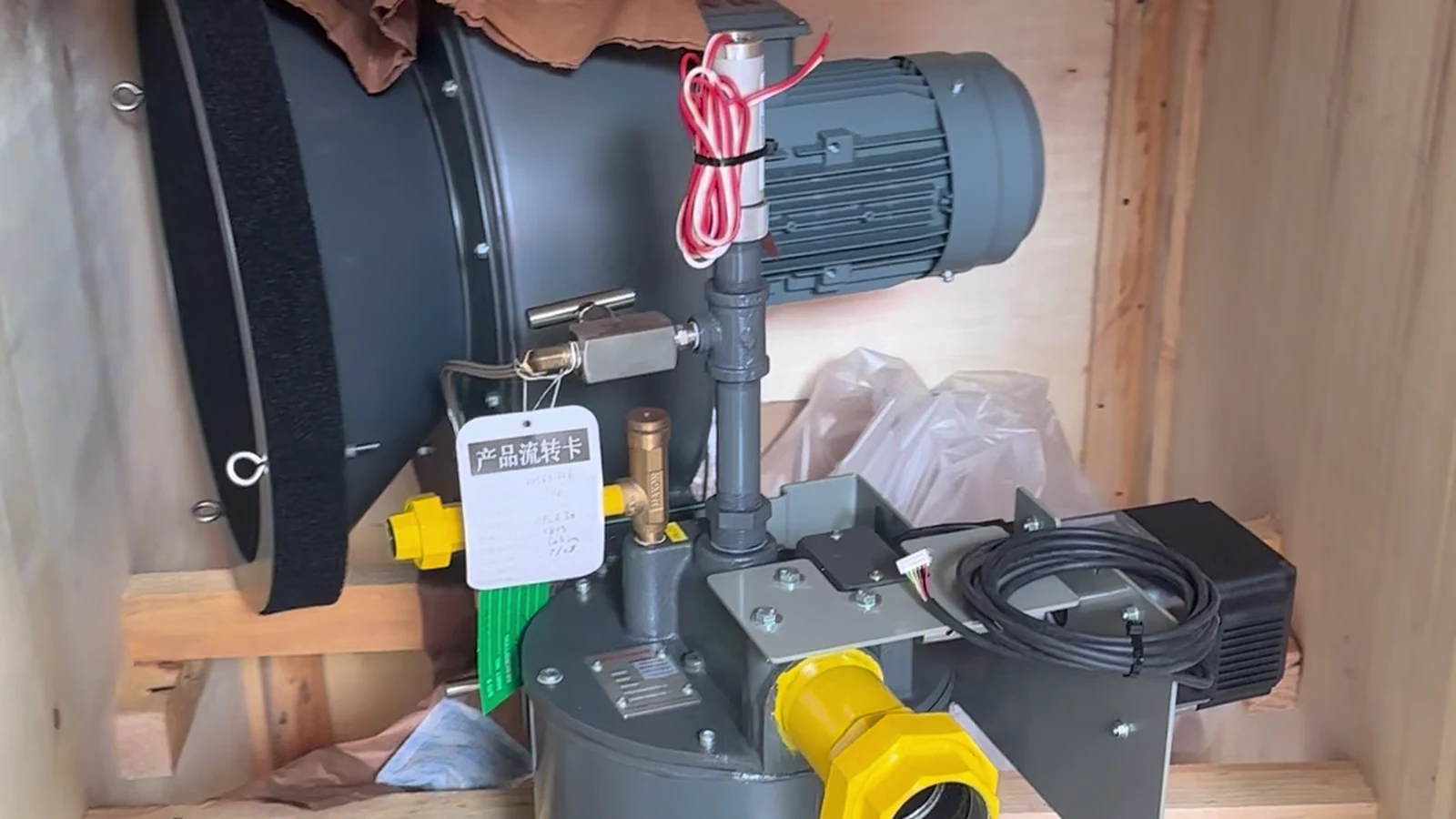
A pre-shipment inspection should answer a simple procurement question: is the equipment being packed the same equipment that was specified? For this Honeywell MAXON OPLE30 burner, the inspection focused on evidence that a buyer can verify before the crate leaves the supplier—product identity, readable nameplate data, visible component condition, and packing status.
The physical unit shown in the inspection is identified as a Honeywell MAXON OVENPAK LE burner, type OPLE30. Its nameplate records 925 kW capacity and 22 mbar gas pressure. Those values apply to this inspected unit and should not be treated as universal ratings for every OVENPAK LE configuration.
What Did the OPLE30 Pre-Shipment Inspection Confirm?
The inspection created a visual record of the product before release. It did not substitute for a factory performance test or site commissioning. The recorded checks covered:
- Model identity: Honeywell MAXON, OVENPAK LE series, type OPLE30.
- Nameplate data: the model, capacity, and gas-pressure fields were made visible for verification.
- Visible components: the burner body, blower assembly, motor, connection points, and externally visible accessories were reviewed for obvious shipping-related issues.
- Packing condition: the product position, crate structure, and protective packing were reviewed before release.
| Inspection field | Recorded value | Procurement use |
|---|---|---|
| Brand | Honeywell MAXON | Confirms manufacturer identification on the inspected product. |
| Series | OVENPAK LE | Connects the unit to the MAXON OVENPAK LE burner family. |
| Type | OPLE30 | Supports burner model confirmation and spare-parts discussion. |
| Capacity | 925 kW | Identifies the rating marked on this specific 925 kW industrial gas burner. |
| Gas pressure | 22 mbar | Provides a nameplate reference that must be reconciled with the final gas-train and site-pressure design. |
What Is the MAXON OVENPAK LE Burner Designed For?
Honeywell describes OVENPAK LE units as nozzle-mixing gas burners for industrial direct-fired applications that require clean combustion and high turndown. In the burner cone, gas from the nozzle mixes rapidly with combustion air. Honeywell lists applications including ovens, dryers, paint lines, food baking, and textile or paper machinery. This places the Honeywell MAXON OVENPAK LE in the industrial air heating burner category rather than treating it as a general-purpose component without an application context. Honeywell’s official OVENPAK LE product page provides the series-level description.
The U.S. Department of Energy separates fuel-based process heating into direct and indirect arrangements and recommends evaluating the complete system rather than a component in isolation. For a Honeywell MAXON gas burner, that means matching the burner to the process air, chamber, fuel train, controls, exhaust path, and required operating envelope—not selecting from heat output alone.
Does “Low Emissions” Define the Final Site NOx Level?
No. Honeywell positions the OVENPAK LE series for low NOx and CO combustion and high turndown. That supports buyer searches for a low NOx gas burner or a high turndown gas burner, but the series description is not a site emissions guarantee. Final emissions depend on the exact burner configuration, fuel composition, process conditions, excess air, firing rate, chamber arrangement, control strategy, measurement basis, and applicable limit.
The U.S. EPA’s technical guidance on NOx control for process heaters describes several burner and combustion-control approaches, while DOE guidance emphasizes checking and adjusting burner air-to-fuel ratios. The practical procurement action is to state the required NOx and CO limits, reference oxygen, test method, operating range, and local code before final selection.
What Should You Send a Honeywell MAXON Burner Supplier?
A useful RFQ starts with evidence. If you are contacting a Honeywell MAXON burner supplier for an OPLE30 burner, replacement, or spare part, provide:
- A clear full-nameplate photograph and typed model number.
- Fuel type and composition, required heat output, and expected turndown or load profile.
- Available gas pressure at the burner under operating flow, not only static upstream pressure.
- Process-air flow, inlet and target temperatures, chamber pressure, and direct- or indirect-fired arrangement.
- Electrical supply, actuator and control details, flame-detection method, and burner-management interface.
- Mounting dimensions, orientation, available installation space, photographs, and relevant drawings.
- Required emissions limits, test basis, site conditions, and applicable safety or environmental rules.
Heatflam supports model checking, replacement selection, and industrial combustion system integration based on the actual model and project requirements. Brand names are used for product identification and technical discussion; suitability must be confirmed for the specific installation.
Why Burner Model Confirmation Matters Before Shipment
Small differences in model suffixes, control arrangements, fuel configuration, mounting, pressure basis, or accessories can change whether a burner fits an existing system. Burner model confirmation therefore starts with the complete nameplate and continues with dimensional, functional, and operating-condition checks.
For this inspection, the visible evidence is straightforward: Honeywell MAXON, OVENPAK LE, OPLE30, 925 kW, and 22 mbar. The next engineering step is to compare that record with the approved purchase specification and the receiving site’s process and utility data.
Frequently Asked Questions
Send Heatflam the nameplate, fuel, heat output, gas pressure, process conditions, controls, dimensions, and required scope for model confirmation, replacement review, or combustion-system support.
REFERENCES AND DATA SOURCES:
- Honeywell — OVENPAK® LE (accessed 2026-08-31).
- U.S. Department of Energy — Improving Process Heating System Performance: A Sourcebook for Industry, Third Edition (2015).
- U.S. Department of Energy — Check Burner Air to Fuel Ratios, Process Heating Tip Sheet #2 (November 2007).
- U.S. Environmental Protection Agency — Alternative Control Techniques Document: NOx Emissions from Process Heaters (Revised) (September 1993).
